Review
. 2020 Jul 16;5(3):e10172.
doi: 10.1002/btm2.10172. eCollection 2020 Sep.

Therapeutic potential of extracellular vesicle-associated long noncoding RNA

Affiliations
Review

Therapeutic potential of extracellular vesicle-associated long noncoding RNA

Louis J Born et al. Bioeng Transl Med. .

Abstract

Both extracellular vesicles (EVs) and long noncoding RNAs (lncRNAs) have been increasingly investigated as biomarkers, pathophysiological mediators, and potential therapeutics. While these two entities have often been studied separately, there are increasing reports of EV-associated lncRNA activity in processes such as oncogenesis as well as tissue repair and regeneration. Given the powerful nature and emerging translational impact of other noncoding RNAs such as microRNA (miRNA) and small interfering RNA, lncRNA therapeutics may represent a new frontier. While EVs are natural vehicles that transport and protect lncRNAs physiologically, they can also be engineered for enhanced cargo loading and therapeutic properties. In this review, we will summarize the activity of lncRNAs relevant to both tissue repair and cancer treatment and discuss the role of EVs in enabling the potential of lncRNA therapeutics.

Keywords: exosomes; extracellular vesicles; lncRNA; microparticles; microvesicles.


Conflict of interest statement

The authors declare no conflict of interest.

Figures
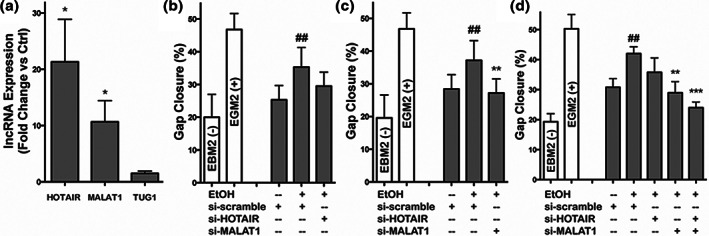
FIGURE 1
FIGURE 1
Role of long noncoding RNA (lncRNA) in endothelial cell (EV)‐derived bioactivity. (a) Expression levels of the indicated lncRNAs were assessed by qPCR in EVs from human umbilical vein endothelial cells (HUVECs) cultured in the presence versus absence of 100 mM ethanol (EtOH) for 24 hr (n = 3; *p < .05). (b–d) HUVEC gap closure was assessed following 24 hr stimulation by 100 μg/ml EVs from HUVECs cultured in the absence (−EtOH) or presence (+EtOH) of 100 mM EtOH for 24 hr following transfection with a scrambled small interfering RNA (siRNA) (scr) or siRNA specific to (b) HOTAIR, (c) MALAT1, or (d) both HOTAIR and MALAT1 (double transfection) (n = 4; ##p < .01 vs. − EtOH + scr; **p < .01, ***p < .001 vs. + EtOH + scr). HUVECs incubated in basal medium (EBM2, without growth factors) were used as the negative control (−) and HUVECs incubated in growth medium (EGM2, with growth factors) were used as positive controls (+). Data reproduced from Reference 11 (open access) with no changes
FIGURE 2
FIGURE 2
Exosomes from human adipose‐derived stem cells exhibit neuroprotective activity that is reduced upon depletion of long noncoding RNA (lncRNA) MALAT1. Graphs compare motor assessments of rats grouped as follows: surgery with no traumatic brain injury (TBI) (sham control C, n = 11), TBI with unconditioned media as vehicle (T; n = 20), TBI treated with exosomes (TE, n = 18), TBI treated with exosomes depleted of MALAT1 (TEdM, n = 20), and TBI with injection of conditioned media depleted of exosomes (TdCM; n = 7). Each rat was subjected to a series of behavioral tests—(a) elevated body swing test (EBST), (b) forelimb akinesia, and (c) paw grasp test—to assess motor and neurological performance of animals, at baseline before surgery and post‐TBI at Days 0, 3, and 7. Two‐way analysis of variance (ANOVA) showed significant effects as follows: EBST, treatment effects F(4) = 27.04; forelimb akinesia treatment effect F(4) = 30.3; paw grasp treatment effect F(4) = 42.2. Post hoc Bonferroni multiple comparisons are reported for differences versus TBI vehicle (T). #p < .01, ##p < .001. Treatment with exosomes depleted of MALAT1 (TEdM) did not improve motor performance on EBST and only improved forelimb akinesia and paw grasp at Day 3. Treatment with conditioned media depleted of exosomes (TdCM) also showed no improvement on EBST and only improved scores at Day 3 on the other two tasks. Lesion assessment: treatment with exosomes derived from hASCs significantly reduces impact and peri‐impact areas of rats after mild TBI. Nissl staining as shown in (f) was performed on Day 11 to assess damage to cortical region post TBI. Graphs (d) and (e) quantify the data from images. (f) The methods for quantifying the impact area and for choosing images for analysis of the peri‐impact area. Data for impact area (d) showed significant reduction in cortical lesion area following treatment with exosomes in the TE group and no rescue by any other treatment. Representative images of sections used for quantifying impact area and peri‐impact are shown (g). For the peri‐impact area (e), there was a significant rescue in the TE group, whereas TEdM group displayed partial rescue of the peri‐impact areas when compared with vehicle (T) and sham controls (C). Data in the bar graphs represent the mean ± SEM values. Impact area F = 14.78; peri‐impact area F = 56.58. Data were analyzed by one‐way analysis of variance (ANOVA) followed by Dunnett's multiple comparison test. #p < .1, ##p < .01. Data reproduced from Reference 56 (open access) with no changes
FIGURE 3
FIGURE 3
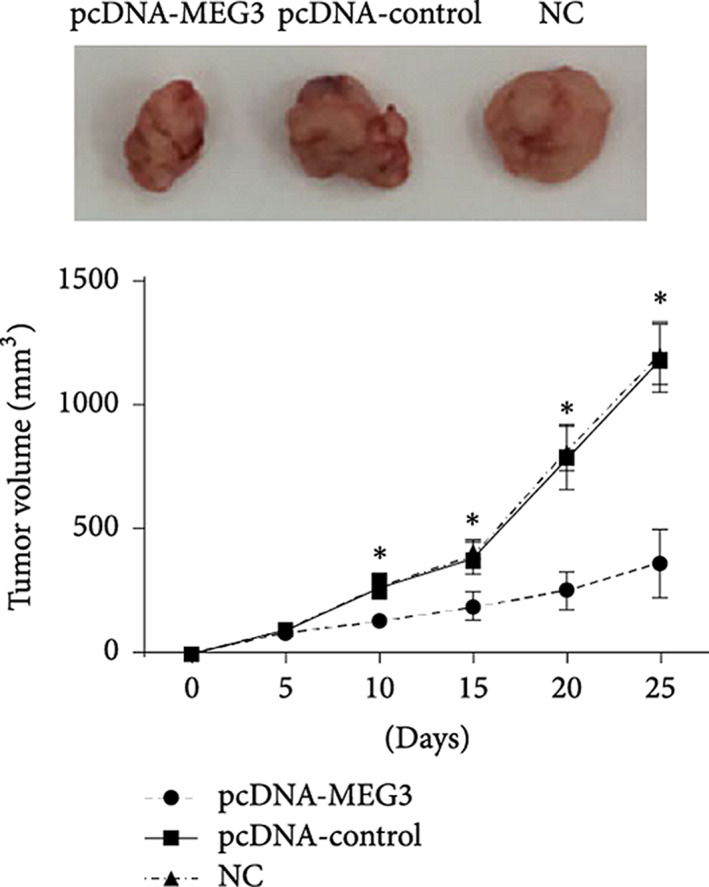
MEG3 overexpression impedes melanoma growth. A375 cells were transplanted subcutaneously into nude mice (25–30 g, 6 weeks old, n = 6 per group) after either no transfection (NC), transfection with a plasmid to overexpress MEG3 (pcDNA‐MEG3), or transfection with the control plasmid (pcDNA control). Upregulation of MEG3 decreased the tumor volume and weight (*p < .05). Data reproduced from Reference 101 (open access) without changes
FIGURE 4
FIGURE 4
Methods to control long noncoding RNA (lncRNA) loading into extracellular vesicles (EVs). Top left, EVs could be isolated from cells known to release vesicles enriched in an lncRNA of interest. Top right, cells could be cultured in an environment that causes enrichment of a specific EV‐associated lncRNA. Bottom right, lncRNAs of interest could be overexpressed via cellular transfection/transduction resulting in stoichiometric enrichment in EVs. Bottom left, lncRNAs of interest could be overexpressed via cellular transfection/transduction followed by creation of EV‐mimics, for example, by filter extrusion

References

    1. Tetta C, Ghigo E, Silengo L, Deregibus MC, Camussi G. Extracellular vesicles as an emerging mechanism of cell‐to‐cell communication. Endocrine. 2013;44(1):11‐19. - PMC - PubMed
    1. Pomatto MAC, Gai C, Deregibus MC, Tetta C, Camussi G. Noncoding RNAs carried by extracellular vesicles in endocrine diseases. Int J Endocrinol. 2018;2018:1‐18. - PMC - PubMed
    1. Ma L, Bajic VB, Zhang Z. On the classification of long non‐coding RNAs. RNA Biol. 2013;10(6):924‐933. - PMC - PubMed
    1. Rinn JL, Chang HY. Genome regulation by long noncoding RNAs. Annu Rev Biochem. 2012;81(1):145‐166. - PMC - PubMed
    1. Zampetaki A, Albrecht A, Steinhofel K. Long non‐coding RNA structure and function: is there a link? Front Physiol. 2018;9:1‐8. - PMC - PubMed

LinkOut - more resources