. 2020 Sep 21;6(9):e05008.
doi: 10.1016/j.heliyon.2020.e05008. eCollection 2020 Sep.

Salt-tolerance induced by leaf spraying with H2O2 in sunflower is related to the ion homeostasis balance and reduction of oxidative damage

Affiliations

Salt-tolerance induced by leaf spraying with H2O2 in sunflower is related to the ion homeostasis balance and reduction of oxidative damage

Petterson Costa Conceição Silva et al. Heliyon. .

Abstract

Salinity is still one of the main factors that limit the growth and production of crops. However, currently, hydrogen peroxide (H2O2) priming has become a promising technique to alleviate the deleterious effects caused by salt. Therefore, this study aimed to test different leaf spraying strategies with H2O2 for acclimation of sunflower plants to salt stress, identifying the main physiological and biochemical changes involved in this process. The experiment was conducted in a completely randomized design, with four replications. Initially, four concentrations of H2O2 were tested (0.1; 1; 10 and 100 mM) associated with different applications: 1AP - one application (48 h before exposure to NaCl); 2AP - two applications (1AP + one application 7 days after exposure to NaCl) and 3AP - three applications (2AP + one application 14 days after exposure to NaCl), besides this two reference treatments were also added: control (absence of NaCl and absence of H2O2) and salt control (presence of 100 mM of NaCl and absence of H2O2). The experiment was conducted in hydroponic system containing Furlani's nutrient solution. Salt stress reduced the growth of sunflower plants, however, the H2O2 priming through leaf spraying was able to reduce the deleterious effects caused by salt, especially in the 1 mM H2O2 treatment with one application. H2O2 acts as a metabolic signal assisting in the maintenance of ionic and redox homeostasis, and consequently increasing the tolerance of plants to salt stress.

Keywords: Agricultural water management; Crop biomass; Crop production; Cross-talk; H2O2; Helianthus annuus L.; Oxidative stress; Physiological parameters; Plant growth; Plant physiology; Salinity.


Figures

Figure 1
Figure 1
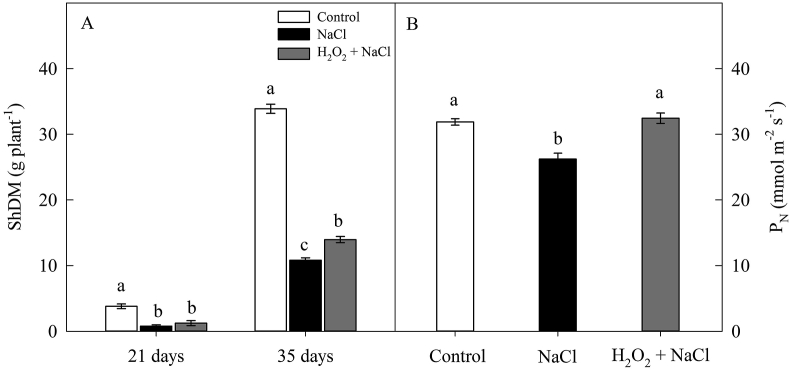
Effect of salt stress (100 mM NaCl) and leaf spraying with H2O2 (1 mM H2O2 1AP) on the shoot dry mass (ShDM) (at 21 and 35 days) (A) and on the net CO2 assimilation rate (PN) (at 35 days) (B) of sunflower plants grown in nutrient solution. Means of four repetitions ±standard error. Means followed by the same letters, on each date, do not differ statistically from each other, using the Tukey's test (p ≤ 0.05). 1AP - one application by leaf spraying 48 h before exposure to NaCl.
Figure 2
Figure 2
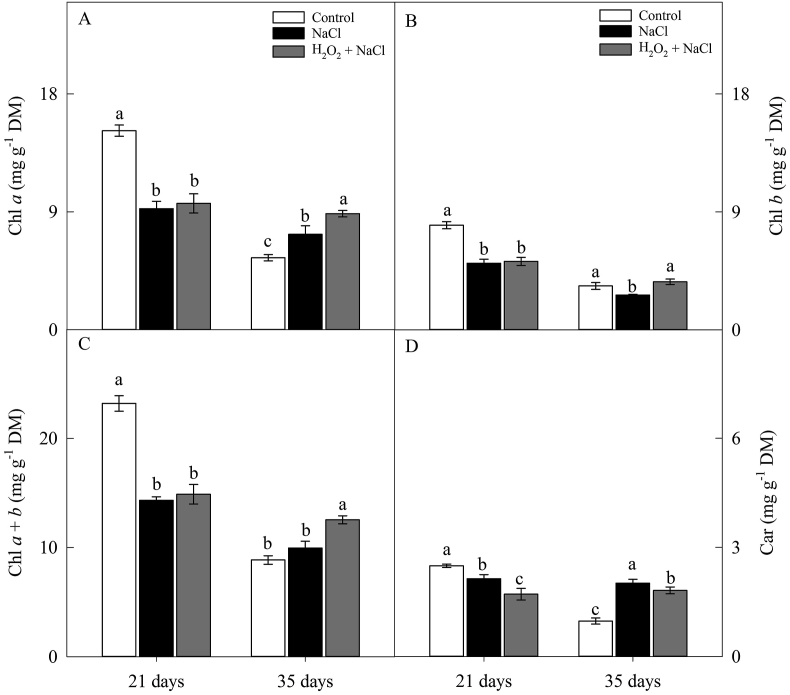
Effect of salt stress (100 mM NaCl) and leaf spraying with H2O2 (1 mM H2O2 1AP) on the content of chlorophyll a (Chl a) (A), chlorophyll b (Chl b) (B), chlorophyll a + b (Chl a + b) (C) and carotenoids (Car) (D) of sunflower plants grown in nutrient solution, at 21 and 35 days. Means of four repetitions ±standard error. Means followed by the same letters, on each date, do not differ statistically from each other, using the Tukey's test (p ≤ 0.05). 1AP - one application by leaf spraying 48 h before exposure to NaCl.
Figure 3
Figure 3
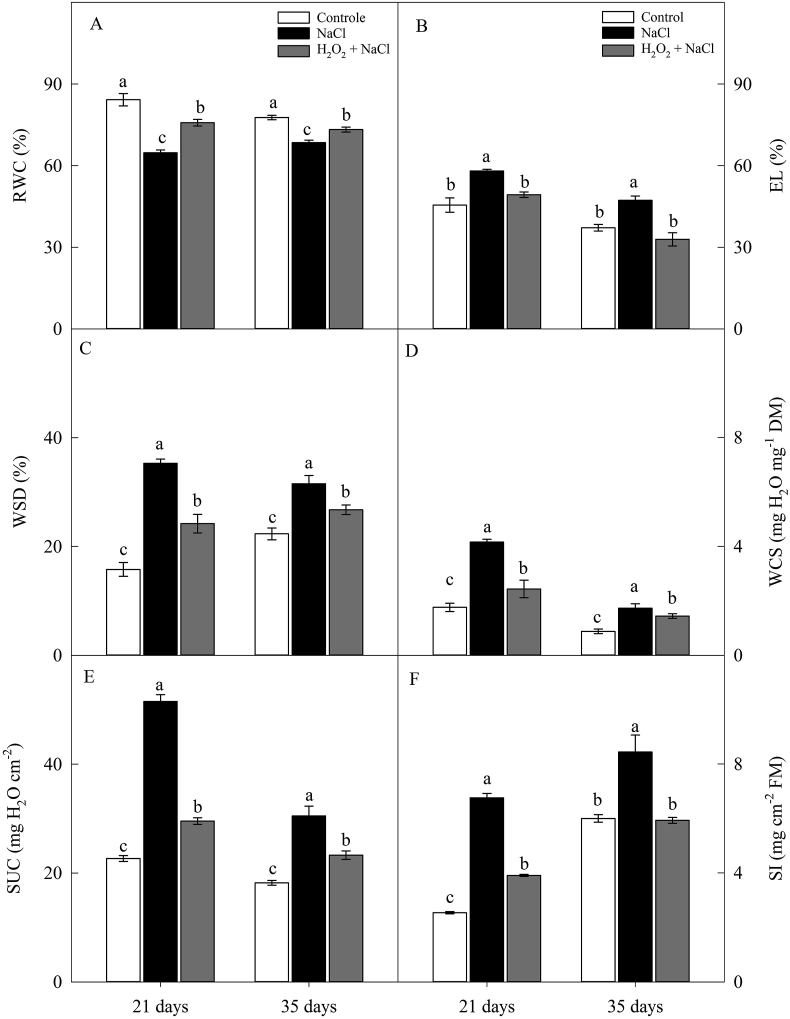
Effect of salt stress (100 mM NaCl) and leaf spraying with H2O2 (1 mM H2O2 1AP) on the relative water content (RWC) (A), electrolyte leakage (EL) (B), water saturation deficit (WSD) (C), water content at saturation (WCS) (D), leaf succulence (SUC) (E) and sclerophylly index (SI) (F) of the leaves of sunflower plants grown in nutrient solution, at 21 and 35 days. Means of four repetitions ±standard error. Means followed by the same letters, on each date, do not differ statistically from each other, using the Tukey's test (p ≤ 0.05). 1AP - one application by leaf spraying 48 h before exposure to NaCl.
Figure 4
Figure 4
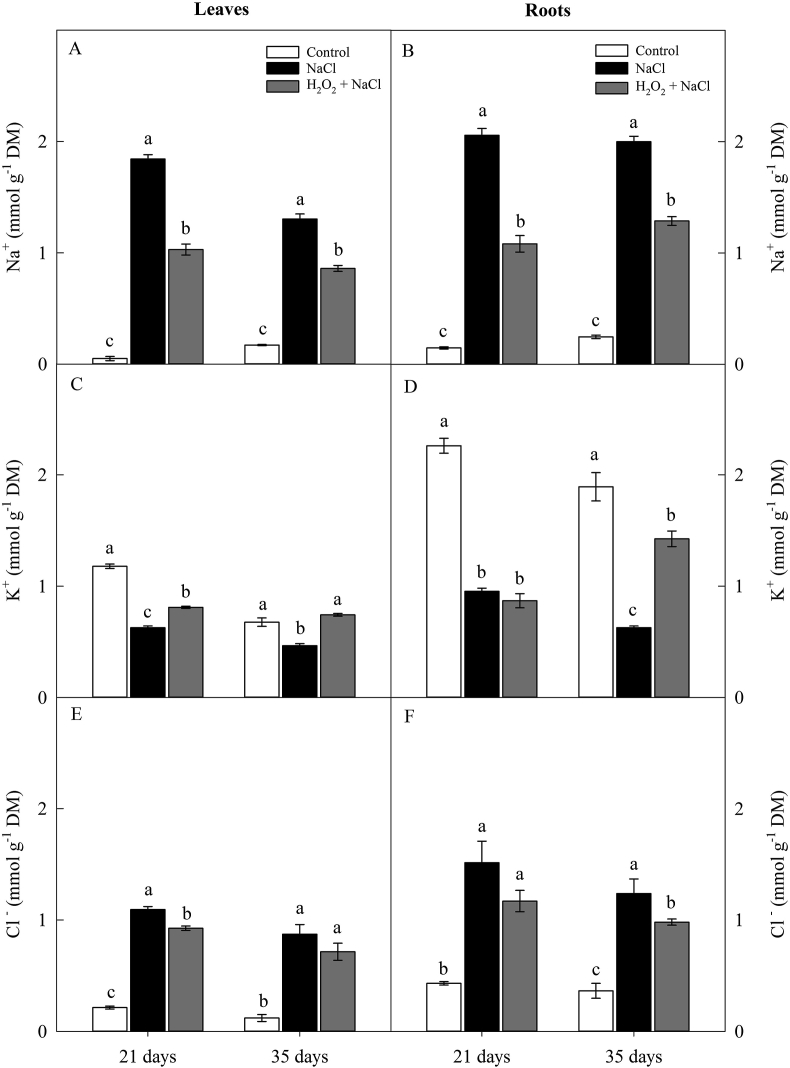
Effect of salt stress (100 mM NaCl) and leaf spraying with H2O2 (1 mM H2O2 1AP) on the contents of Na+ (A and B), K+ (C and D), Cl (E and F) in leaves and roots, respectively, of sunflower plants grown in nutrient solution, at 21 and 35 days. Means of four repetitions ±standard error. Means followed by the same letters, on each date, do not differ statistically from each other, using the Tukey's test (p ≤ 0.05). 1AP - one application by leaf spraying 48 h before exposure to NaCl.
Figure 5
Figure 5
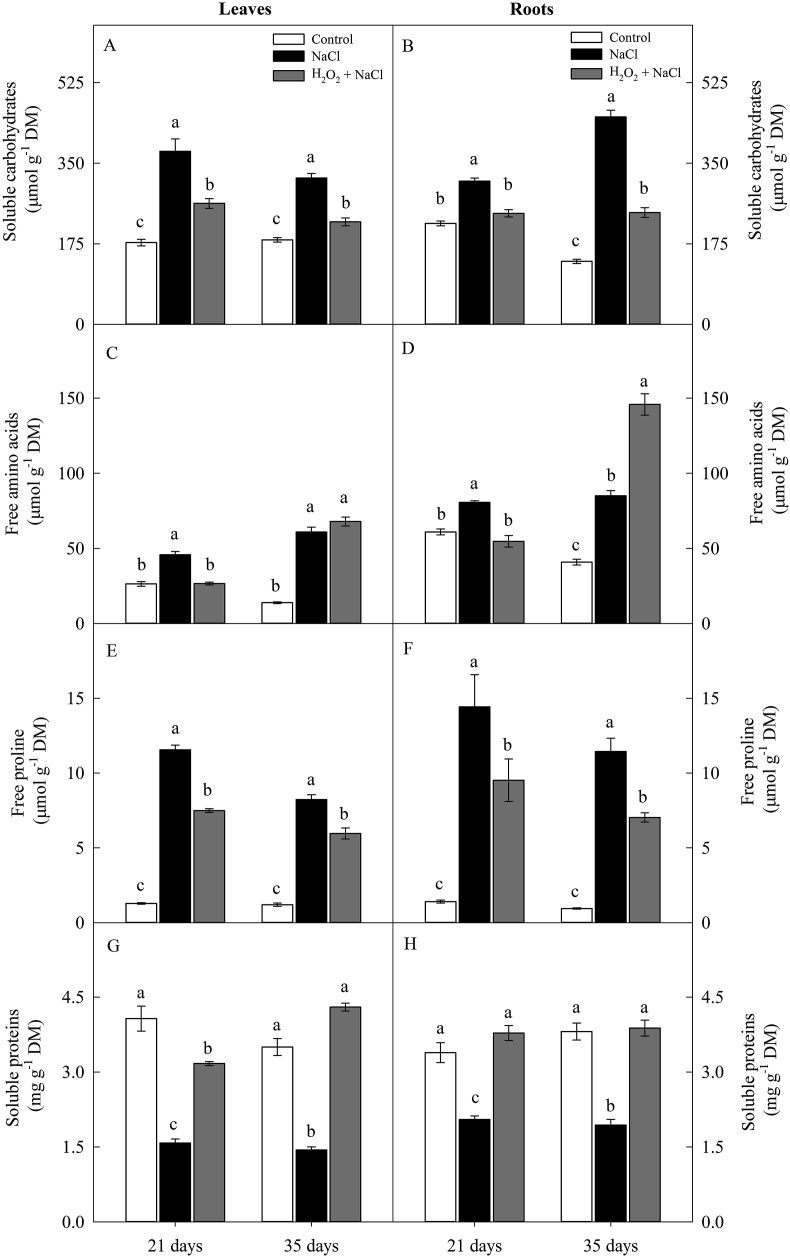
Effect of salt stress (100 mM NaCl) and leaf spraying with H2O2 (1 mM H2O2 1AP) on the levels of soluble carbohydrates (A and B), free amino acids (C and D), free proline (E and F), and soluble proteins (G and H) in leaves and roots, respectively, of sunflower plants grown in nutrient solution, at 21 and 35 days. Means of four repetitions ±standard error. Means followed by the same letters, on each date, do not differ statistically from each other, using the Tukey's test (p ≤ 0.05). 1AP - one application by leaf spraying 48 h before exposure to NaCl.
Figure 6
Figure 6
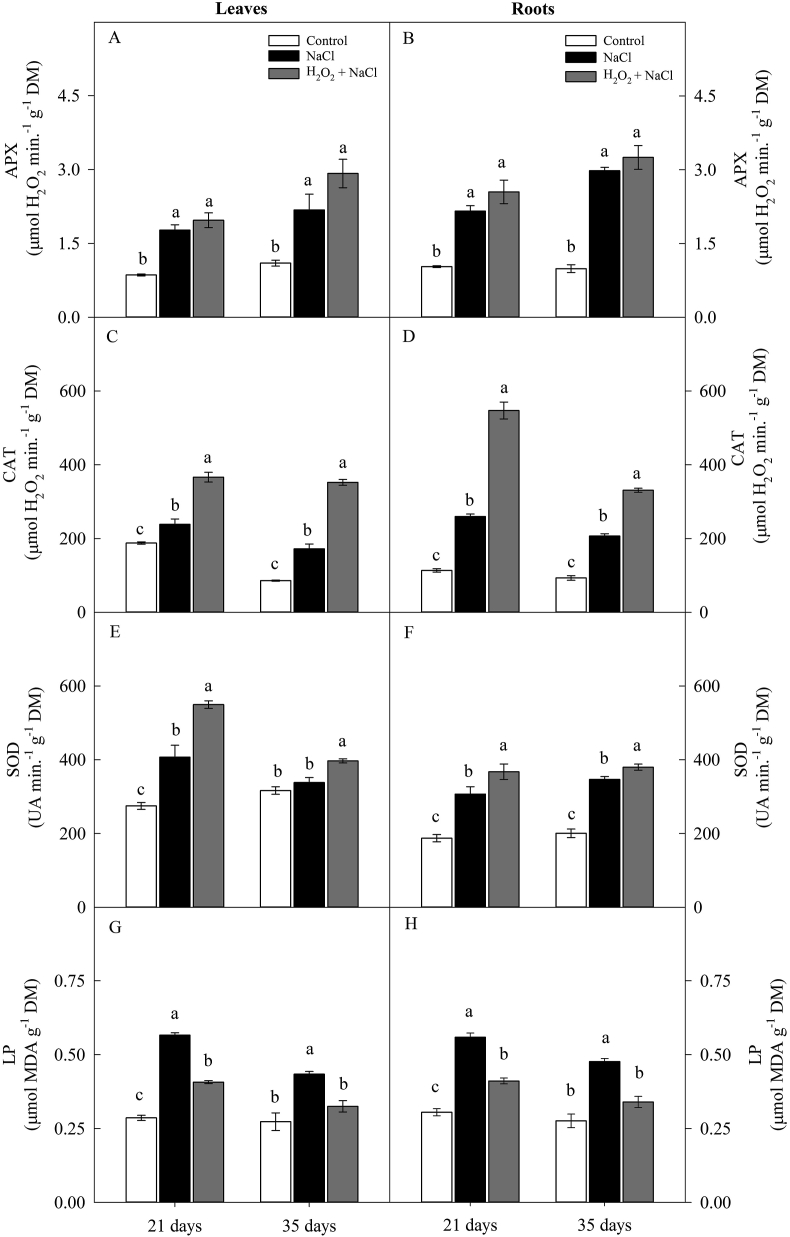
Effect of salt stress (100 mM NaCl) and leaf spraying with H2O2 (1 mM H2O2 1AP) on the activity of ascorbate peroxidase (APX) (A and B), catalase (CAT) (C and D), superoxide dismutase (SOD) (E and F), and lipid peroxidation (LP) (G and H) in leaves and roots, respectively, of sunflower plants grown in nutrient solution, at 21 and 35 days. Means of four repetitions ±standard error. Means followed by the same letters, on each date, do not differ statistically from each other, using the Tukey's test (p ≤ 0.05). 1AP - one application by leaf spraying 48 h before exposure to NaCl.

References

    1. Azevedo Neto A.D., Prisco J.T., Enéas Filho J., Medeiros J.V.R., Gomes Filho E. Hydrogen peroxide pre-treatment induces salt-stress acclimation in maize plants. J. Plant Physiol. 2005;162:1114–1122. - PubMed
    1. Azevedo Neto A.D., Prisco J.T., Gomes Filho E. Changes in soluble amino-N, soluble proteins and free amino acids in leaves and roots of salt-stressed maize genotypes. J. Plant Interact. 2009;4:137–144.
    1. Bacelar E.A., Correia C.M., Moutinho-Pereira J.M., Gonçalves C.B., Lopes J.I., Torres-Pereira J.M.G. Sclerophylly and leaf anatomical traits of five field-grown olive cultivars growing under drought conditions. Tree Physiol. 2004;24:233–239. - PubMed
    1. Bagheri M., Gholami M., Baninasab B. Hydrogen peroxide-induced salt tolerance in relation to antioxidant systems in pistachio seedlings. Sci. Hortic. 2019;2443:207–213.
    1. Bates L.S., Waldren R.P., Teare I.D. Rapid determination of free proline for water-stress studies. Plant Soil. 1973;39:205–207.

LinkOut - more resources