


Dapansutrile, an oral selective NLRP3 inflammasome inhibitor, for treatment of gout flares: an open-label, dose-adaptive, proof-of-concept, phase 2a trial
- PMID: 33005902
- PMCID: PMC7523621
- DOI: 10.1016/s2665-9913(20)30065-5
Dapansutrile, an oral selective NLRP3 inflammasome inhibitor, for treatment of gout flares: an open-label, dose-adaptive, proof-of-concept, phase 2a trial
Erratum in
-
Correction to Lancet Rheumatol 2020; 2: e270-80.Lancet Rheumatol. 2020 Jun;2(6):e321. doi: 10.1016/S2665-9913(20)30135-1. Lancet Rheumatol. 2020. PMID: 38273594 No abstract available.
-
Correction to Lancet Rheumatol 2020; 2: e270-80.Lancet Rheumatol. 2020 Jul;2(7):e388. doi: 10.1016/S2665-9913(20)30166-1. Epub 2020 Jun 25. Lancet Rheumatol. 2020. PMID: 38273604 No abstract available.
Abstract
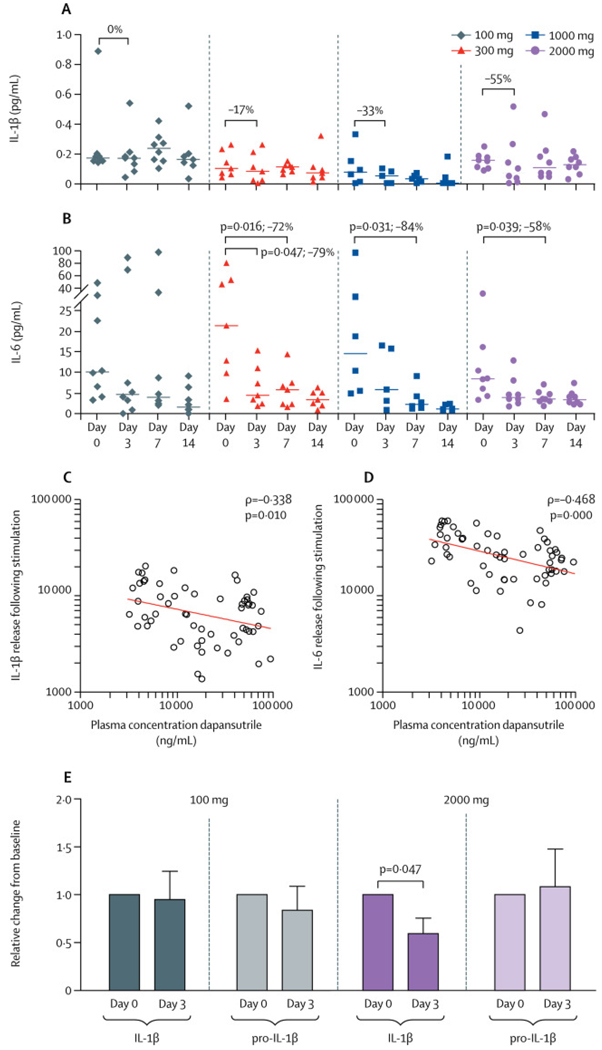
Background: Gout flares are driven by interleukin (IL)-1β. Dapansutrile inhibits the NLRP3 inflammasome and subsequent activation of IL-1β. In this study we aimed to investigate the safety and efficacy of orally administered dapansutrile in patients with a gout flare.
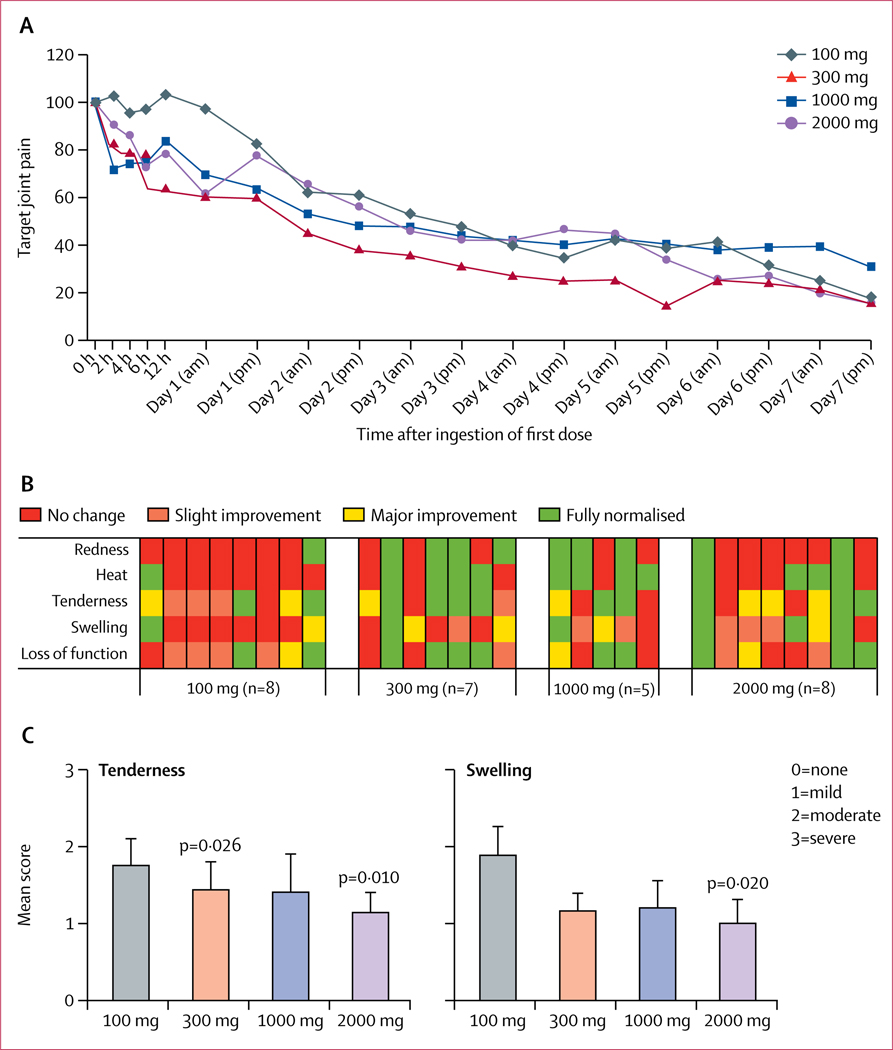
Methods: In this open-label, proof-of-concept, phase 2a trial, adult patients (aged 18-80 years) with a monoarticular monosodium urate crystal-proven gout flare were enrolled at an outpatient clinic in the Netherlands and sequentially assigned using a dose-adaptive design to receive 100 mg/day, 300 mg/day, 1000 mg/day, or 2000 mg/day oral dapansutrile for 8 days. The coprimary outcomes were change in patient-reported target joint pain from baseline to day 3 and from baseline to day 7, assessed in the per-protocol population (all patients who received at least 80% of the study drug and had no major protocol deviations). Safety was assessed in the intention-to-treat population. This trial is registered with the EU Clinical Trials Register, EudraCT 2016-000943-14, and is completed.
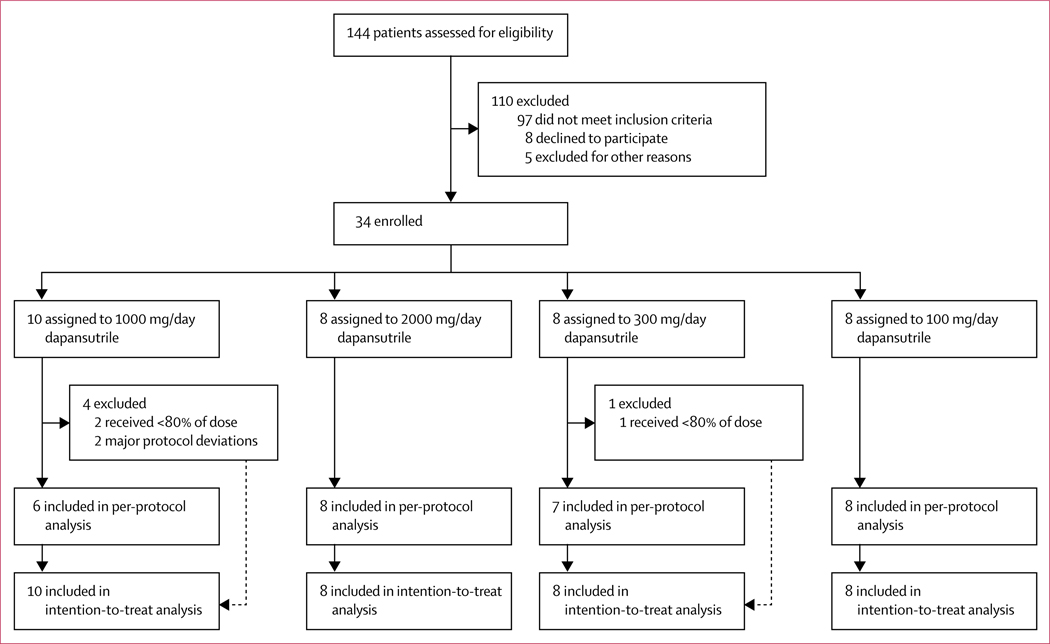
Findings: Between May 18, 2017, and Jan 21, 2019, 144 patients were assessed for eligibility, of whom 34 were enrolled and 29 were included in the per-protocol population (three patients were excluded due to receiving <80% of study drug and two had major protocol deviations): eight patients received 100 mg/day, seven received 300 mg/day, six received 1000 mg/day, and eight received 2000 mg/day. Between baseline and day 3, there was a mean reduction in patient-reported target joint pain of 52·4% (SD 32·94; p=0∙016) for the 100 mg/day group, 68·4% (34·29; p=0∙016) for the 300 mg/day group, 55·8% (44·90; p=0∙063) for the 1000 mg/day group, and 57·6% (38·72; p=0∙016) for the 2000 mg/day group. At day 7, there was a mean reduction of 82·1% (22·68; p=0∙031) for the 100 mg/day group, 84·2% (16·33; p=0∙016) for the 300 mg/day group, 68·9% (34·89; p=0∙031) for the 1000 mg/day group, and 83·9% (15·44; p=0∙008) for the 2000 mg/day group, compared to baseline. 25 (73·5%) of 34 patients reported a total of 45 treatment-emergent adverse events, most of which were metabolism and nutrition disorders (17 [37·8%]) and gastrointestinal disorders (ten [22·2%]). Two serious adverse events occurred during the study, admission to hospital because of worsening of gout flare at day 3, and admission to hospital because of coronary stenosis 18 days after the patient received their last dose; these were considered moderate in severity and unrelated to the study drug.
Interpretation: Dapansutrile is a specific NLRP3 inflammasome inhibitor with a satisfactory safety profile and efficacy in the reduction of target joint pain in this study. Future studies are needed to confirm the clinical potential of dapansutrile.
Figures
References
Grants and funding
LinkOut - more resources
Full Text Sources
Other Literature Sources