


Shifts in alcohol consumption during the COVID-19 pandemic: early indications from Australia
- PMID: 33006789
- PMCID: PMC7537267
- DOI: 10.1111/add.15275
Shifts in alcohol consumption during the COVID-19 pandemic: early indications from Australia
Abstract
Background and aim: The effect of the COVID-19 pandemic on alcohol consumption is currently unclear. This study aimed to provide early estimates of how stress and demographics will interact with shifts in harmful alcohol consumption from before the COVID-19 outbreak to 2 months into social distancing.
Design: Cross-sectional convenience sample.
Setting: Australia.
Participants: A total of 1684 Australians aged 18-65 years who drink at least monthly.
Measurements: Items from the Alcohol Use Disorders Identification Test (AUDIT) and the stress subscale of the Depression Anxiety and Stress Scale (DASS).
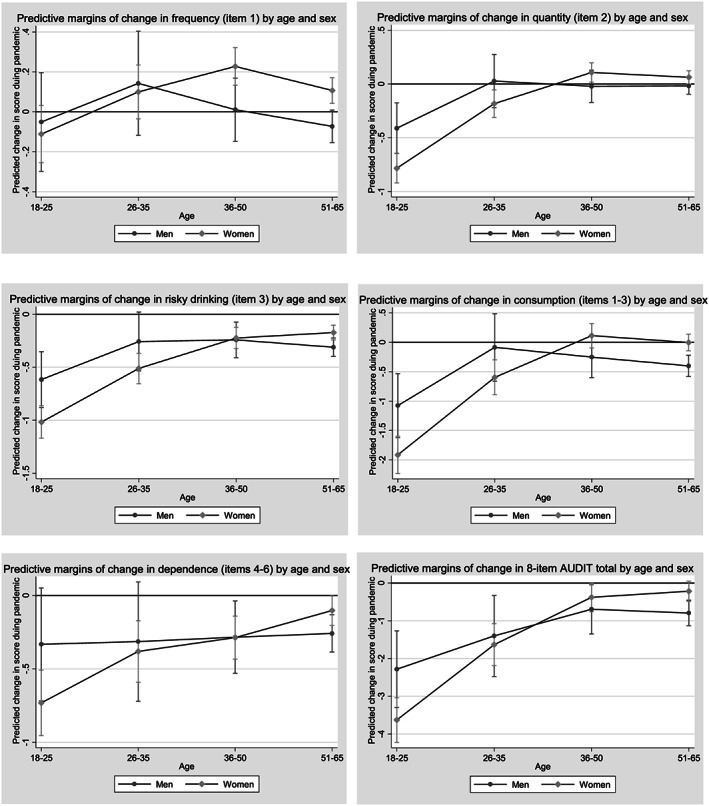
Findings: Overall, harmful drinking decreased during social distancing measures in our sample [2019 score = 8.2, 95% confidence interval (CI) = 7.9-8.4; during the pandemic = 7.3, 95% CI = 7.1-7.6]. Younger drinkers, particularly young women, decreased their consumption the most, but there was a small increase in consumption in middle-aged women. Drinkers experiencing high levels of stress also reported a relatively higher shift in harmful consumption compared with those with low levels of stress (β = 0.65, P = 0.003), despite reporting a small decrease overall.
Conclusions: The closure of licensed premises and social distancing measures in Australia in response to the COVID-19 outbreak appear to have reduced harmful alcohol consumption in younger drinkers, particularly young women.
Keywords: AUDIT; Alcohol; COVID-19; harmful drinking; risky drinking; stress.
© 2020 Society for the Study of Addiction.
Figures
References
-
- World Health Organization (WHO) . Situation report—118. In: WHO, editor. Coronavirus Disease (COVID‐2019); 2020. Available at: https://www.who.int/docs/default‐source/coronaviruse/situation‐reports/2... (accessed 17 May 2020).
-
- Green E. Some countries are banning alcohol sales in their lockdowns—leading shoppers to panic‐buy, the world: PRX. 2020. Available at: https://www.pri.org/stories/2020‐2004‐2009/some‐countries‐are‐banning‐al... (accessed 5 May 2020).
-
- ABC News . Delhi imposes 70 per cent coronavirus tax on alcohol to curb India's post‐lockdown thirst: ABC online. 2020. Available at: https://www.abc.net.au/news/2020‐2005‐2006/india‐hikes‐alcohol‐prices‐th... (accessed 6 May 2020).
-
- Paradis C. Open versus closed: the risks associated with retail liquor stores during COVID‐19. Canadian Centre on Substance Use and Addiction. 2020. Available at: https://www.ccsa.ca/open‐versus‐closed‐risks‐associated‐retail‐liquor‐st... (accessed 5 May 2020).
Publication types
MeSH terms
LinkOut - more resources
Full Text Sources
Medical
