


Capturing the Perspective of Prospective Urology Applicants: Impacts of COVID-19 on Medical Education
- PMID: 33007312
- PMCID: PMC7525272
- DOI: 10.1016/j.urology.2020.09.027
Capturing the Perspective of Prospective Urology Applicants: Impacts of COVID-19 on Medical Education
Abstract
Objective: To capture the perspective of prospective urology applicants experiencing unique challenges in the context of COVID-19.
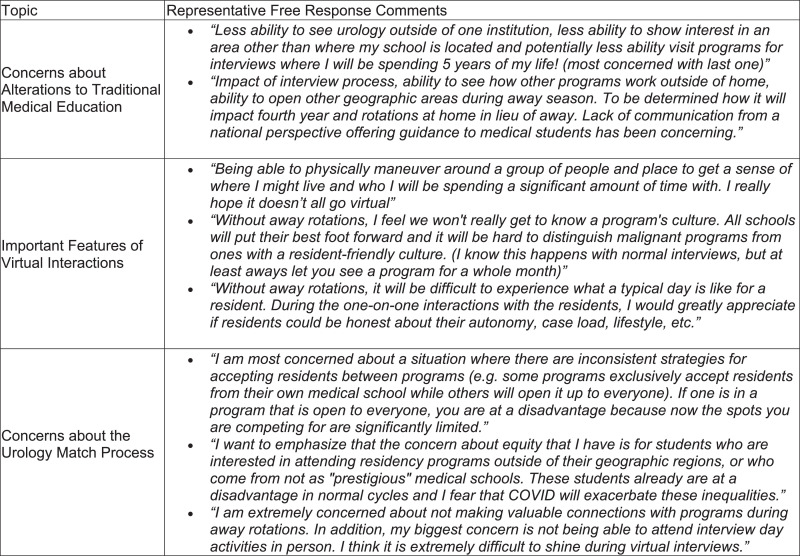
Methods: A voluntary, anonymous survey was distributed online, assessing the impact of COVID-19 on a large sample of US medical students planning to apply to urology residencies. Themes of (1) specialty discernment, (2) alterations to medical education, and (3) the residency application process were explored.
Results: A total of 238 medical students, 87% third and fourth years, responded to the survey. While 85% indicated that the pandemic had not deterred their specialty choice, they noted substantial impacts on education, including 82% reporting decreased exposure to urology. Nearly half of students reported changes to required rotations and 35% reported changes to urology-specific rotations at their home institutions. Students shared concerns about suspending in-person experiences, including the impact on letters of recommendation (68% "very concerned) and program choice (73% "very concerned"). Looking to the possibility of virtual interactions, students identified the importance of small group and one-on-one communication with residents (83% "very important") and opportunities to learn about hospital facilities (72% "very important").
Conclusion: Despite the impacts of COVID-19 on medical education, prospective urology applicants appear to remain confident in their specialty choice. Students' biggest concerns involve disruption of away rotations, including impacts on obtaining letters of recommendation and choosing a residency program.
Copyright © 2020 Elsevier Inc. All rights reserved.
Figures


References
-
- The Coalition for Physician Accountability's Work Group on Medical Students in the Class of 2021 Moving Across Institutions for Post Graduate Training. Final report and recommendations for medical education institutions of LCME-accredited. 2020.Available at: http://www.nrmp.org/coalition-physician-accountability-documents.
-
- Slaugenhoupt BL, Ogunyemi O, Giannopoulos M, et al. An update on the current status of medical student urology education in the United States. Urology. 2014;84:743–747. - PubMed
-
- Li Y, Chu C, de la Calle CM, et al. Multi-institutional collaborative resident education in the era of COVID-19. Urol Pract. 2020;6:425–433. - PubMed
