Review
. 2021 Jan;27(1):21-35.
doi: 10.1016/j.bbmt.2020.09.030. Epub 2020 Sep 29.

NK Cell Adoptive Immunotherapy of Cancer: Evaluating Recognition Strategies and Overcoming Limitations

Affiliations
Review

NK Cell Adoptive Immunotherapy of Cancer: Evaluating Recognition Strategies and Overcoming Limitations

Carlos E Sanchez et al. Transplant Cell Ther. 2021 Jan.

Abstract

Natural killer (NK) cells, the primary effector cells of the innate immune system, utilize multiple strategies to recognize tumor cells by (1) detecting the presence of activating receptor ligands, which are often upregulated in cancer; (2) targeting cells that have a loss of major histocompatibility complex (MHC); and (3) binding to antibodies that bind to tumor-specific antigens on the tumor cell surface. All these strategies have been successfully harnessed in adoptive NK cell immunotherapies targeting cancer. In this review, we review the applications of NK cell therapies across different tumor types. Similar to other forms of immunotherapy, tumor-induced immune escape and immune suppression can limit NK cell therapies' efficacy. Therefore, we also discuss how these limitations can be overcome by conferring NK cells with the ability to redirect their tumor-targeting capabilities and survive the immune-suppressive tumor microenvironment. Finally, we also discuss how future iterations can benefit from combination therapies with other immunotherapeutic agents.

Keywords: ADCC; NK activating receptors; NK cell; NK inhibitory receptors; Tumor immunotherapy.


Conflict of interest statement

Conflict of interest statement: C.R.Y.C. and C.M.B. are cofounders of a biotechnology company, Mana Therapeutics, developing T cell therapies for cancer. C.R.Y.C. and C.M.B. have filed a patent involving TGF-β-based constructs for gene-engineered NK cell therapies. C.M.B. is a cofounder and SAB member of Catamaran Bio, an NK cell therapy company. C.R.Y.C. is a consultant for the same company. C.R.Y.C. and C.M.B. are performing research sponsored by Catamaran Bio, a company developing NK cell therapies.

Figures

Figure 1.
Figure 1.
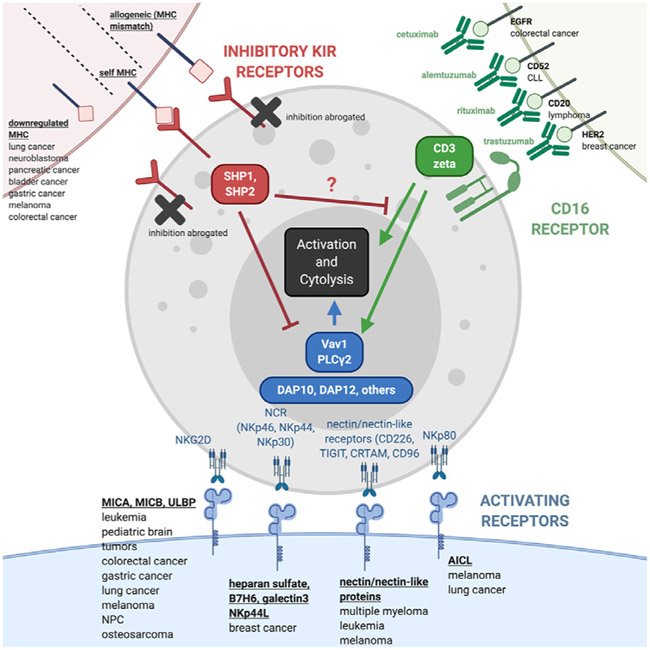
Top left, in red: NK cells recognize tumor targets that lack MHC, as this prevents the inhibitory response mediated by KIR. Several tumors down-regulate MHC in response to T cell immune pressure. The same pathway does not become activated in the setting of allogeneic NK cells and is only engaged when NK cell effectors recognize self MHC. Bottom, in blue: NK cell activating receptor ligands are expressed by numerous malignancies [45-60,62,242-247], and these tumors engage NK-activating receptors, some of which associate with ITAM-containing DAP10 and DAP12 to mediate NK cell activation via proteins such as Vav1 and PLCγ2. Top right, in green: NK cells are the principal effectors of ADCC, mediating tumor lysis in settings when antibodies targeting overexpressed surface targets are used. Various antibodies have been developed to recruit ADCC against tumor cells bearing targets such as Her2, CD20, EGFR, and/or CD52. These antibodies bind to the CD16 receptor, which, in turn, is associated with ITAM-containing proteins such as the TCRζ chain–leading to NK cell activation.
Figure 2.
Figure 2.
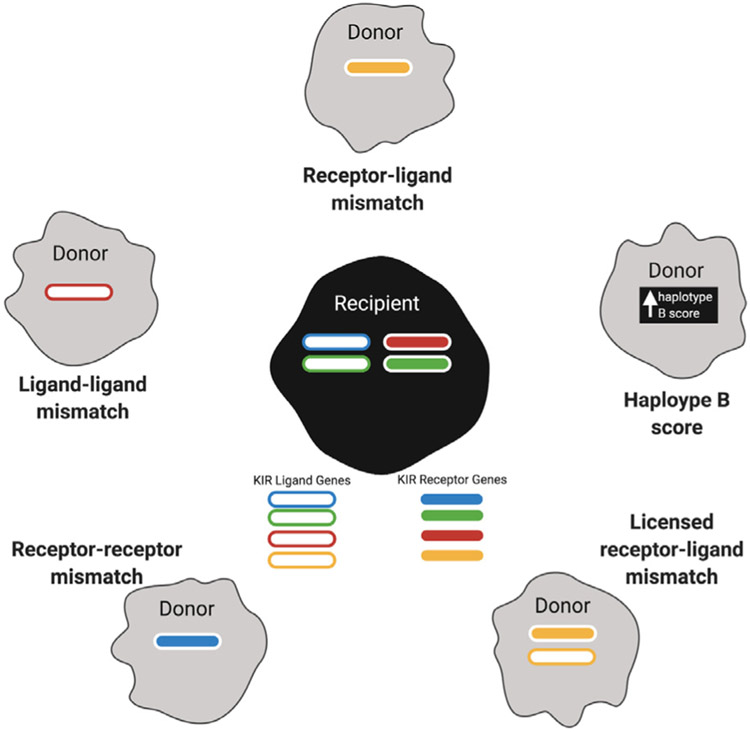
Donor selection relies on gene expression of KIR-related genes in both donor and recipient. KIR ligand genes are shown as outlined rectangles, and KIR receptor genes are shown as filled rectangles. The presence of a gene in the donor or recipient is shown, and ligand-receptors pairs are shown in the same color. Selection is based on the presence of genes in the donor and absence in the recipient (receptor-receptor and ligand-ligand), a haplotype B score (see text for explanation), presence of matched receptor-gene pairs in the donor and absence in the recipient (licensed receptor-ligand), and presence of receptor genes in the donor and absence of ligand genes in the recipient (receptor-ligand).

References

    1. Lanier LL, Testi R, Bindl J, Phillips JH Identity of Leu-19 (CD56) leukocyte differentiation antigen and neural cell adhesion molecule. J Exp Med. 1989;169:2233–2238. - PMC - PubMed
    1. Ritz J, Schmidt RE, Michon J, Hercend T, Schlossman SF Characterization of functional surface structures on human natural killer cells. Adv Immunol. 1988;42:181–211. - PubMed
    1. Cortez VS, Robinette ML, Colonna M Innate lymphoid cells: new insights into function and development. Curr Opin Immunol. 2015;32:71–77. - PMC - PubMed
    1. Lanier LL NK cell recognition. Annu Rev Immunol. 2005;23:225–274. - PubMed
    1. Vivier E, Tomasello E, Baratin M, Walzer T, Ugolini S Functions of natural killer cells. Nat Immunol. 2002;9:503–510. - PubMed

Publication types