Review
. 2020 Sep 30;12(10):2815.
doi: 10.3390/cancers12102815.

DUX Hunting-Clinical Features and Diagnostic Challenges Associated with DUX4-Rearranged Leukaemia

Affiliations
Review

DUX Hunting-Clinical Features and Diagnostic Challenges Associated with DUX4-Rearranged Leukaemia

Jacqueline A Rehn et al. Cancers (Basel). .

Abstract

DUX4-rearrangement (DUX4r) is a recently discovered recurrent genomic lesion reported in 4-7% of childhood B cell acute lymphoblastic leukaemia (B-ALL) cases. This subtype has favourable outcomes, especially in children and adolescents treated with intensive chemotherapy. The fusion most commonly links the hypervariable IGH gene to DUX4 a gene located within the D4Z4 macrosatellite repeat on chromosome 4, with a homologous polymorphic repeat on chromosome 10. DUX4r is cryptic to most standard diagnostic techniques, and difficult to identify even with next generation sequencing assays. This review summarises the clinical features and molecular genetics of DUX4r B-ALL and proposes prospective new diagnostic methods.

Keywords: DUX4; ERG; acute lymphoblastic leukaemia; molecular subtype.


Conflict of interest statement

D.L.W. receives research support from BMS, and Honararia from BMS and Amgen. D.T.Y. receives research support from BMS & Novartis, and Honararia Amgen, BMS, Novartis, Takeda and Pfizer. None of these agencies have had a role in the preparation of this manuscript. All other authors declare no conflict of interest.

Figures
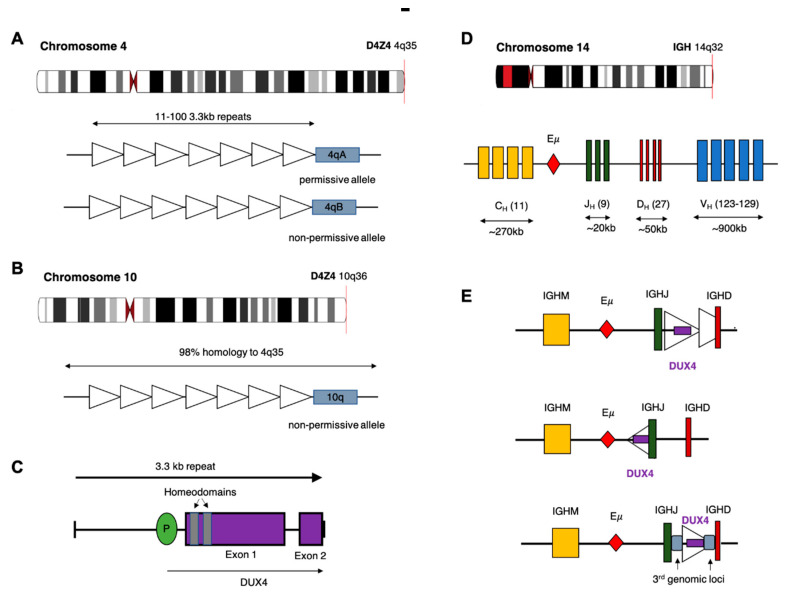
Figure 1
Figure 1
Potential chromosomal rearrangements involving IGH and DUX4. (A) Ideogram of chromosome 4 indicating location of the D4Z4 array and a depiction of the two alleles which vary in the sequence distal to the final repeat (repeat indicated by open triangles). This includes the permissive 4qA allele which can result in FSHD when contracted to fewer than 10 repeats. (B) Ideogram of chromosome 10 indicating location of the homologous D4Z4 array with 98% identical sequence. This chromosome is associated with a non-permissive allele which does not result in FSHD. (C) Schematic diagram of the repeat 3.3 kb repeat sequence indicating location and exons of the DUX4 gene. (D) Ideogram of chromosome 14 and depiction of the IGH locus indicating constant (CH), joining (JH), diversity (DH) and variable (VH) alleles (E) Schematic diagram depicting possible rearrangements as a result of cryptic insertion of DUX4 from either chromosome 4 or 10 into the IGH locus. DUX4 can be inserted in either orientation, include only a partial or one complete and one partial copy of the repeat array and also be inserted with sequence from a third genomic location.
Figure 2
Figure 2
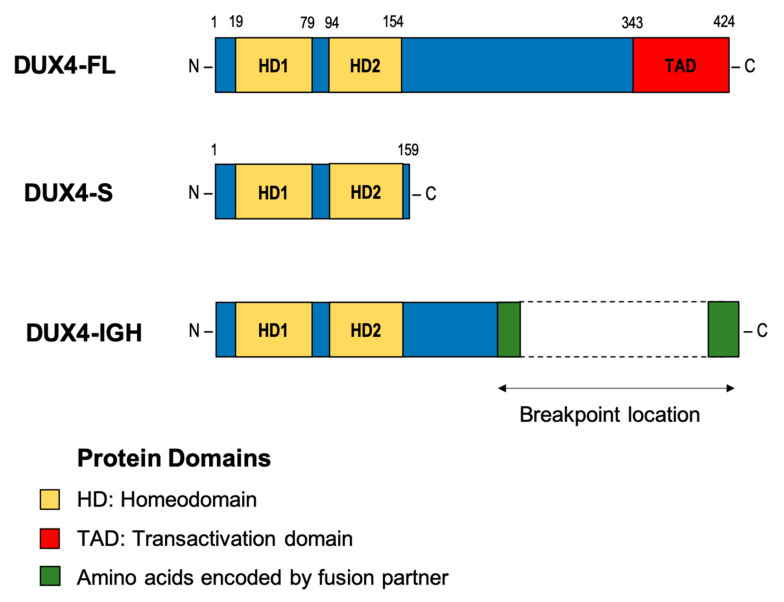
Deduced proteins of the various forms of DUX4. Full-length DUX4 (DUX4-FL) and truncated DUX4 (DUX4-S) generated from an alternatively spliced transcript of DUX4 (DUX4-s) lacking the C-terminal transactivation domain. Putative DUX4-IGH chimeric protein in which the C-terminal portion of DUX4 containing the transactivation domain is replaced with amino acid sequence encoded by the genomic location into which DUX4 was inserted. Length of the C-terminal portion of the chimeric protein can vary between patients, depending on the breakpoint location within exon 1 of DUX4.

References

    1. Inaba H., Greaves M., Mullighan C.G. Acute lymphoblastic leukaemia. Lancet. 2013;381:1943–1955. doi: 10.1016/S0140-6736(12)62187-4. - DOI - PMC - PubMed
    1. Tasian S.K., Loh M.L., Hunger S.P. Childhood acute lymphoblastic leukemia: Integrating genomics into therapy. Cancer. 2015;121:3577–3590. doi: 10.1002/cncr.29573. - DOI - PMC - PubMed
    1. Hunger S.P., Mullighan C.G. Redefining ALL classification: Toward detecting high-risk ALL and implementing precision medicine. Blood. 2015;125:3977–3987. doi: 10.1182/blood-2015-02-580043. - DOI - PMC - PubMed
    1. Harvey R.C., Mullighan C.G., Chen I.-M., Wharton W., Mikhail F.M., Carroll A.J., Kang H., Liu W., Dobbin K.K., Smith M.A., et al. Rearrangement of CRLF2 is associated with mutation of JAK kinases, alteration of IKZF1, Hispanic/Latino ethnicity, and a poor outcome in pediatric B-progenitor acute lymphoblastic leukemia. Blood. 2010;115:5312–5321. doi: 10.1182/blood-2009-09-245944. - DOI - PMC - PubMed
    1. Mullighan C.G., Collins-Underwood J.R., Phillips L.A.A., Loudin M.G., Liu W., Zhang J., Ma J., Coustan-Smith E., Harvey R.C., Willman C.L., et al. Rearrangement of CRLF2 in B-progenitor-and Down syndrome-associated acute lymphoblastic leukemia. Nat. Genet. 2009;41:1243–1246. doi: 10.1038/ng.469. - DOI - PMC - PubMed

LinkOut - more resources