. 2020 Sep 30;12(10):935.
doi: 10.3390/pharmaceutics12100935.

Completing the Enalaprilat Excretion Pathway-Renal Handling by the Proximal Tubule

Affiliations

Completing the Enalaprilat Excretion Pathway-Renal Handling by the Proximal Tubule

Nori J L Smeets et al. Pharmaceutics. .

Abstract

Background: Enalapril is often used in the treatment of cardiovascular diseases. Clinical data suggest that the urinary excretion of enalaprilat, the active metabolite of enalapril, is mediated by renal transporters. We aimed to identify enalaprilat specificity for renal proximal tubular transporters.

Methods: Baculovirus-transduced HEK293 cells overexpressing proximal tubular transporters were used to study enalaprilat cellular uptake. Uptake into cells overexpressing the basolateral transporters OCT2, OAT1, OAT2, or OAT3 and apical transporters OAT4, PEPT1, PEPT2, OCTN1, OCTN2, MATE1, MATE2k, and URAT1 was compared with mock-transduced control cells. Transport by renal efflux transporters MRP2, MPR4, P-gp, and BCRP was tested using a vesicular assay. Enalaprilat concentrations were measured using LC-MS/MS.

Results: Uptake of enalaprilat into cells expressing OAT3 as well as OAT4 was significantly higher compared to control cells. The enalaprilat affinity for OAT3 was 640 (95% CI: 520-770) µM. For OAT4, no reliable affinity constant could be determined using concentrations up to 3 mM. No transport was observed for other transporters.

Conclusion: The affinity of enalaprilat for OAT3 and OAT4 was notably low compared to other substrates. Taking this affinity and clinically relevant plasma concentrations of enalaprilat and other OAT3 substrates into account, we believe that drug-drug interactions on a transporter level do not have a therapeutic consequence and will not require dose adjustments of enalaprilat itself or other OAT3 substrates.

Keywords: drug transporters; enalapril; enalaprilat; proximal tubule cell.


Conflict of interest statement

The authors declare no conflict of interest. The authors declare that they have no known competing financial interests or personal relationships that could have appeared to influence the work reported in this paper.

Figures
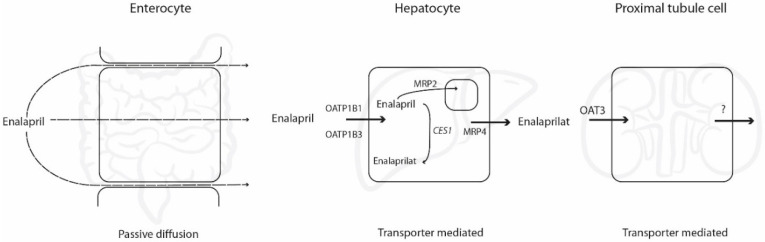
Figure 1
Figure 1
Processes governing absorption, metabolism, and excretion of enalapril and enalaprilat in the intestine, liver, and kidney. CES1: carboxylesterase 1.
Figure 2
Figure 2
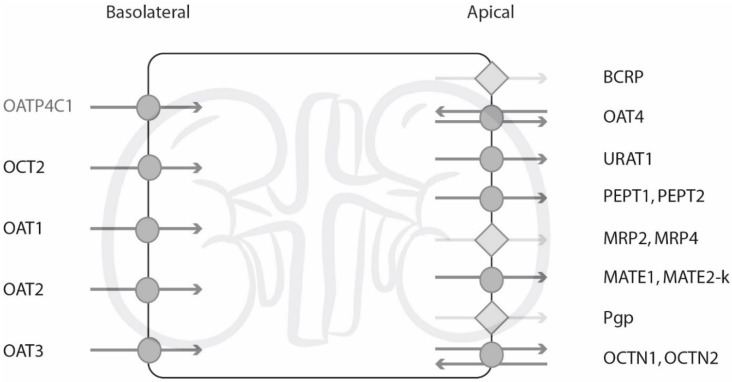
Human renal uptake transporters in the basolateral and apical membrane. In this study, transporters depicted as a circle in darker grey were investigated using a cellular assay, and diamond-shaped transporters in light grey with a vesicular assay. Figure adapted from Giacomini et al., Ivanyuk et al., and Yin et al. (references in text).
Figure 3
Figure 3
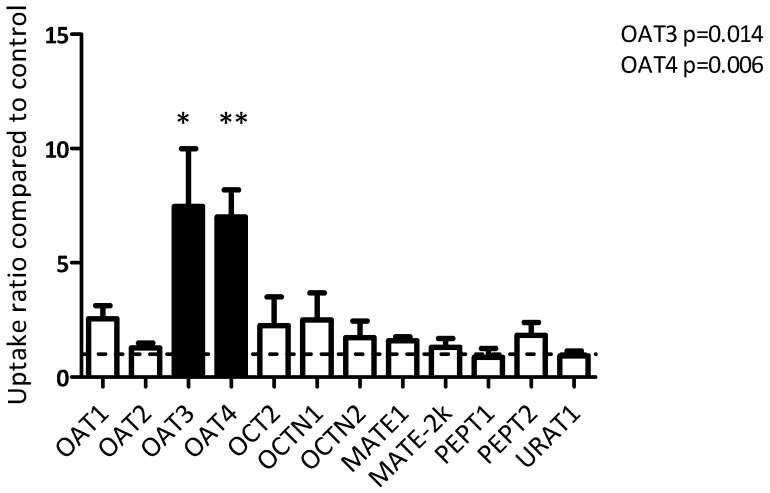
Uptake of enalaprilat was mediated by OAT3 and OAT4 in HEK293 cells transiently overexpressing a single uptake transporter. Transport is expressed as ratio of control cells and presented as means ± SEM. Data were pooled from three independent experiments. Dotted line represents a ratio between transporter and control of 1 (i.e., no active transport). An asterisk indicates a statistically significant difference from the control by one-way ANOVA using Dunnett’s post hoc test (* p < 0.05, ** p < 0.01).
Figure 4
Figure 4
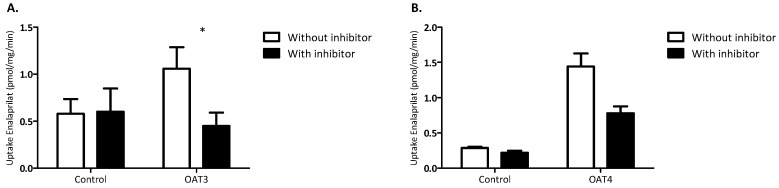
Transport of enalapril by OAT3 and OAT4 was effectively inhibited by the OAT inhibitor MK571. Effect of the OAT inhibitor MK571 (10 µM) on the uptake of enalaprilat into HEK293 cells overexpressing OAT3 (A) and OAT4 (B). Transport is expressed as pmol/mg/min and presented as mean ± SEM. Data were pooled from three independent experiments. An asterisk indicates a statistically significant difference from the non-inhibited transporter by a paired sample T-test (* p < 0.05).
Figure 5
Figure 5
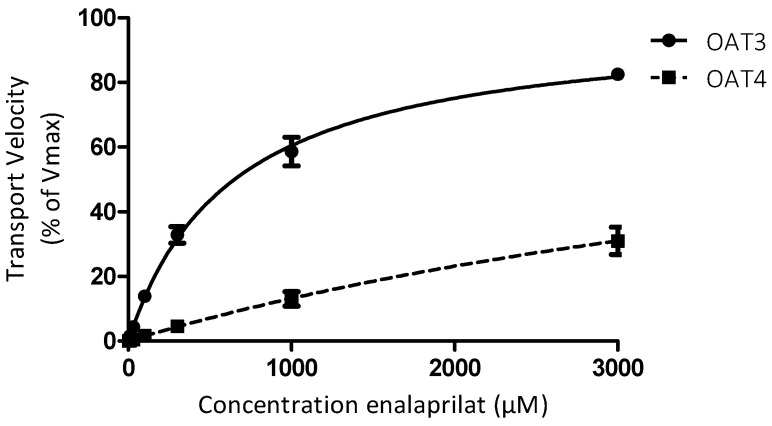
Concentration-dependent uptake of enalaprilat by OAT3 and OAT4. Michaelis–Menten kinetic curves showing the relationship between enalaprilat concentration and transport velocity of OAT3 and OAT4. For OAT3, a Km value of 640 µM (95% CI 510–770 µM) was observed, whereas saturation of transport via OAT4 was not reached over the concentration range measured. Transport velocity is expressed in percentage of maximum velocity and presented as mean ± SEM for each data point. Data were pooled from three independent experiments.

References

    1. Wilkins E., Wilson L., Wickramasinghe K., Bhatnagar P., Leal J., Luengo-Fernandez R., Burns R., Rayner M., Townsend N. European Cardiovascular Disease Statistics 2017. European Heart Network; Brussels, Belgium: 2017.
    1. Lopez-Sendon J., Swedberg K., McMurray J., Tamargo J., Maggioni A.P., Dargie H., Tendera M., Waagstein F., Kjekshus J., Lechat P., et al. Expert consensus document on angiotensin converting enzyme inhibitors in cardiovascular disease: The Task Force on ACE-inhibitors of the European Society of Cardiology. Eur. Heart J. 2004;25:1454–1470. doi: 10.1016/j.ehj.2004.06.003. - DOI - PubMed
    1. Webb A.J., Fischer U., Mehta Z., Rothwell P.M. Effects of antihypertensive-drug class on interindividual variation in blood pressure and risk of stroke: A systematic review and meta-analysis. Lancet. 2010;375:906–915. doi: 10.1016/S0140-6736(10)60235-8. - DOI - PubMed
    1. Knutter I., Wollesky C., Kottra G., Hahn M.G., Fischer W., Zebisch K., Neubert R.H., Daniel H., Brandsch M. Transport of angiotensin-converting enzyme inhibitors by H+/peptide transporters revisited. J. Pharm. Exp. 2008;327:432–441. doi: 10.1124/jpet.108.143339. - DOI - PubMed
    1. Liu L., Cui Y., Chung A.Y., Shitara Y., Sugiyama Y., Keppler D., Pang K.S. Vectorial transport of enalapril by Oatp1a1/Mrp2 and OATP1B1 and OATP1B3/MRP2 in rat and human livers. J. Pharm. Exp. 2006;318:395–402. doi: 10.1124/jpet.106.103390. - DOI - PubMed

LinkOut - more resources