. 2020 Sep 30;10(10):1395.
doi: 10.3390/biom10101395.

Targeting Mitochondria in Melanoma

Affiliations

Targeting Mitochondria in Melanoma

Sepideh Aminzadeh-Gohari et al. Biomolecules. .

Abstract

Drastically elevated glycolytic activity is a prominent metabolic feature of cancer cells. Until recently it was thought that tumor cells shift their entire energy production from oxidative phosphorylation (OXPHOS) to glycolysis. However, new evidence indicates that many cancer cells still have functional OXPHOS, despite their increased reliance on glycolysis. Growing pre-clinical and clinical evidence suggests that targeting mitochondrial metabolism has anti-cancer effects. Here, we analyzed mitochondrial respiration and the amount and activity of OXPHOS complexes in four melanoma cell lines and normal human dermal fibroblasts (HDFs) by Seahorse real-time cell metabolic analysis, immunoblotting, and spectrophotometry. We also tested three clinically approved antibiotics, one anti-parasitic drug (pyrvinium pamoate), and a novel anti-cancer agent (ONC212) for effects on mitochondrial respiration and proliferation of melanoma cells and HDFs. We found that three of the four melanoma cell lines have elevated glycolysis as well as OXPHOS, but contain dysfunctional mitochondria. The antibiotics produced different effects on the melanoma cells and HDFs. The anti-parasitic drug strongly inhibited respiration and proliferation of both the melanoma cells and HDFs. ONC212 reduced respiration in melanoma cells and HDFs, and inhibited the proliferation of melanoma cells. Our findings highlight ONC212 as a promising drug for targeting mitochondrial respiration in cancer.

Keywords: BRAF; NRAS; ONC212; Warburg effect; anti-parasitic drug; antibiotic; melanoma; mitochondrial respiration.


Conflict of interest statement

The authors declare no conflict of interest.

Figures
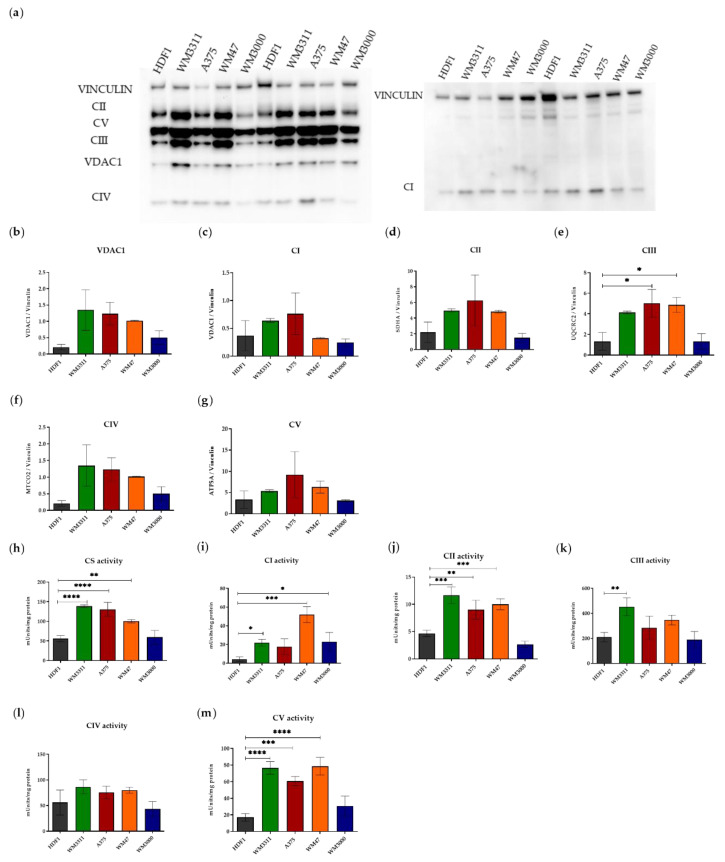
Figure 1
Figure 1
Melanoma cell lines show higher levels of OXPHOS compared to HDFs. (a) The left and right panels represent two separate western blots because of the equal size of the MTCO2 (CIV) and the NDUFS4 (CI) protein. (bg) Western blot analysis for subunits of OXPHOS complexes (CI-CV), VDAC1 and vinculin in HDF1, WM3311, A375, WM47 and WM3000 cells. (hm) Absolute activities of citrate synthase and OXPHOS complexes in HDF1, WM3311, A375, WM47 and WM3000 cells. Values are given as mean ± SD. One-way ANOVA followed by Dunnett’s Multiple Comparison Test; * p ≤ 0.05; ** p ≤ 0.01; *** p ≤ 0.001; **** p ≤ 0.0001. For western blot and enzymatic activity: post-nuclear supernatant containing the mitochondrial fraction was used. Two and three independent experiments were performed for western blot (n = 2) and enzymatic activity (n = 3), respectively. The levels of OXPHOS complexes and VDAC1 were normalized to vinculin. The activities of the OXPHOS complexes were normalized to protein concentration in cell lysates. Citrate synthase (CS); Complex I (CI); Complex II (CII); Complex III (CIII); Complex IV (CIV); Complex V (CV).
Figure 2
Figure 2
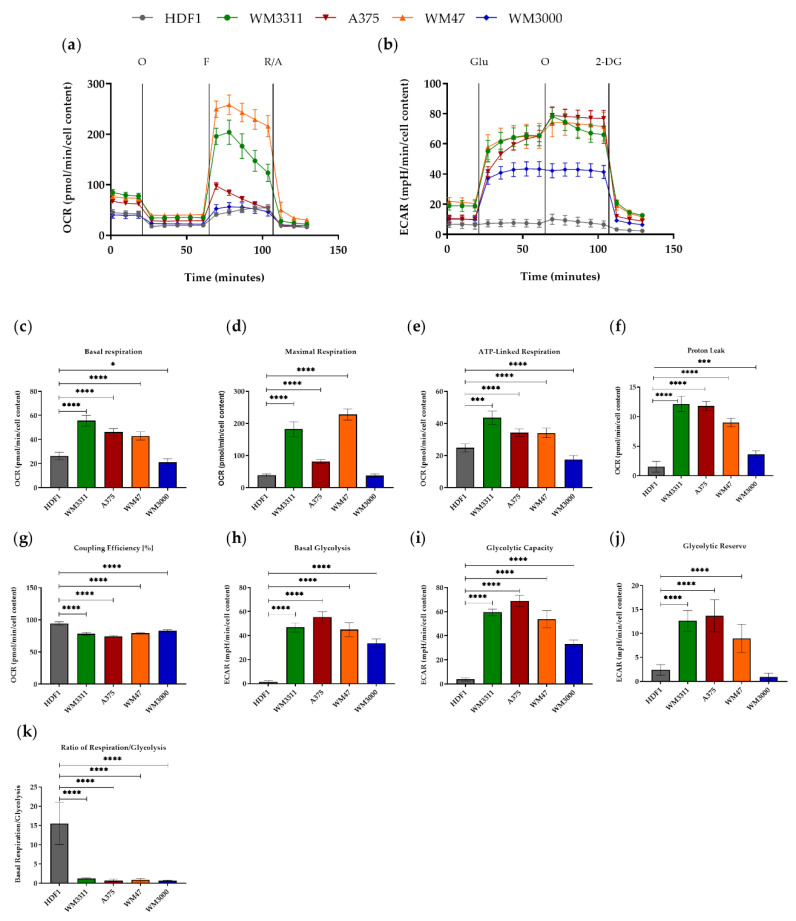
Results of the Mito Stress (a) and Glycolysis Stress (b) tests in HDF1, WM3311, A375, WM47 and WM3000 cells are presented as real-time measurements of OCR. (c) Basal respiration, (d) maximal respiration, (e) ATP-linked respiration, (f) proton leak, (g) coupling efficiency %, (h) basal glycolysis, (i) glycolytic capacity, (j) glycolytic reverse, (k) ratio of respiration to glycolysis. Values are given as mean ± SD. One-way ANOVA followed by Dunnett’s Multiple Comparison Test; * p ≤ 0.05; *** p ≤ 0.001; **** p ≤ 0.0001. For every cell line, two independent measurements with 6 to 8 replicates were performed. 10 mM Glucose (Glu); 5 µM Oligomycin (O); 2 µM FCCP (F); 0.5 µM Rotenone and Antimycin A (R/A); 50 mM 2-Deoxy-d-glucose (2DG).
Figure 3
Figure 3
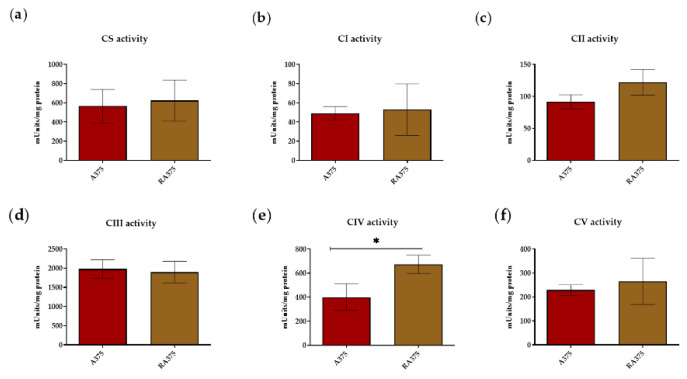
(af) Absolute activities of citrate synthase and OXPHOS complexes in isolated mitochondria in R-A375 and A375 cells. Citrate synthase (CS); Complex I (CI); Complex II (CII); Complex III (CIII); Complex IV (CIV); Complex V (CV). Values are given as mean ± SD. Unpaired T-test; * p ≤ 0.05. The activities of the OXPHOS complexes were normalized to the protein concentration in cell lysates. Measurements were repeated independently three times and each measurement included two replicates (n = 3).
Figure 4
Figure 4
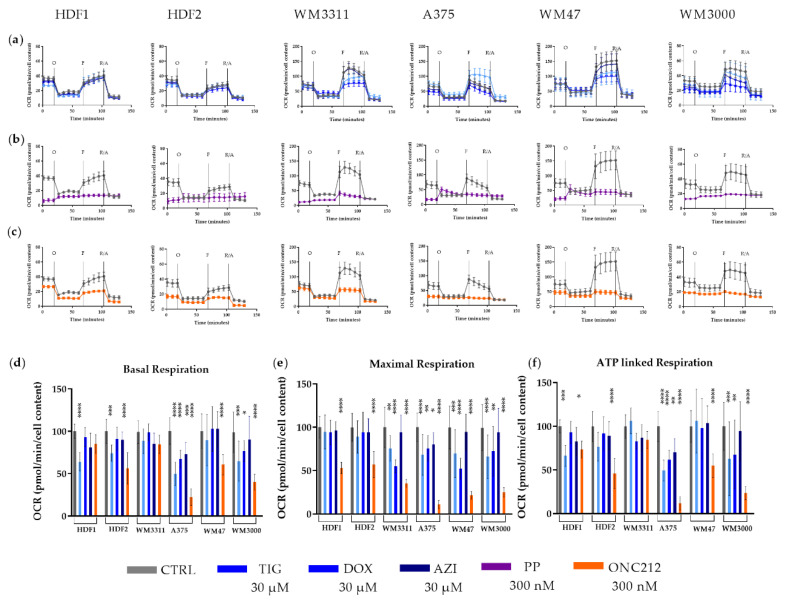
OCR measurements of (a) TIX-, DOX- and AZI-treated, (b) PP-treated, (c) ONC212-treated melanoma cells and HDFs compared to corresponding vehicle-treated cells during a mitochondrial stress test. Levels of (d) basal respiration, (e) maximal respiration, and (f) ATP-linked respiration in TIX-, DOX-, AZI- and ONC212-treated cells expressed relative to values of vehicle-treated cells normalized to 100%. Values are given as mean ± SD. One-way ANOVA followed by Dunnett’s Multiple Comparison Test; * p ≤ 0.05; ** p ≤ 0.01; *** p ≤ 0.001; **** p ≤ 0.0001. For every cell line, two independent measurements with 6 to 8 replicates were performed. Cells were treated with 30 µM TIG, DOX and AZI, and 300 nM PP and ONC212. 5 µM Oligomycin (O); 2 µM FCCP (F); 0.5 µM Rotenone and Antimycin A (R/A).
Figure 5
Figure 5
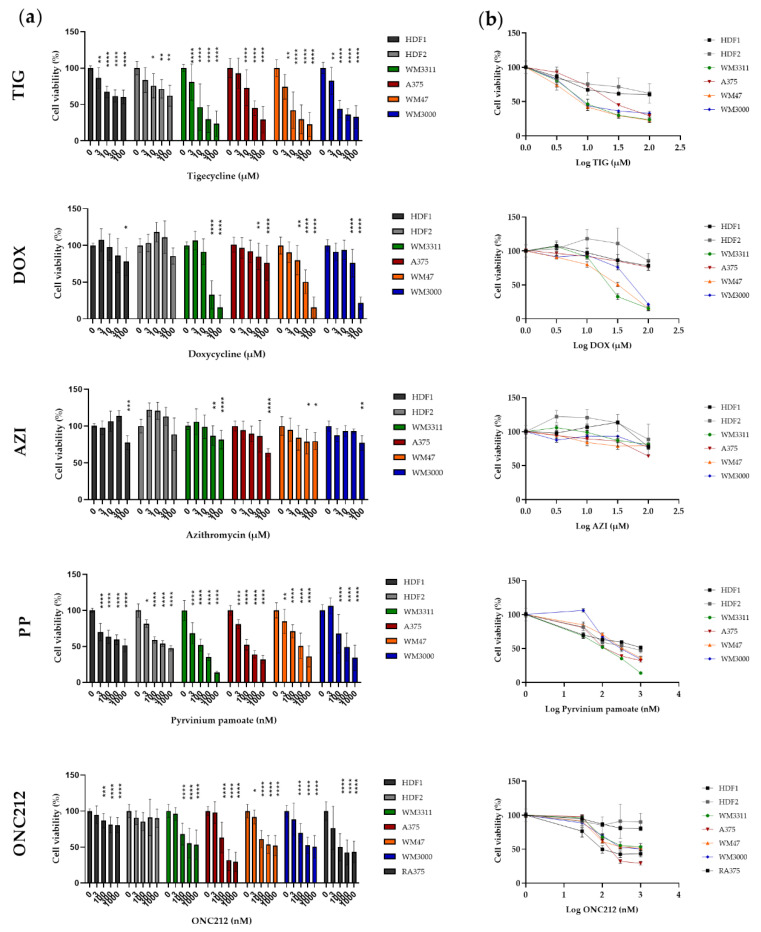
(a) Effect of TIG, DOX, AZI, PP and ONC212 on the growth of monolayer cultures of melanoma and HDF cell lines at the indicated concentrations for 72 h. (b) Dose response curve to generate IC50 values of drugs in melanoma cell lines and HDFs. Values are given as mean ± SD. Values are expressed relative to cell viability in vehicle-treated cells normalized to 100%. Values are given as mean ± SD. One-way ANOVA followed by Dunnett’s Multiple Comparison Test; * p ≤ 0.05; ** p ≤ 0.01; *** p ≤ 0.001; **** p ≤ 0.0001. Two to five independent experiments with four replicates were performed.
Figure 6
Figure 6
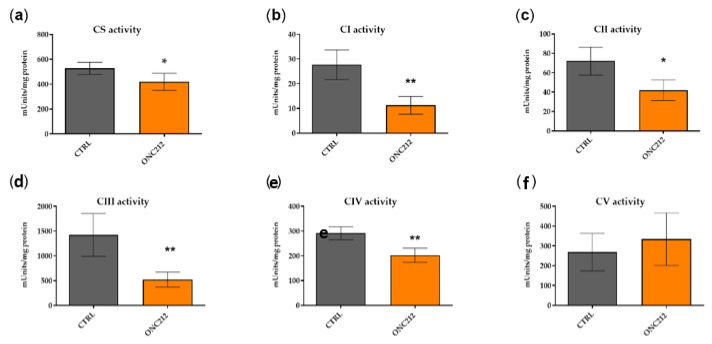
Absolute activities of citrate synthase and OXPHOS complexes in isolated mitochondria from 300 nM ONC212- or vehicle-treated A375 cells. (a) Citrate synthase (CS); (b) Complex I (CI); (c) Complex II (CII); (d) Complex III (CIII); (e) Complex IV (CIV); (f) Complex V (CV). Values are given as mean ± SD. Unpaired T-test; * p ≤ 0.05; ** p ≤ 0.01. The activities of OXPHOS complexes were normalized to protein concentration in cell lysates. Measurements were repeated three times and each measurement includes two replicates (n = 3).

References

    1. Siegel R.L., Miller K.D., Jemal A. Cancer statistics, 2019. CA Cancer J. Clin. 2019;69:7–34. doi: 10.3322/caac.21551. - DOI - PubMed
    1. Zou W., Wolchok J.D., Chen L. PD-L1 (B7-H1) and PD-1 pathway blockade for cancer therapy: Mechanisms, response biomarkers, and combinations. Sci. Transl. Med. 2016;8:328rv324. doi: 10.1126/scitranslmed.aad7118. - DOI - PMC - PubMed
    1. Weiss S.A., Wolchok J.D., Sznol M. Immunotherapy of Melanoma: Facts and Hopes. Clin. Cancer Res. 2019;25:5191–5201. doi: 10.1158/1078-0432.CCR-18-1550. - DOI - PMC - PubMed
    1. Lasche M., Emons G., Grundker C. Shedding New Light on Cancer Metabolism: A Metabolic Tightrope Between Life and Death. Front. Oncol. 2020;10:409. doi: 10.3389/fonc.2020.00409. - DOI - PMC - PubMed
    1. Vasan K., Werner M., Chandel N.S. Mitochondrial Metabolism as a Target for Cancer Therapy. Cell Metab. 2020 doi: 10.1016/j.cmet.2020.06.019. - DOI - PMC - PubMed

Publication types

MeSH terms