. 2020 Sep 30;10(10):694.
doi: 10.3390/brainsci10100694.

A Genotype-Phenotype Study of High-Resolution FMR1 Nucleic Acid and Protein Analyses in Fragile X Patients with Neurobehavioral Assessments

Affiliations

A Genotype-Phenotype Study of High-Resolution FMR1 Nucleic Acid and Protein Analyses in Fragile X Patients with Neurobehavioral Assessments

Dejan B Budimirovic et al. Brain Sci. .

Abstract

Fragile X syndrome (FXS) is caused by silencing of the FMR1 gene, which encodes a protein with a critical role in synaptic plasticity. The molecular abnormality underlying FMR1 silencing, CGG repeat expansion, is well characterized; however, delineation of the pathway from DNA to RNA to protein using biosamples from well characterized patients with FXS is limited. Since FXS is a common and prototypical genetic disorder associated with intellectual disability (ID) and autism spectrum disorder (ASD), a comprehensive assessment of the FMR1 DNA-RNA-protein pathway and its correlations with the neurobehavioral phenotype is a priority. We applied nine sensitive and quantitative assays evaluating FMR1 DNA, RNA, and FMRP parameters to a reference set of cell lines representing the range of FMR1 expansions. We then used the most informative of these assays on blood and buccal specimens from cohorts of patients with different FMR1 expansions, with emphasis on those with FXS (N = 42 total, N = 31 with FMRP measurements). The group with FMRP data was also evaluated comprehensively in terms of its neurobehavioral profile, which allowed molecular-neurobehavioral correlations. FMR1 CGG repeat expansions, methylation levels, and FMRP levels, in both cell lines and blood samples, were consistent with findings of previous FMR1 genomic and protein studies. They also demonstrated a high level of agreement between blood and buccal specimens. These assays further corroborated previous reports of the relatively high prevalence of methylation mosaicism (slightly over 50% of the samples). Molecular-neurobehavioral correlations confirmed the inverse relationship between overall severity of the FXS phenotype and decrease in FMRP levels (N = 26 males, mean 4.2 ± 3.3 pg FMRP/ng genomic DNA). Other intriguing findings included a significant relationship between the diagnosis of FXS with ASD and two-fold lower levels of FMRP (mean 2.8 ± 1.3 pg FMRP/ng genomic DNA, p = 0.04), in particular observed in younger age- and IQ-adjusted males (mean age 6.9 ± 0.9 years with mean 3.2 ± 1.2 pg FMRP/ng genomic DNA, 57% with severe ASD), compared to FXS without ASD. Those with severe ID had even lower FMRP levels independent of ASD status in the male-only subset. The results underscore the link between FMR1 expansion, gene methylation, and FMRP deficit. The association between FMRP deficiency and overall severity of the neurobehavioral phenotype invites follow up studies in larger patient cohorts. They would be valuable to confirm and potentially extend our initial findings of the relationship between ASD and other neurobehavioral features and the magnitude of FMRP deficit. Molecular profiling of individuals with FXS may have important implications in research and clinical practice.

Keywords: FMR1; FMRP; PCR; autism spectrum disorder; fragile X syndrome.


Conflict of interest statement

D.B.B. has received funding from Seaside, Roche, Neuren, Pfizer, Shire, Lundbeck, Forest, Sunovion, SyneuRX, Alcobra, Akili, Medgenics, Purdue, Supernus as a main sub-investigator, and Ovid and Zynerba Pharmaceuticals as the principal investigator on clinical trials. He also consulted on clinical trial outcome measures focused meetings (Seaside, Ovid). All the above funding has been directed to Kennedy Krieger Institute/the Johns Hopkins Medical Institutions; D.B.B. receives no personal funds, and the Institute has no relevant financial interest in any of the commercial entities listed. A.S., S.F.-S., E.B., K.N., K.C., K.J., J.K., A.H., and G.J.L. are or were employed by Asuragen at the time the work was performed and have or may have stock options in the company. G.J.L., E.B., and A.H. are inventors on one or more patents or patent applications associated with genotyping or epityping FMR1 molecular features. E.B.-K. has received funding from Acadia, Alcobra, AMO, Asuragen, BioMarin, Cydan, Fulcrum, GeneTx, GW, Ionis, Lumos, Marinus, Neuren, Neurotrope, Novartis, Ovid, Roche, Seaside Therapeutics, Ultragenyx, Vtesse/Sucampo/Mallinckrodt, Yamo, and Zynerba Pharmaceuticals to consult on clinical trial design, run clinical trials, or develop testing standards or biomarkers, all of which is directed to RUMC in support of rare disease programs; E.B.-K. receives no personal funds, and RUMC has no relevant financial interest in any of the commercial entities listed. G.L. and W.T.B. declare no conflicts of interest for the patent “System and Method for Quantifying Fragile X Mental 1Protein in tissue and blood samples” (United States Patent # 8628934). W.E.K. receives no personal funds and has no relevant financial interest in any of the commercial entities listed. He is Chief Medical Officer of Anavex Life Sciences Corp. and has been consultant to AveXis, EryDel, GW, Marinus, Neuren, Newron, Ovid, Stalicla, and Zynerba. The other co-authors declare that they have no competing interests.

Figures

Figure 1
Figure 1
(A) GS-PCR/AGE and Sanger sequencing for repeat sizing. (B) RP-PCR/CE repeat sizing and AGG interruptions (represented as horizontal column breaks, determined using Xpansion Interpreter PCR). (C) Methylation percentage assessed with mPCR. (D) FMR1 mRNA expression levels for matched cell lines (RT-qPCR), and (E) FMRP levels normalized to the recombinant FMRP peptide GST-SR7. In (B,C), the second (usually longer) CGG allele for female cell lines is shown in green; all others are given in blue.
Figure 2
Figure 2
(A) FMR1 genotype (top panel) and (B) methylation status (middle panel) correlated with (C) FMRP levels (lower panel). Samples were annotated for FMR1 CGG repeat length and degree of methylation using AmplideX PCR/CE FMR1 and mPCR technologies. Male and female samples are colored in blue and green, respectively. Bottom panel: Error bars represent standard deviations. FM samples without methylation mosaicism are indicated with an asterisk above the bar.
Figure 3
Figure 3
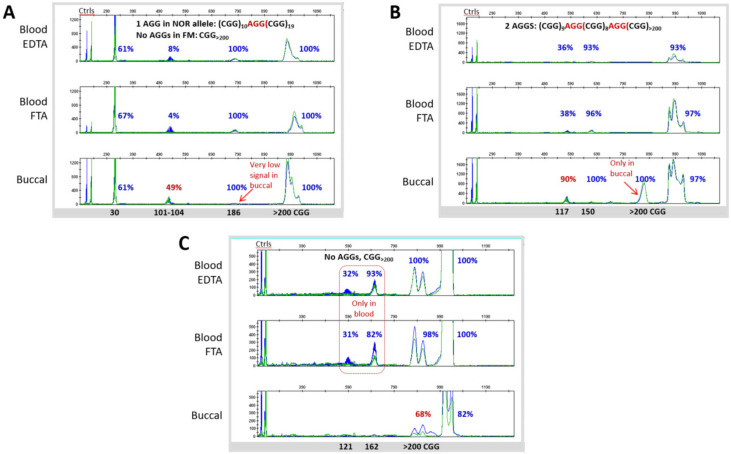
Blood samples collected in EDTA tubes or spotted on FTA paper used only for DNA analyses were compared with cheek swab specimens. DNA analyses from three representative FM subjects are shown. (A) Male with FXS (sample 09) with a fully methylated expansion and no detectable size or methylation mosaicism. (B) Female with FXS (sample 19) with random X-inactivation of the normal allele and a fully methylated FM allele. (C) Male with FXS (sample 02) with FM, PM size and methylation mosaicism in both blood and buccal gDNA. Capillary electrophoresis traces show CGG repeat length (blue, undigested) and methylation status (green, digested).
Figure 4
Figure 4
Level of concordance in primary allele CGG sizing and methylation status in blood and buccal specimen from subjects with FXS. (A) Female with FXS (sample 04) with PM size mosaicism and differential relative methylation in blood and buccal gDNA. (B) Male with FXS (sample 06) with an additional FM peak in buccal cells compared to blood, along with methylation mosaicism. (C) Male with FXS (sample 15) with a blood-only PM size mosaicism and reduced relative methylation of the FM in the buccal sample. Capillary electrophoresis traces show CGG repeat length (blue, undigested) and methylation status (green, digested).
Figure 5
Figure 5
FMRP levels and methylation mosaicism (MM) status from whole blood specimens. In the FM–FMRP Subcohort males (N = 26), those with MM (Y) had significantly higher FMRP levels as measured by the qFMRP assay. One-way ANOVA (p = 0.02), where the green line shows the mean for each group, and box plots represent the median and quantiles. Y (yes), N (no) methylation mosaicism.
Figure 6
Figure 6
FMRP levels in whole blood specimens from males with FXS with and without ASD. qFMRP measurements showed significantly higher levels in the FXS-only group than in those with FXS + ASD (p = 0.04, Welch’s t-test). The box plots outline median and percentiles 25 and 75 for each group, while the green line represents the mean for each group.

References

    1. Kaufmann W.E., Reiss A.L. Molecular and cellular genetics of fragile X syndrome. Am. J. Med. Genet. 1999;88:11–24. doi: 10.1002/(SICI)1096-8628(19990205)88:1<11::AID-AJMG3>3.0.CO;2-O. - DOI - PubMed
    1. Bagni C., Tassone F., Neri G., Hagerman R. Fragile X syndrome: Causes, diagnosis, mechanisms, and therapeutics. J. Clin. Investig. 2012;122:4314–4322. doi: 10.1172/JCI63141. - DOI - PMC - PubMed
    1. Gholizadeh S., Halder S.K., Hampson D.R. Expression of fragile X mental retardation protein in neurons and glia of the developing and adult mouse brain. Brain Res. 2015;1596:22–30. doi: 10.1016/j.brainres.2014.11.023. - DOI - PubMed
    1. Banerjee A., Ifrim M.F., Valdez A.N., Raj N., Bassell G.J. Aberrant RNA translation in fragile X syndrome: From FMRP mechanisms to emerging therapeutic strategies. Brain Res. 2018;1693 Pt A:24–36. doi: 10.1016/j.brainres.2018.04.008. - DOI - PMC - PubMed
    1. Darnell J.C., Klann E. The translation of translational control by FMRP: Therapeutic targets for FXS. Nat. Neurosci. 2013;16:1530–1536. doi: 10.1038/nn.3379. - DOI - PMC - PubMed

LinkOut - more resources