Review
. 2020 Sep 30;12(10):2828.
doi: 10.3390/cancers12102828.

Senescent Tumor CD8+ T Cells: Mechanisms of Induction and Challenges to Immunotherapy

Affiliations
Review

Senescent Tumor CD8+ T Cells: Mechanisms of Induction and Challenges to Immunotherapy

Wei Liu et al. Cancers (Basel). .

Abstract

The inability of tumor-infiltrating T lymphocytes to eradicate tumor cells within the tumor microenvironment (TME) is a major obstacle to successful immunotherapeutic treatments. Understanding the immunosuppressive mechanisms within the TME is paramount to overcoming these obstacles. T cell senescence is a critical dysfunctional state present in the TME that differs from T cell exhaustion currently targeted by many immunotherapies. This review focuses on the physiological, molecular, metabolic and cellular processes that drive CD8+ T cell senescence. Evidence showing that senescent T cells hinder immunotherapies is discussed, as are therapeutic options to reverse T cell senescence.

Keywords: CD8+ T cells; immunotherapy; metabolism; senescence.


Conflict of interest statement

The authors declare no conflict of interest.

Figures
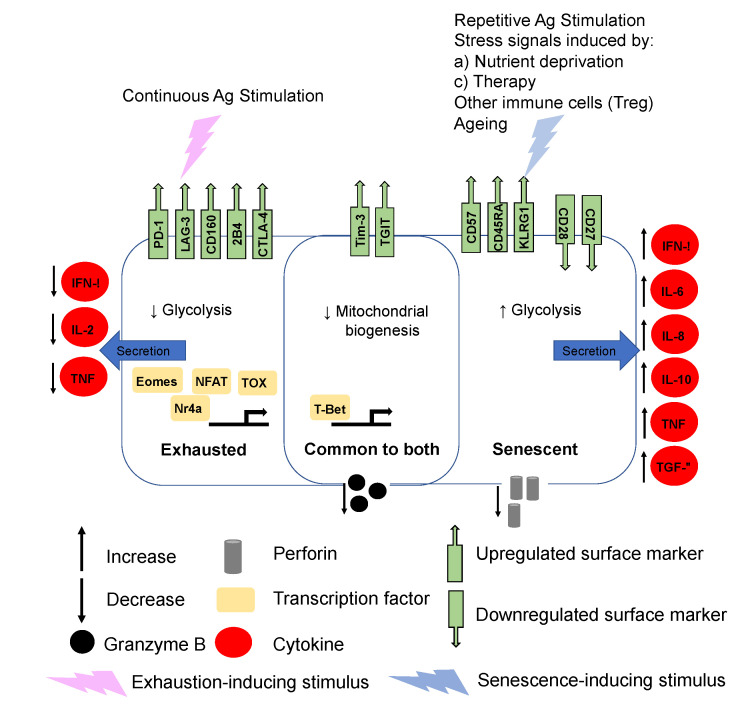
Figure 1
Figure 1
Surface phenotypic, metabolic and transcriptional differences between CD8+ dysfunctional senescent and exhaustive states. Characteristics common to both dysfunctional states are shown the in the middle, purple overlapping section. While both T cell state exhibit decreased effector function, senescent T cells have a very distinct senescence-associated secretory phenotype (SASP) with increased cytokine production of IFN-γ, IL-6, IL-8, IL-10, TNF and TGF-β. In contrast. exhausted T cells are characterized by decreased IL-2, TNF and IFN-γ production. While some surface markers such as Tim-3 and TGIT are common to both dysfunctional T cell states, there is otherwise quite a distinct pattern of expression. Ag = antigen.
Figure 2
Figure 2
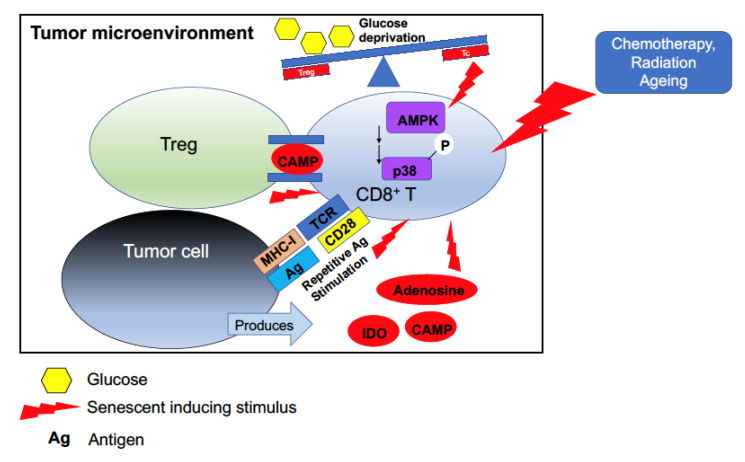
T cell senescence can occur via multiple mechanisms within the tumor microenvironment. Tregs, through glucose metabolic competition and transfer of cAMP produced by tumors, can induce CD8+ T cell senescence, as can other metabolites produced by tumor cells, such as adenosine. Repeated antigen stimulation and external factors such as chemotherapeutic and radiation therapy also induce premature senescence. A key molecular pathway involved in CD8+ T cell senescence induction is non-canonical signaling through p38-MAPK.

References

    1. Waldman A.D., Fritz J.M., Lenardo M.J. A guide to cancer immunotherapy: From T cell basic science to clinical practice. Nat. Rev. Immunol. 2020:1–18. doi: 10.1038/s41577-020-0306-5. - DOI - PMC - PubMed
    1. Martinez-Lostao L., Anel A., Pardo J. How Do Cytotoxic Lymphocytes Kill Cancer Cells? Clin. Cancer Res. 2015;21:5047–5056. doi: 10.1158/1078-0432.CCR-15-0685. - DOI - PubMed
    1. Larkin J., Chiarion-Sileni V., Gonzalez R., Grob J.-J., Cowey C.L., Lao C.D., Schadendorf D., Dummer R., Smylie M., Rutkowski P., et al. Combined Nivolumab and Ipilimumab or Monotherapy in Untreated Melanoma. New Engl. J. Med. 2015;373:23–34. doi: 10.1056/NEJMoa1504030. - DOI - PMC - PubMed
    1. Barber D.L., Wherry E.J., Masopust D., Zhu B., Allison J., Sharpe A.H., Freeman G.J., Ahmed R. Restoring function in exhausted CD8 T cells during chronic viral infection. Nature. 2006;439:682–687. doi: 10.1038/nature04444. - DOI - PubMed
    1. Locke F.L., Neelapu S.S., Bartlett N.L., Siddiqi T., Chavez J.C., Hosing C.M., Ghobadi A., Budde L.E., Bot A., Rossi J.M., et al. Phase 1 Results of ZUMA-1: A Multicenter Study of KTE-C19 Anti-CD19 CAR T Cell Therapy in Refractory Aggressive Lymphoma. Mol. Ther. 2017;25:285–295. doi: 10.1016/j.ymthe.2016.10.020. - DOI - PMC - PubMed