Neighborhood-Level Redlining and Lending Bias Are Associated with Breast Cancer Mortality in a Large and Diverse Metropolitan Area
- PMID: 33008873
- PMCID: PMC7855192
- DOI: 10.1158/1055-9965.EPI-20-1038
Neighborhood-Level Redlining and Lending Bias Are Associated with Breast Cancer Mortality in a Large and Diverse Metropolitan Area
Abstract
Background: Structural inequities have important implications for the health of marginalized groups. Neighborhood-level redlining and lending bias represent state-sponsored systems of segregation, potential drivers of adverse health outcomes. We sought to estimate the effect of redlining and lending bias on breast cancer mortality and explore differences by race.
Methods: Using Georgia Cancer Registry data, we included 4,943 non-Hispanic White (NHW) and 3,580 non-Hispanic Black (NHB) women with a first primary invasive breast cancer diagnosis in metro-Atlanta (2010-2014). Redlining and lending bias were derived for census tracts using the Home Mortgage Disclosure Act database. We calculated hazard ratios and 95% confidence intervals (CI) for the associations of redlining, lending bias on breast cancer mortality and estimated race-stratified associations.
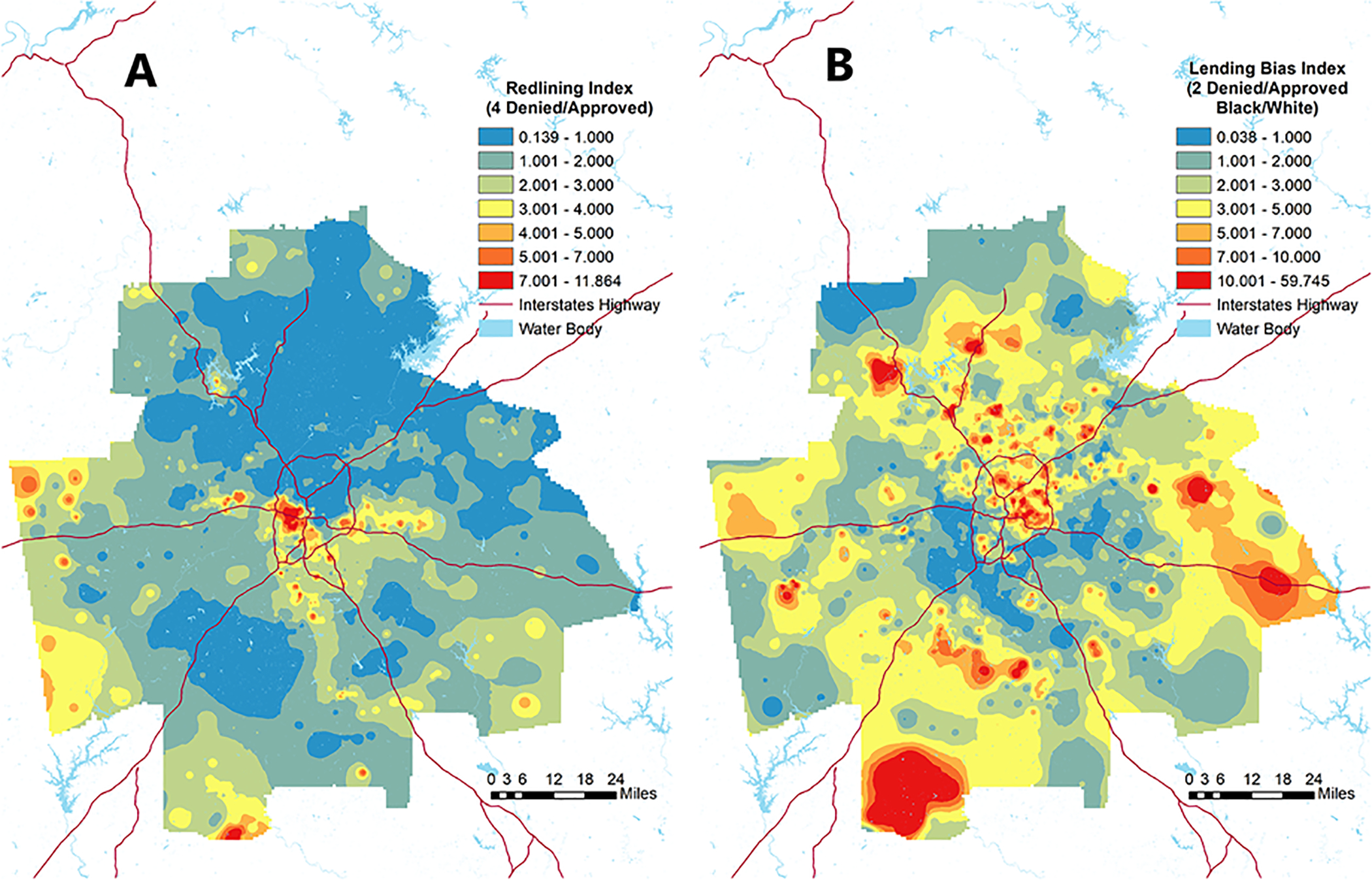
Results: Overall, 20% of NHW and 80% of NHB women lived in redlined census tracts, and 60% of NHW and 26% of NHB women lived in census tracts with pronounced lending bias. Living in redlined census tracts was associated with a nearly 1.60-fold increase in breast cancer mortality (hazard ratio = 1.58; 95% CI, 1.37-1.82) while residing in areas with substantial lending bias reduced the hazard of breast cancer mortality (hazard ratio = 0.86; 95% CI, 0.75-0.99). Among NHB women living in redlined census tracts, we observed a slight increase in breast cancer mortality (hazard ratio = 1.13; 95% CI, 0.90-1.42); among NHW women the association was more pronounced (hazard ratio = 1.39; 95% CI, 1.09-1.78).
Conclusions: These findings underscore the role of ecologic measures of structural racism on cancer outcomes.
Impact: Place-based measures are important contributors to health outcomes, an important unexplored area that offers potential interventions to address disparities.
©2020 American Association for Cancer Research.
Conflict of interest statement
Figures
Comment in
-
Neighborhood-Level Redlining and Lending Bias Are Associated with Breast Cancer Mortality in a Large and Diverse Metropolitan Area-Letter.Cancer Epidemiol Biomarkers Prev. 2021 Apr;30(4):799. doi: 10.1158/1055-9965.EPI-20-1763. Cancer Epidemiol Biomarkers Prev. 2021. PMID: 33811167 No abstract available.
-
Redlining, Lending Bias, and Breast Cancer Mortality-Reply.Cancer Epidemiol Biomarkers Prev. 2021 Apr;30(4):800. doi: 10.1158/1055-9965.EPI-20-1837. Cancer Epidemiol Biomarkers Prev. 2021. PMID: 33811168 Free PMC article. No abstract available.
References
-
- Krieger N Discrimination and Health Inequities. Int J Health Serv 2014. October 1;44(4):643–710. - PubMed
-
- Carmona M Place value: place quality and its impact on health, social, economic and environmental outcomes. J Urban Des. 2019. January 2;24(1):1–48.
-
- Bailey ZD, Krieger N, Agénor M, Graves J, Linos N, Bassett MT. Structural racism and health inequities in the USA: evidence and interventions. The Lancet. 2017. April 8;389(10077):1453–63. - PubMed
-
- Powell JA. Structural Racism: Building upon the Insights of John Calmore. N C Law Rev. 2007 2008;86:791.
Publication types
MeSH terms
Grants and funding
LinkOut - more resources
Full Text Sources
Medical