


Survival of Severe Acute Respiratory Syndrome Coronavirus 2 (SARS-CoV-2) and Influenza Virus on Human Skin: Importance of Hand Hygiene in Coronavirus Disease 2019 (COVID-19)
- PMID: 33009907
- PMCID: PMC7665347
- DOI: 10.1093/cid/ciaa1517
Survival of Severe Acute Respiratory Syndrome Coronavirus 2 (SARS-CoV-2) and Influenza Virus on Human Skin: Importance of Hand Hygiene in Coronavirus Disease 2019 (COVID-19)
Abstract
Background: The stability of the severe acute respiratory syndrome coronavirus 2 (SARS-CoV-2) on human skin remains unknown, considering the hazards of viral exposure to humans. We generated a model that allows the safe reproduction of clinical studies on the application of pathogens to human skin and elucidated the stability of SARS-CoV-2 on human skin.
Methods: We evaluated the stability of SARS-CoV-2 and influenza A virus (IAV), mixed with culture medium or upper respiratory mucus, on human skin surfaces and the dermal disinfection effectiveness of 80% (weight/weight) ethanol against SARS-CoV-2 and IAV.
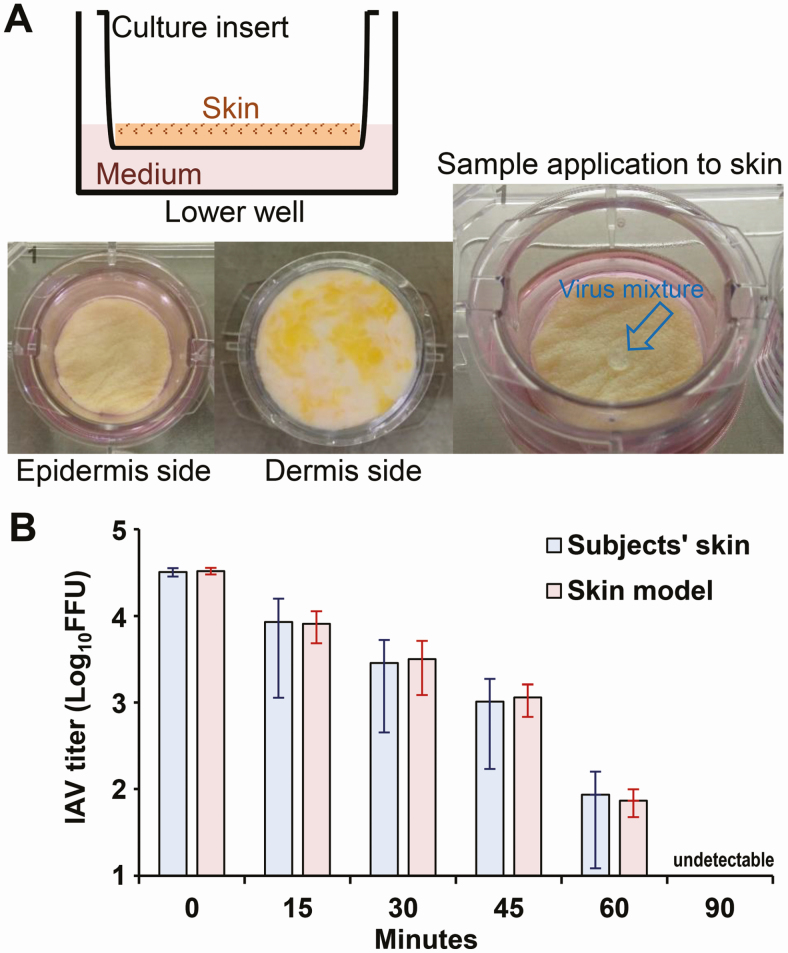
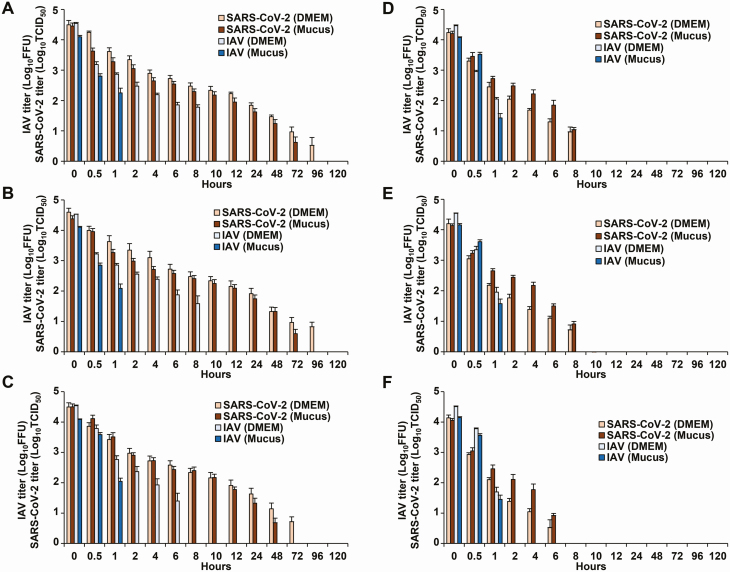
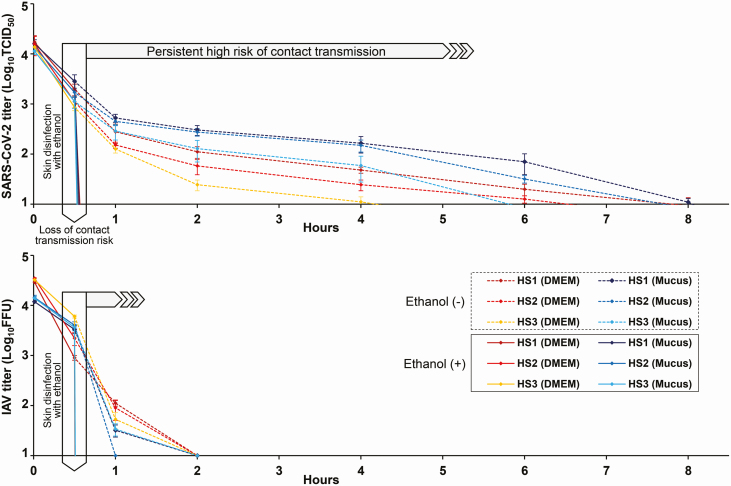
Results: SARS-CoV-2 and IAV were inactivated more rapidly on skin surfaces than on other surfaces (stainless steel/glass/plastic); the survival time was significantly longer for SARS-CoV-2 than for IAV (9.04 hours [95% confidence interval, 7.96- 10.2 hours] vs 1.82 hours [1.65-2.00 hours]). IAV on other surfaces was inactivated faster in mucus versus medium conditions, while SARS-CoV-2 showed similar stability in the mucus and medium; the survival time was significantly longer for SARS-CoV-2 than for IAV (11.09 hours [10.22-12.00 hours] vs 1.69 hours [1.57-1.81 hours]). Moreover, both SARS-CoV-2 and IAV in the mucus/medium on human skin were completely inactivated within 15 seconds by ethanol treatment.
Conclusions: The 9-hour survival of SARS-CoV-2 on human skin may increase the risk of contact transmission in comparison with IAV, thus accelerating the pandemic. Proper hand hygiene is important to prevent the spread of SARS-CoV-2 infections.
Keywords: SARS-CoV-2; hand hygiene; human skin; influenza A virus; stability.
© The Author(s) 2020. Published by Oxford University Press for the Infectious Diseases Society of America. All rights reserved. For permissions, e-mail: journals.permissions@oup.com.
Figures
Comment in
-
Reply to Gracely.Clin Infect Dis. 2021 Aug 2;73(3):e854-e856. doi: 10.1093/cid/ciab023. Clin Infect Dis. 2021. PMID: 33439965 No abstract available.
-
Half-Life Defined as the Time Until Half of the Log Titer Is Not Informative and Should Be Replaced With Segments: Comment on Hirose et al, 2020.Clin Infect Dis. 2021 Aug 2;73(3):e853-e854. doi: 10.1093/cid/ciab021. Clin Infect Dis. 2021. PMID: 33439971 No abstract available.
References
-
- van Doremalen N, Bushmaker T, Munster VJ. Stability of Middle East respiratory syndrome coronavirus (MERS-CoV) under different environmental conditions. Euro Surveill 2013; 18:20590. - PubMed
-
- Duan SM, Zhao XS, Wen RF, et al. ; SARS Research Team Stability of SARS coronavirus in human specimens and environment and its sensitivity to heating and UV irradiation. Biomed Environ Sci 2003; 16:246–55. - PubMed
Publication types
MeSH terms
Grants and funding
LinkOut - more resources
Full Text Sources
Other Literature Sources
Medical
Research Materials
Miscellaneous
