Higher levels of (Internet) Gaming Disorder symptoms according to the WHO and APA frameworks associate with lower striatal volume
- PMID: 33010145
- PMCID: PMC8943682
- DOI: 10.1556/2006.2020.00066
Higher levels of (Internet) Gaming Disorder symptoms according to the WHO and APA frameworks associate with lower striatal volume
Abstract
Background and aims: Growing concerns about the addictive nature of Internet and computer games led to the preliminary recognition of Internet Gaming Disorder (IGD) as an emerging disorder by the American Psychiatric Association (APA) and the official recognition of Gaming Disorder (GD) as a new diagnosis by the World Health Organization (WHO). While the definition of clear diagnostic criteria for (I)GD represents an important step for diagnosis and treatment of the disorder, potential neurobiological correlates of the criteria remain to be explored.
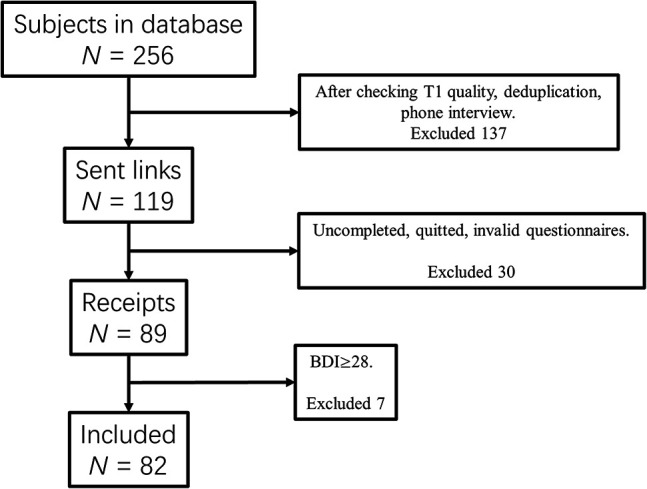
Methods: The present study employed a dimensional Magnetic Resonance Imaging (MRI) approach to determine associations between (I)GD symptom-load according to the APA and WHO diagnostic frameworks and brain structure in a comparably large sample of n = 82 healthy subjects.
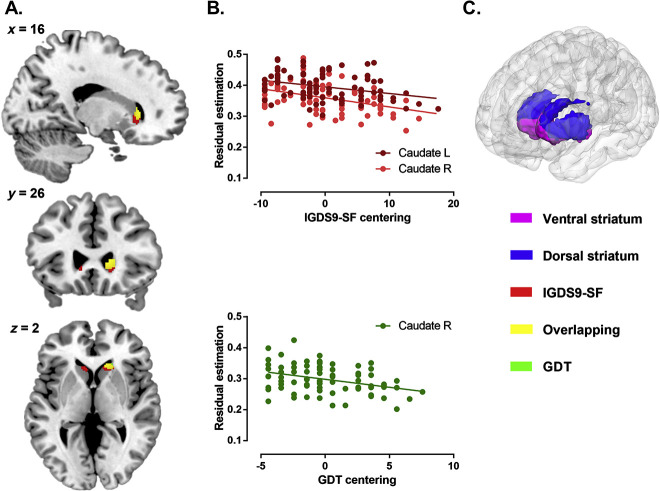
Results: Higher symptom-load on both, the APA and WHO diagnostic frameworks convergently associated with lower volumes of the striatum.
Discussion: The results from this exploratory study provide the first initial evidence for a neurobiological foundation of the proposed diagnostic criteria for (I)GD according to both diagnostic classification systems and suggest that the transition from non-disordered to disordered gaming may be accompanied by progressive neuroplastic changes in the striatum, thus resembling progressive changes in other addictive disorders.
Conclusions: The proposed (I)GD criteria in both diagnostic systems were associated with neurostructural alterations in the striatum, suggesting an association with progressive changes in the motivational systems of the brain.
Keywords: DSM-5; ICD-11; gray matter; internet gaming disorder; striatum.
Conflict of interest statement
The authors report no conflict of interest.
Figures
References
-
- Baron-Cohen, S., Wheelwright, S., Skinner, R., Martin, J., & Clubley, E. (2001). The autism-spectrum quotient (AQ): Evidence from asperger syndrome/high-functioning autism, males and females, scientists and mathematicians. Journal of Autism and Developmental Disorders, 31(1), 5–17. 10.1023/a:1005653411471. - DOI - PubMed
-
- Beck, A. T., Steer, R. A., & Brown, G. K. (1996). Beck depression inventory-II. San Antonio, 78(2), 490–498.
MeSH terms
LinkOut - more resources
Full Text Sources