


An integrated system of air sampling and simultaneous enrichment for rapid biosensing of airborne coronavirus and influenza virus
- PMID: 33010706
- PMCID: PMC7518959
- DOI: 10.1016/j.bios.2020.112656
An integrated system of air sampling and simultaneous enrichment for rapid biosensing of airborne coronavirus and influenza virus
Abstract
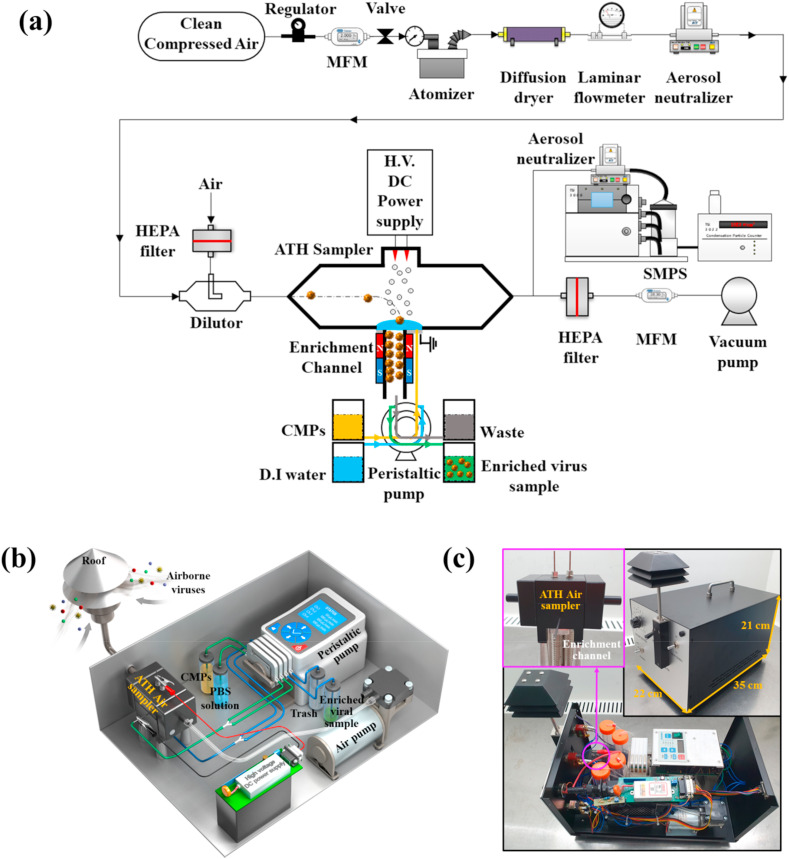
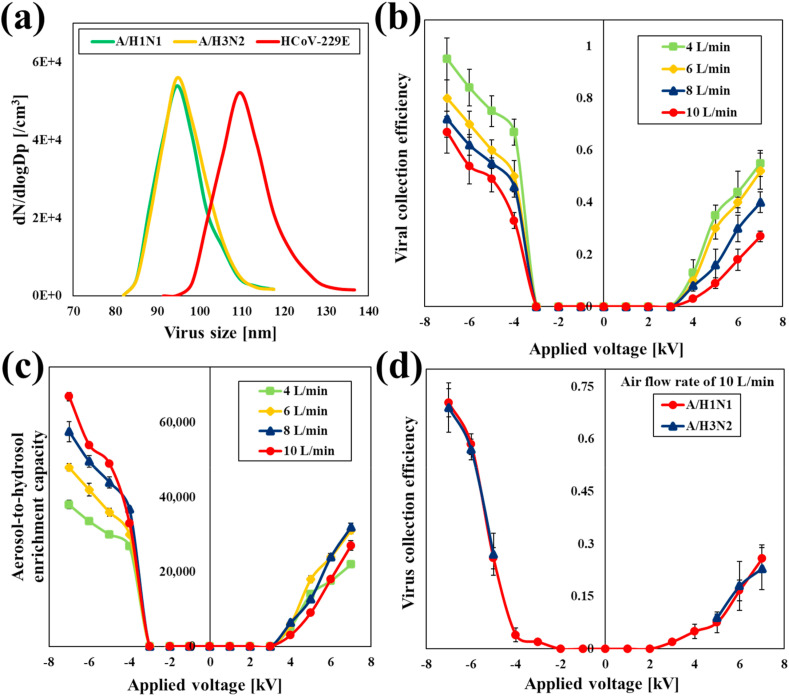
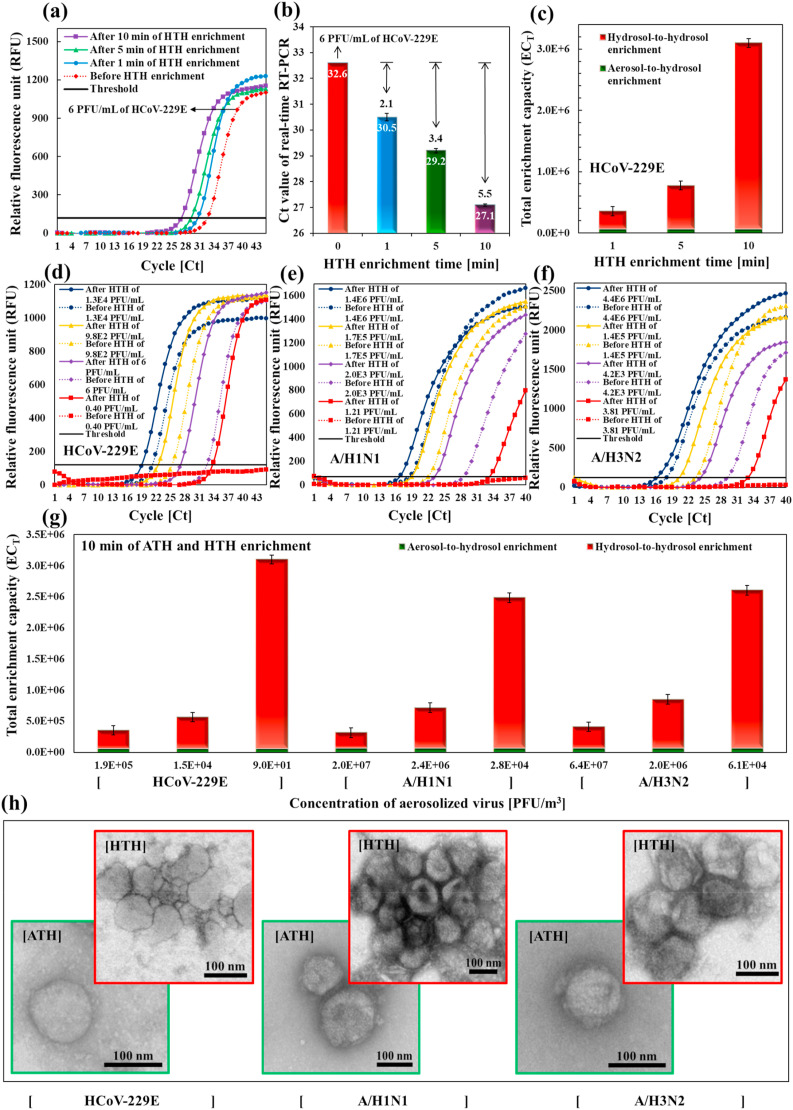
Point-of-care risk assessment (PCRA) for airborne viruses requires a system that can enrich low-concentration airborne viruses dispersed in field environments into a small volume of liquid. In this study, airborne virus particles were collected to a degree above the limit of detection (LOD) for a real-time quantitative reverse transcription polymerase chain reaction (qRT-PCR). This study employed an electrostatic air sampler to capture aerosolized test viruses (human coronavirus 229E (HCoV-229E), influenza A virus subtype H1N1 (A/H1N1), and influenza A virus subtype H3N2 (A/H3N2)) in a continuously flowing liquid (aerosol-to-hydrosol (ATH) enrichment) and a concanavalin A (ConA)-coated magnetic particles (CMPs)-installed fluidic channel for simultaneous hydrosol-to-hydrosol (HTH) enrichment. The air sampler's ATH enrichment capacity (EC) was evaluated using the aerosol counting method. In contrast, the HTH EC for the ATH-collected sample was evaluated using transmission-electron-microscopy (TEM)-based image analysis and real-time qRT-PCR assay. For example, the ATH EC for HCoV-229E was up to 67,000, resulting in a viral concentration of 0.08 PFU/mL (in a liquid sample) for a viral epidemic scenario of 1.2 PFU/m3 (in air). The real-time qRT-PCR assay result for this liquid sample was "non-detectable" however, subsequent HTH enrichment for 10 min caused the "non-detectable" sample to become "detectable" (cycle threshold (CT) value of 33.8 ± 0.06).
Keywords: Aerosol-to-hydrosol sampling; Airborne virus; Airborne virus monitoring; Coronavirus; Electrostatic air sampler; Virus enrichment.
Copyright © 2020 Elsevier B.V. All rights reserved.
Conflict of interest statement
The authors declare that they have no known competing financial interests or personal relationships that could have appeared to influence the work reported in this paper.
Figures
References
-
- Chia P.Y., Coleman K.K., Tan Y.K., Ong S.W.X., Gum M., Lau S.K., Sutjipto S., Lee P.H., Son T.T., Young B.E., Milton D.K., Gray G.C., Schuster S., Barkham T., De P.P., Vasoo S., Chan M., Ang B.S.P., Tan B.H., Leo Y.-S., Ng O.-T., Wong M.S.Y., Marimuthu K. 2020. medRxiv.
-
- Corman V.M., Landt O., Kaiser M., Molenkamp R., Meijer A., Chu D.K., Bleicker T., Brünink S., Schneider J., Schmidt M.L., Mulders D.G., Haagmans B.L., Veer B.V.D., Brink S.V.D., Wijsman L., Goderski G., Romette J., Ellis J., Zambon M., Peiris M., Gooddens H., Reusken C., Koopmans M.P., Drosten C. Euro Surveill. 2020;25(3):2000045.
MeSH terms
Substances
LinkOut - more resources
Full Text Sources
Other Literature Sources
Medical
