


Value Utilization of Emergency Medical Services Air Transport in Acute Ischemic Stroke
- PMID: 33011044
- PMCID: PMC8006070
- DOI: 10.1016/j.jemermed.2020.08.005
Value Utilization of Emergency Medical Services Air Transport in Acute Ischemic Stroke
Abstract
Background: Determining whether a patient has a time-critical medical condition requiring helicopter Emergency Medical Services (HEMS) transportation is a challenge with acute ischemic stroke (AIS). Although HEMS is largely accepted as improving outcomes in time-sensitive conditions, overtriage of patients ineligible for acute stroke therapies places patients and providers at unnecessary risk and wastes limited health care resources.
Objective: We sought to identify how accurate our triage system was at identifying high-yield EMS transfers. A better triage system would decrease the volume of low flight value HEMS transfers.
Methods: We conducted a retrospective study during a 1-year period. Low flight value was defined by acute therapy eligibility and presenting medical status.
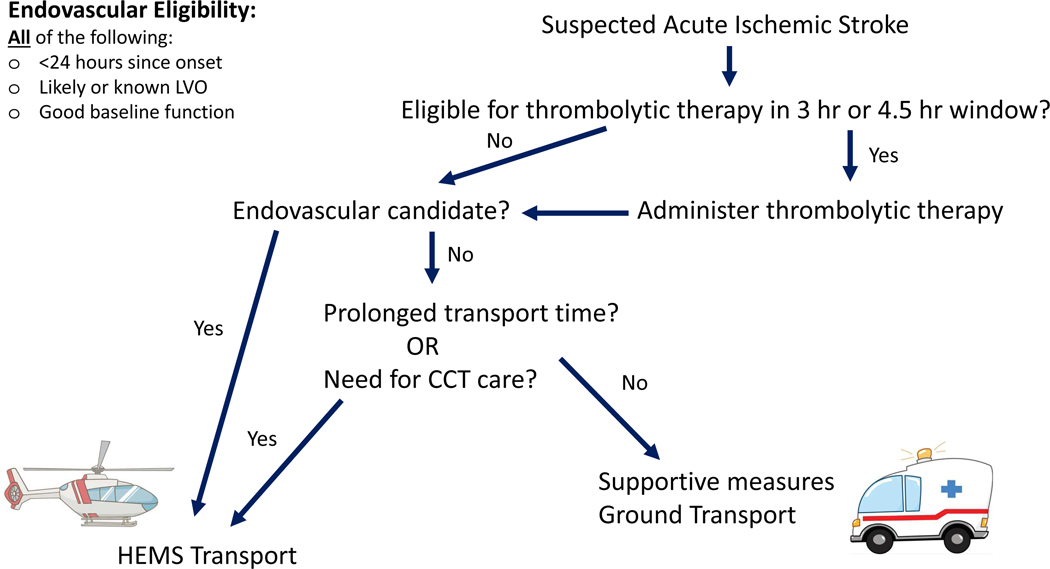
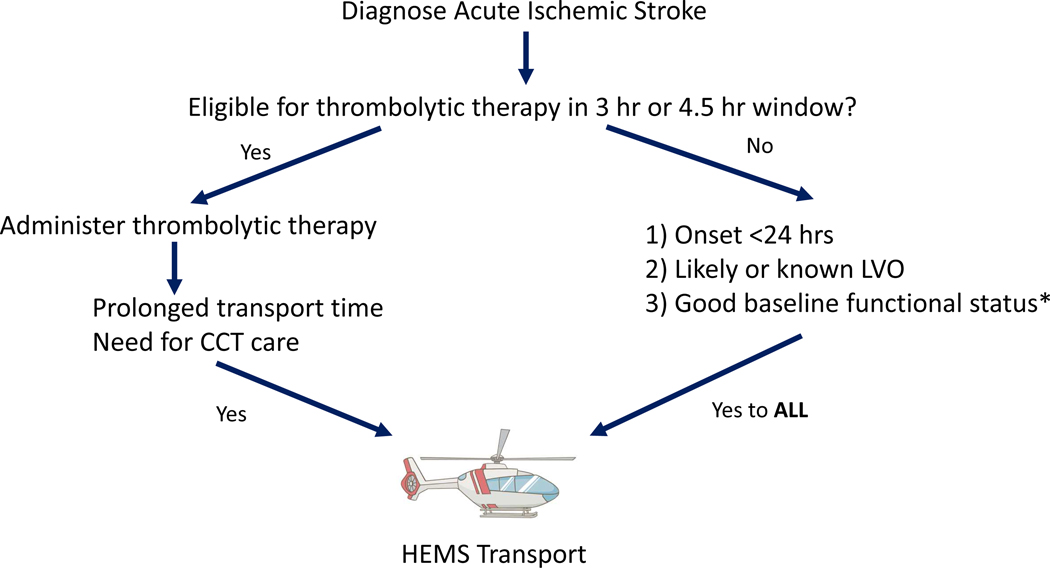
Results: Of 141 AIS patients transferred by HEMS, 23 (16%) were deemed of low flight value; 14 (61%) were outside the acute treatment time window for either intravenous tissue plasminogen activator or endovascular therapy (EVT); 5 patients (22%) were ineligible for EVT (National Institute of Health Stroke Scale < 6); 2 patients (9%) were ineligible for EVT (Modified Rankin Scale ≥ 3); and 2 patients (9%) were flown despite negative angiographic studies performed at transferring institution. Thirteen (57%) of the patients were interfacility transfers as opposed to direct HEMS transport from the field.
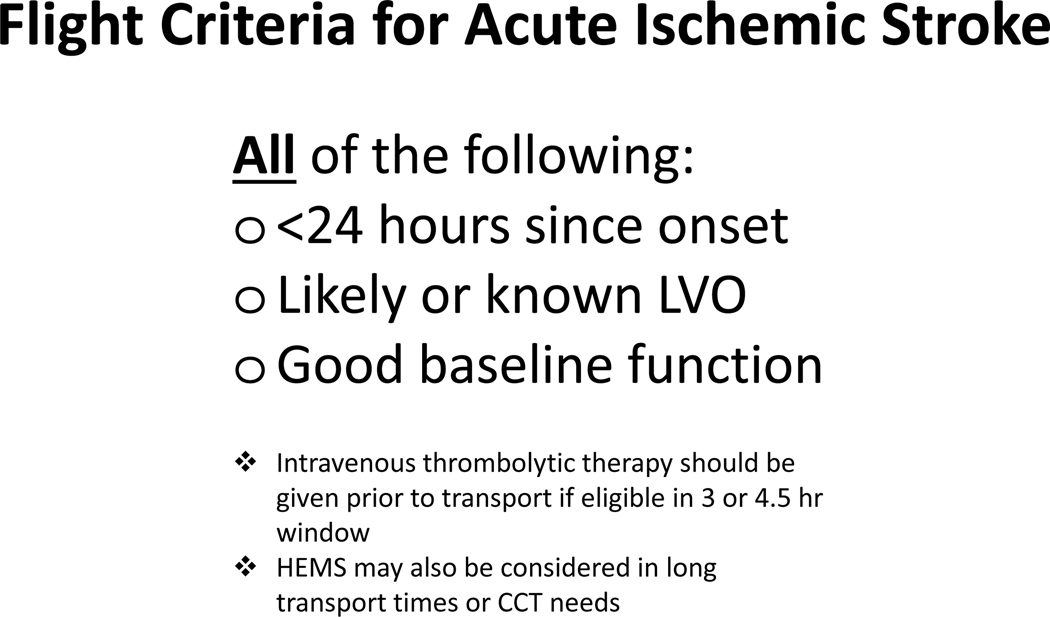
Conclusions: HEMS transport for AIS patients plays a crucial role in delivering the best evidence-based care. However, a significant percent of patients did not meet criteria for its optimal utilization, most commonly due to expired treatment windows. Furthermore, low flight value transfers were initiated in spite of physician evaluation > 50% of the time. These results represent a unique opportunity to coordinate education and build effective triage paradigms across a system of stroke care.
Keywords: aeromedical transport; prehospital; stroke; thrombolytics; triage.
Copyright © 2020 Elsevier Inc. All rights reserved.
Figures
Comment in
-
Evolving the Proposed HEMS Stroke Triaging Tool.J Emerg Med. 2021 Jun;60(6):812-813. doi: 10.1016/j.jemermed.2020.12.036. J Emerg Med. 2021. PMID: 34147229 No abstract available.
-
Reply Letter to Evolving the Proposed HEMS Stroke Triaging Tool.J Emerg Med. 2021 Jun;60(6):813-814. doi: 10.1016/j.jemermed.2021.01.030. J Emerg Med. 2021. PMID: 34147230 Free PMC article. No abstract available.
References
-
- Vercruysse GA, Friese RS, Khalil M, et al. Overuse of helicopter transport in the minimally injured: A health care system problem that should be corrected. J Trauma Acute Care Surg 2015;78:510–515. - PubMed
-
- Thomalla G, Simonsen CZ, Boutitie F, et al. MRI-Guided Thrombolysis for Stroke with Unknown Time of Onset. N Engl J Med 2018;379:611–622. - PubMed
-
- Goyal M, Menon BK, van Zwam WH, et al. Endovascular thrombectomy after large-vessel ischaemic stroke: a meta-analysis of individual patient data from five randomised trials. Lancet 2016;387:1723–1731. - PubMed
MeSH terms
Substances
Grants and funding
LinkOut - more resources
Full Text Sources
Medical
