. 2020 Dec;15(12):1823-1835.
doi: 10.1016/j.jtho.2020.09.009. Epub 2020 Oct 1.

SCLC Subtypes Defined by ASCL1, NEUROD1, POU2F3, and YAP1: A Comprehensive Immunohistochemical and Histopathologic Characterization

Affiliations

SCLC Subtypes Defined by ASCL1, NEUROD1, POU2F3, and YAP1: A Comprehensive Immunohistochemical and Histopathologic Characterization

Marina K Baine et al. J Thorac Oncol. 2020 Dec.

Abstract

Introduction: Recent studies have identified subtypes of small cell lung carcinoma (SCLC) defined by the RNA expression of ASCL1, NEUROD1, POU2F3, and YAP1 transcriptional regulators. There are only limited data on the distribution of these markers at the protein level and associated pathologic characteristics in clinical SCLC samples.

Methods: The expression of ASCL1, NEUROD1, POU2F3, and YAP1 was analyzed by immunohistochemistry in 174 patient samples with SCLC. Subtypes defined by these markers were correlated with histologic characteristics, expression of classic neuroendocrine markers (synaptophysin, chromogranin A, CD56, INSM1), and other SCLC markers, including the neuroendocrine phenotype-associated markers TTF-1 and DLL3.

Results: ASCL1 and NEUROD1 expression had the following distribution: (1) 41% ASCL1+/NEUROD1-; (2) 37% ASCL1+/NEUROD1+; (3) 8% ASCL1-/NEUROD1+; and (4) 14% ASCL1-/NEUROD1-. On the basis of their relative expression, 69% of cases were ASCL1-dominant and 17% were NEUROD1-dominant. POU2F3 was expressed in 7% of SCLC and was mutually exclusive of ASCL1 and NEUROD1. YAP1 was expressed at low levels, primarily in combined SCLC, and was not exclusive of other subtypes. Both ASCL1-dominant and NEUROD1-dominant subtypes were associated with neuroendocrine markerhigh/TTF-1high/DLL3high profile, whereas POU2F3 and other ASCL1/NEUROD1 double-negative tumors were neuroendocrine markerlow/TTF-1low/DLL3low.

Conclusions: This is the first comprehensive immunohistochemical and histopathologic analysis of novel SCLC subtypes in patient samples. We confirm that ASCL1/NEUROD1 double-negative tumors represent a distinct neuroendocrine-low subtype of SCLC, which is either uniquely associated with POU2F3 or lacks a known dominant regulator. The expression profiles of these markers appear more heterogeneous in native samples than in experimental models, particularly with regard to the high prevalence of ASCL1/NEUROD1 coexpression. These findings may have prognostic and therapeutic implications and warrant further clinical investigation.

Keywords: ASCL1; NEUROD1; Neuroendocrine; POU2F3; Small cell lung carcinoma; YAP1.


Conflict of interest statement

The authors declare that there are no conflicts of interests.

Figures

Figure 1.
Figure 1.. ASCL1 and NEUROD1 co-expression profiles.
(A) Pie chart illustrating the expression patterns of ASCL1 [A] and NEUROD1 [N] in SCLC. (B) Pie chart illustrating the distribution of marker-dominant subtypes: ASCL1-dominant (ASCL1 H-score > NEUROD1 H-score), NEUROD1-dominant (NEUROD1 H-score > ASCL1 H-score), and double-negative (negative for both markers). (C) Dot-plot depicting the H-score difference between ASCL1 and NEUROD1 (ΔH-score): each dot represents an individual case with its corresponding ΔH-score on the y-axis. All positive values represent ASCL1-dominant tumors, and all negative values represent NEUROD1-dominant ones. Bracket indicates a minority of cases with close scores for both markers (ΔH-score ≤50). (D) A case with dual-high ASCL1 and NEUROD1, illustrating that both markers are co-expressed in the same cell population.
Figure 2.
Figure 2.. POU2F3 and YAP1 expression in ASCL1/NEUROD1-defined subtypes.
Dot-plots depicting POU2F3 (A) and YAP1 (B) expression in ASCL1-dominant (ASLC1), NEUROD1-dominant (NEUROD1) and double-negative (DN) tumors. The superimposed diamond plots display the group means (central horizontal lines), with the diamond height representing the 95% confidence interval (CI), and overlap marks drawn within the diamond at √2/2 x CI/2 above or below the mean, such that when the interval between these marks in one group overlaps with the mean of another group, it indicates that these groups are not different at the 95% confidence level. Thick gray lines indicate standard deviations. Gray arrow in A indicates an exceptional tumor with divergent immunoprofiles in different areas, in which POU2F3 expression was limited to a sub-population of cells lacking any NEUROD1 or ASCL1 expression (see Supplementary Figure 1). Inset in B shows YAP1 scores in the DN subset with or without POU2F3 expression. Table columns in B correspond to ASCL1, NEUROD1, DN, POU2F3 and DN, NOS. NOS: not otherwise specified; μ ± σ: mean ± standard deviation
Figure 3.
Figure 3.. Association of SCLC subtypes with classical markers of SCLC, DLL3 and tumor histology.
Dot-plots with superimposed diamond plots (see Figure 2 legend for details) and bar graphs illustrating (A) NE marker expression (combined NE score; see Methods), (B) the average number of positive NE markers, (C) Ki-67 proliferative index, (D) TTF-1 expression, (E) DLL3 expression, and (F) tumor histology in SCLC subtypes. Abbreviations: ASCL1 = ASCL1-dominant; DN, NOS = ASCL1/NEUROD1-double-negative, not otherwise specified; DN, POU2F3 = ASCL1/NEUROD1-double-negative, POU2F3-positive; Comb = combined; NE = neuroendocrine; NEUROD1 = NEUROD1-dominant; Tot = total; μ ± σ: mean ± standard deviation
Figure 4.
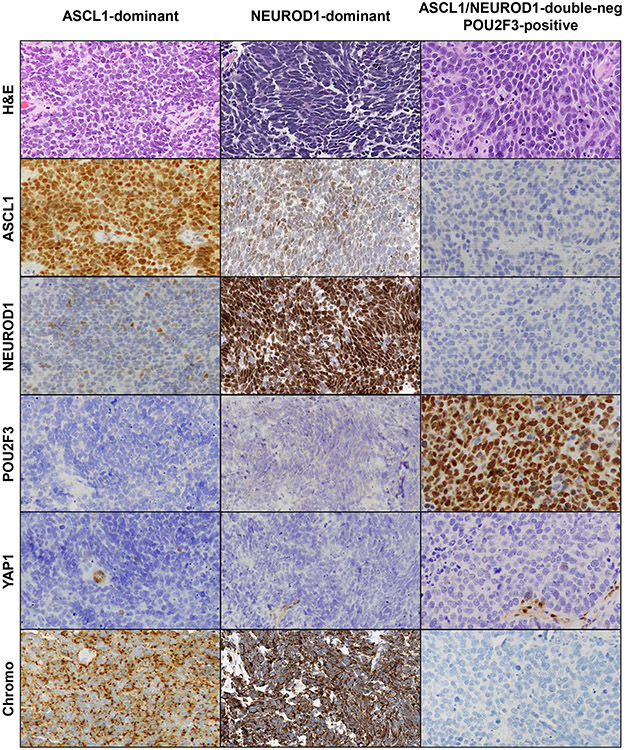
Figure 4.. Histology illustration.
Examples of SCLC subtypes defined by ASCL1, NEUROD1 and POU2F3 expression. H&E illustrates classic histologic features of SCLC in all subtypes. Low-level co-expression of NEUROD1 is seen in the ASCL1-dominant case, and low-level ASCL1 co-expression is seen in the NEUROD1-dominant case. YAP1 is negative in tumor cells, but labeling is seen in benign stromal and endothelial cells. Expression of chromogranin (Chromo) illustrates high expression of neuroendocrine markers in ASCL1 and NEUROD1 subtypes, and low expression in the double-negative subtypes (for illustrated POU2F3-positive case, INSM1 and CD56 were expressed; not shown).
Figure 5.
Figure 5.. Correlates of YAP1 expression in SCLC and example of YAP1 expression in a case of combined small cell carcinoma and adenocarcinoma.
(A) Comparison of ASCL1, NEUROD1, POU2F3, conventional markers of SCLC, and histology in tumors with differential YAP1 expression. (B) A case of combined small cell carcinoma and adenocarcinoma illustrating strong YAP1 expression in the adenocarcinoma component with weak focal staining in the adjacent SCLC component (highlighted in the high-power inset). In the background, strongly YAP1-positive cells are endothelial and stromal cells.

Comment in

  • Reassessing the SCLC Subtypes.
    Yatabe Y. Yatabe Y. J Thorac Oncol. 2020 Dec;15(12):1819-1822. doi: 10.1016/j.jtho.2020.10.011. J Thorac Oncol. 2020. PMID: 33246595 No abstract available.

References

    1. Hann CL, Rudin CM. Management of small-cell lung cancer: incremental changes but hope for the future. Oncology (Williston Park) 2008;22:1486–1492. - PMC - PubMed
    1. Sabari JK, Lok BH, Laird JH, et al. Unravelling the biology of SCLC: implications for therapy. Nat Rev Clin Oncol 2017;14:549–561. - PMC - PubMed
    1. Travis WD, Brambilla E, Burke A, et al. WHO classification of tumours of the lung, pleura, thymus and heart. Lyon: International Agency for Research on Cancer; 2015. - PubMed
    1. Rekhtman N Neuroendocrine tumors of the lung: an update. Arch Pathol Lab Med 2010;134:1628–1638. - PubMed
    1. George J, Lim JS, Jang SJ, et al. Comprehensive genomic profiles of small cell lung cancer. Nature 2015;524:47–53. - PMC - PubMed

Publication types