


Development and validation of two SCORE-based cardiovascular risk prediction models for Eastern Europe: a multicohort study
- PMID: 33011775
- PMCID: PMC7544536
- DOI: 10.1093/eurheartj/ehaa571
Development and validation of two SCORE-based cardiovascular risk prediction models for Eastern Europe: a multicohort study
Erratum in
-
Erratum to: Development and validation of two SCORE-based cardiovascular risk prediction models for Eastern Europe: a multicohort study.Eur Heart J. 2021 Feb 11;42(6):670. doi: 10.1093/eurheartj/ehaa875. Eur Heart J. 2021. PMID: 33033828 Free PMC article. No abstract available.
Abstract
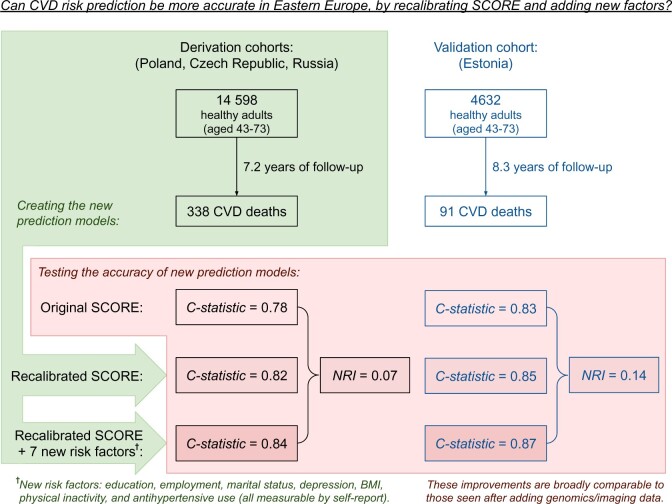
Aims: Cardiovascular disease (CVD) risk prediction models are used in Western European countries, but less so in Eastern European countries where rates of CVD can be two to four times higher. We recalibrated the SCORE prediction model for three Eastern European countries and evaluated the impact of adding seven behavioural and psychosocial risk factors to the model.
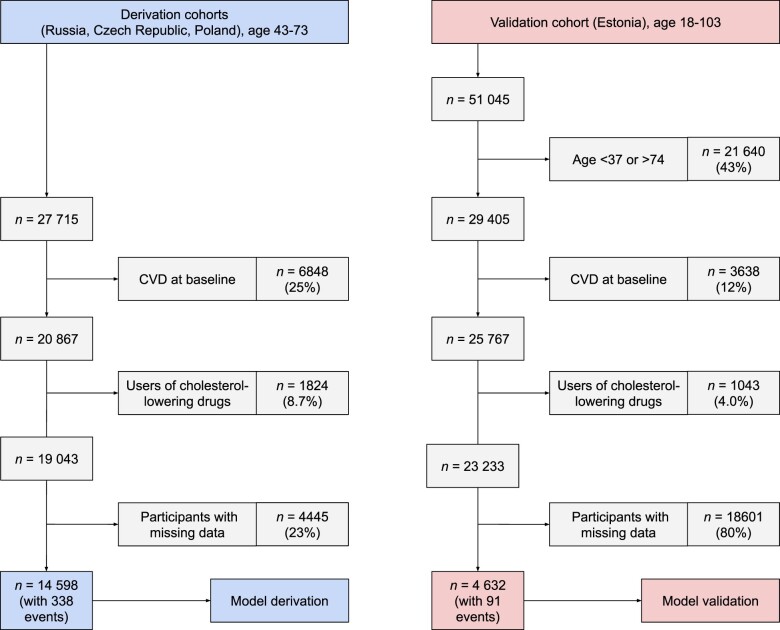
Methods and results: We developed and validated models using data from the prospective HAPIEE cohort study with 14 598 participants from Russia, Poland, and the Czech Republic (derivation cohort, median follow-up 7.2 years, 338 fatal CVD cases) and Estonian Biobank data with 4632 participants (validation cohort, median follow-up 8.3 years, 91 fatal CVD cases). The first model (recalibrated SCORE) used the same risk factors as in the SCORE model. The second model (HAPIEE SCORE) added education, employment, marital status, depression, body mass index, physical inactivity, and antihypertensive use. Discrimination of the original SCORE model (C-statistic 0.78 in the derivation and 0.83 in the validation cohorts) was improved in recalibrated SCORE (0.82 and 0.85) and HAPIEE SCORE (0.84 and 0.87) models. After dichotomizing risk at the clinically meaningful threshold of 5%, and when comparing the final HAPIEE SCORE model against the original SCORE model, the net reclassification improvement was 0.07 [95% confidence interval (CI) 0.02-0.11] in the derivation cohort and 0.14 (95% CI 0.04-0.25) in the validation cohort.
Conclusion: Our recalibrated SCORE may be more appropriate than the conventional SCORE for some Eastern European populations. The addition of seven quick, non-invasive, and cheap predictors further improved prediction accuracy.
Keywords: Cardiovascular diseases; Eastern Europe; Psychosocial deprivation; Risk prediction; Sensitivity and specificity; Socioeconomic factors.
© The Author(s) 2020. Published by Oxford University Press on behalf of the European Society of Cardiology.
Figures
Comment in
-
Estimating risk of cardiovascular disease in Eastern Europe.Eur Heart J. 2020 Sep 14;41(35):3334-3335. doi: 10.1093/eurheartj/ehaa685. Eur Heart J. 2020. PMID: 33011777 No abstract available.
References
-
- Piepoli MF, Hoes AW, Agewall S, Albus C, Brotons C, Catapano AL, Cooney M-T, Corrà U, Cosyns B, Deaton C, Graham I, Hall MS, Hobbs FDR, Løchen M-L, Löllgen H, Marques-Vidal P, Perk J, Prescott E, Redon J, Richter DJ, Sattar N, Smulders Y, Tiberi M, van der Worp HB, van Dis I, Verschuren WMM. 2016 European Guidelines on cardiovascular disease prevention in clinical practice: the Sixth Joint Task Force of the European Society of Cardiology and Other Societies on Cardiovascular Disease Prevention in Clinical Practice. Eur Heart J 2016;37:2315–2381. - PMC - PubMed
-
- Conroy RM, Pyörälä K, Fitzgerald AE, Sans S, Menotti A, De Backer G, De Bacquer D, Ducimetiere P, Jousilahti P, Keil U, Njølstad I. Estimation of ten-year risk of fatal cardiovascular disease in Europe: the SCORE project. Eur Heart J 2003;24:987–1003. - PubMed
-
- Fiscella K, Tancredi D, Franks P. Adding psychosocial status to Framingham scoring to reduce disparities in coronary risk assessment. Am Heart J 2009;157:988–994. - PubMed
-
- Vikhireva O, Broda G, Kubinova R, Malyutina S, Pająk A, Tamosiunas A, Skodova Z, Simonova G, Bobak M, Pikhart H. Does inclusion of education and marital status improve SCORE performance in Central and Eastern Europe and former Soviet Union? Findings from MONICA and HAPIEE cohorts. PLoS One 2014;9:e94344. - PMC - PubMed
