


Patients' Reaction to Diagnosis with Thyroid Cancer or an Indeterminate Thyroid Nodule
- PMID: 33012267
- PMCID: PMC8195875
- DOI: 10.1089/thy.2020.0233
Patients' Reaction to Diagnosis with Thyroid Cancer or an Indeterminate Thyroid Nodule
Abstract
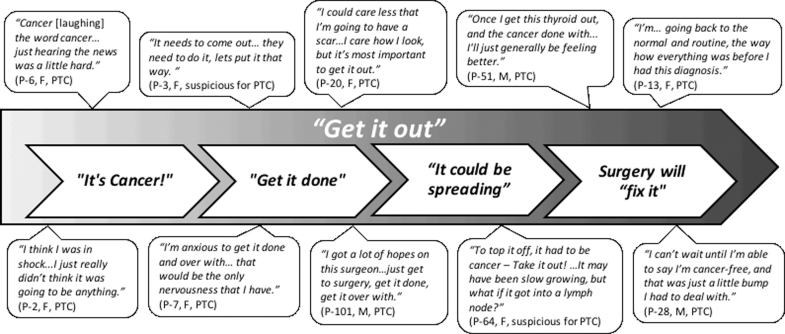
Introduction: Little is known about the experiences and concerns of patients recently diagnosed with thyroid cancer or an indeterminate thyroid nodule. This study sought to explore patients' reactions to diagnosis with papillary thyroid cancer (PTC) or indeterminate cytology on fine needle aspiration. Methods: We conducted semistructured interviews with 85 patients with recently diagnosed PTC or an indeterminate thyroid nodule before undergoing thyroidectomy. We included adults with nodules ≥1 cm and Bethesda III, IV, V, and VI cytology. The analysis utilized grounded theory methodology to create a conceptual model of patient reactions. Results: After diagnosis, participants experienced shock, anxiety, fear, and a strong need to "get it out" because "it's cancer!" This response was frequently followed by a sense of urgency to "get it done," which made waiting for surgery difficult. These reactions occurred regardless of whether participants had confirmed PTC or indeterminate cytology. Participants described the wait between diagnosis and surgery as difficult, because the cancer or nodule was "still sitting there" and "could be spreading." Participants often viewed surgery and getting the cancer out as a "fix" that would resolve their fears and worries, returning them to normalcy. The need to "get it out" also led some participants to minimize the risk of complications or adverse outcomes. Education about the slow-growing nature of PTC reassured some, but not all patients. Conclusions: After diagnosis with PTC or an indeterminate thyroid nodule, many patients have strong emotional reactions and an impulse to "get it out" elicited by the word "cancer." This reaction can persist even after receiving education about the excellent prognosis. Understanding patients' response to diagnosis is critical, because their emotional reactions likely pose a barrier to implementing guidelines recommending less extensive management for PTC.
Keywords: active surveillance; anxiety; cancer fear; indeterminate nodule; qualitative; thyroid cancer; thyroid nodule.
Conflict of interest statement
The authors have no conflicts of interest to disclose.
Figures
References
-
- Davies L, Morris LG, Haymart M, Chen AY, Goldenberg D, Morris J, Ogilvie JB, Terris DJ, Netterville J, Wong RJ, Randolph G, Committee AESS. 2015. American Association of Clinical Endocrinologists and American College of Endocrinology Disease State Clinical Review: the increasing incidence of thyroid cancer. Endocr Pract 21:686–696 - PMC - PubMed
-
- National Cancer Institute Surveillance, Epidemiology, and End Results Program Explorer Application. Available at https://seer.cancer.gov/explorer/application (accessed March23, 2020)
-
- McDow AD PS 2019. Extent of surgery for low-risk differentiated thyroid cancer. Surg Clin North Am 99:599–610 - PubMed
-
- Haugen BR, Alexander EK, Bible KC, Doherty GM, Mandel SJ, Nikiforov YE, Pacini F, Randolph GW, Sawka AM, Schlumberger M, Schuff KG, Sherman SI, Sosa JA, Steward DL, Tuttle RM, Wartofsky L. 2016. 2015 American Thyroid Association Management guidelines for adult patients with thyroid nodules and differentiated thyroid cancer: The American Thyroid Association Guidelines Task Force on Thyroid Nodules and Differentiated Thyroid Cancer. Thyroid 26:1–133 - PMC - PubMed
Publication types
MeSH terms
Grants and funding
LinkOut - more resources
Full Text Sources
Medical
