


Salmonella enterica serovar Typhimurium gene sseK3 is required for intracellular proliferation and virulence
- PMID: 33012979
- PMCID: PMC7491001
Salmonella enterica serovar Typhimurium gene sseK3 is required for intracellular proliferation and virulence
Abstract
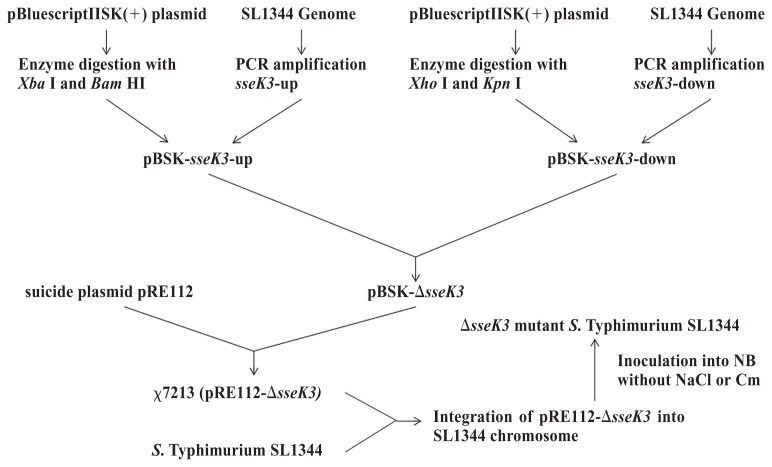
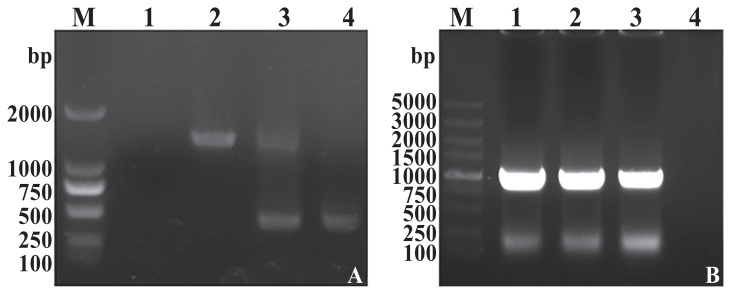
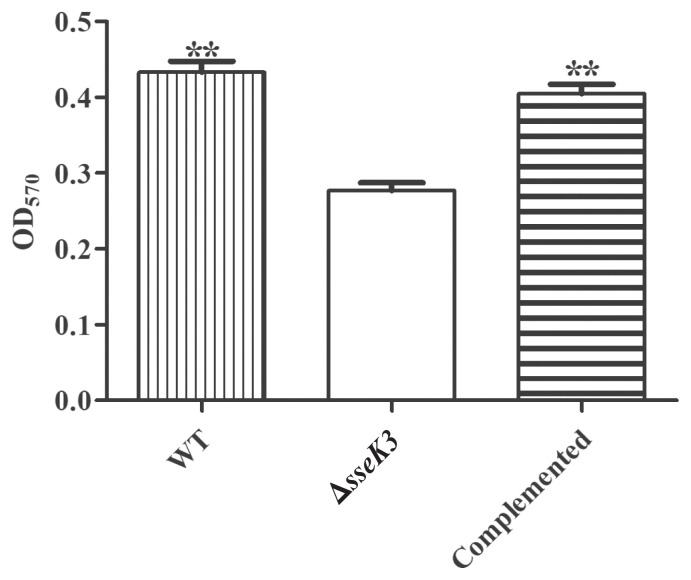
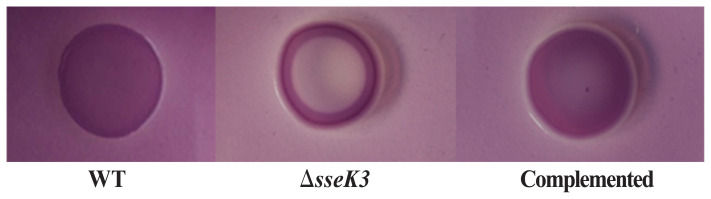
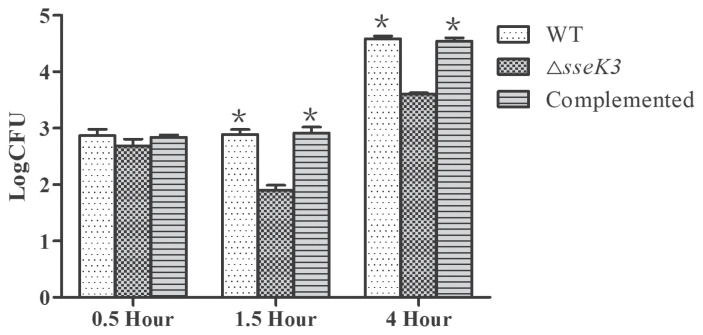
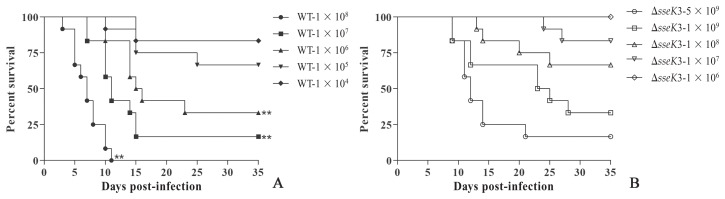
Salmonella enterica serovar Typhimurium (S. Typhimurium) is one of the most significant zoonotic pathogens that poses a threat to humans. Previous studies have identified that Salmonella-secreted effector K3 (SseK3) is a novel translated and secreted protein of S. Typhimurium. The objective of this study was to determine whether deletion of the sseK3 gene can attenuate the virulence of S. Typhimurium. To do this, we constructed an sseK3 deletion mutant using the double-exchange allele of the suicide plasmid pRE112ΔsseK3 and assessed the virulence and intracellular proliferation of the mutant. The sseK3 deletion mutant exhibited adhesion and invasion properties similar to those of wild-type (WT) S. Typhimurium, although the virulence and intracellular proliferation of the mutant were significantly reduced compared to that of the WT strain. Furthermore, the observed increase in the median lethal dose (LD50) reflects a decrease in the pathogenicity of the sseK3 deletion mutant in a murine model. In summary, we concluded that disruption of sseK3 can attenuate the intracellular proliferation and reduce the virulence of S. Typhimurium.
Salmonella enterica serovar Typhimurium (S. Typhimurium) est un des agents pathogènes zoonotiques les plus importants qui représente une menace pour les humains. Des études antérieures ont identifié que l’effecteur K3 secrété par Salmonella (SseK3) est une nouvelle protéine traduite et secrétée par S. Typhimurium. L’objectif de la présente étude était de déterminer si une délétion du gène sseK3 pouvait atténuer la virulence de S. Typhimurium. Nous avons construit un mutant avec la délétion de sseK3 en utilisant l’allèle d’échange double du plasmide suicide pRE112ΔsseK3 et avons évalué la virulence et la prolifération intracellulaire du mutant. Le mutant de délétion démontrait des propriétés d’adhésion et d’invasion similaires à celles du type sauvage (WT) de S. Typhimurium, bien que la virulence et la prolifération intracellulaire du mutant étaient considérablement réduites comparativement à celles de la souche WT. De plus, l’augmentation observée de la dose létale médiane (LD50) reflète une diminution dans la pathogénicité de ce mutant de délétion sseK3 dans un modèle murin. En résumé, nous concluons qu’une perturbation de sseK3 peut atténuer la prolifération intracellulaire et réduire la virulence de S. Typhimurium.(Traduit par Docteur Serge Messier).
Copyright and/or publishing rights held by the Canadian Veterinary Medical Association.
Figures
References
-
- Tsolis RM, Kingsley RA, Townsend SM, Ficht TA, Adams LG, Bäumler AJ. Of mice, calves, and men. Comparison of the mouse typhoid model with other Salmonella infections. Adv Exp Med Biol. 1999;473:261–274. - PubMed
MeSH terms
Substances
LinkOut - more resources
Full Text Sources
Research Materials