. 2020 Sep 9:11:583311.
doi: 10.3389/fphar.2020.583311. eCollection 2020.

Effectiveness and Safety of Oral Anticoagulants in Older Patients With Atrial Fibrillation: A Systematic Review and Meta-Analysis

Affiliations

Effectiveness and Safety of Oral Anticoagulants in Older Patients With Atrial Fibrillation: A Systematic Review and Meta-Analysis

Maxim Grymonprez et al. Front Pharmacol. .

Abstract

Background and objective: Atrial fibrillation (AF), the most common cardiac arrhythmia, typically increases with age. Oral anticoagulants (OACs) are the cornerstone of treatment to reduce the associated risk for systemic thromboembolism. Four large randomized controlled trials (RCTs) have shown that non-vitamin K antagonist oral anticoagulants (NOACs) are non-inferior to vitamin K antagonists (VKAs) in preventing stroke and systemic embolism, as well as regarding their risk for major bleeding. However, as vulnerable geriatric patients with AF were largely underrepresented in these trials, physicians are faced with the challenge of choosing the right anticoagulant for geriatric patients in real-life clinical practice. In this vulnerable patient group, NOACs tend to be underused or underdosed due to concerns of excessive fall-related intracranial bleeding, cognitive impairment, multiple drug-drug interactions, low body weight or impaired renal function. As life expectancy continues to rise worldwide, the number of geriatric patients substantially increases. Therefore, there is an urgent need for a critical appraisal of the added value of NOACs in geriatric patients with AF at high thromboembolic and bleeding risk.

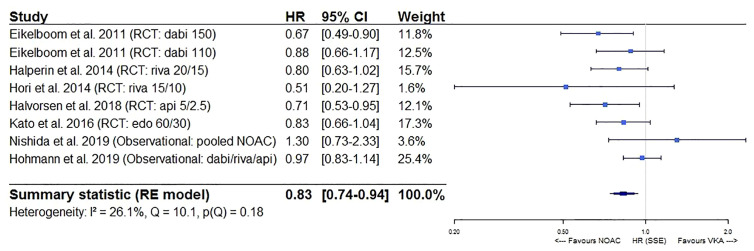
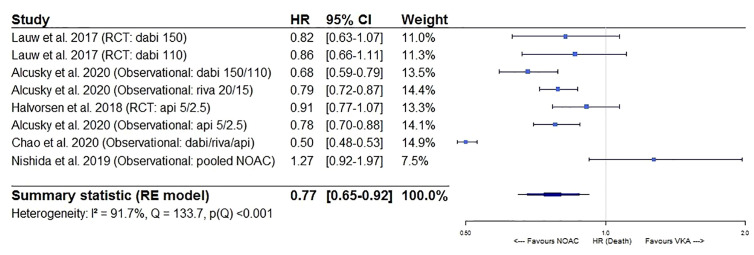
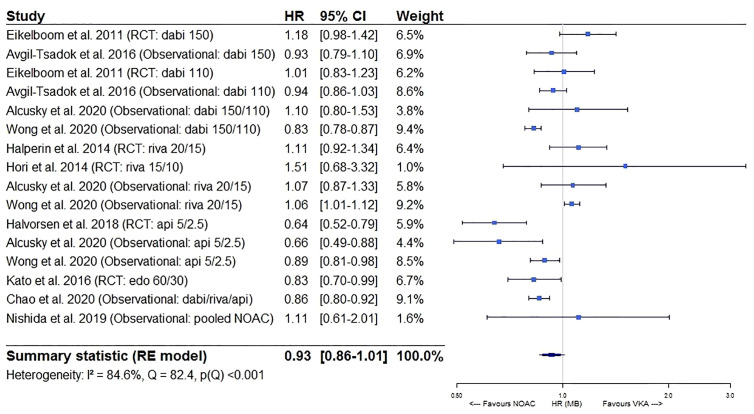
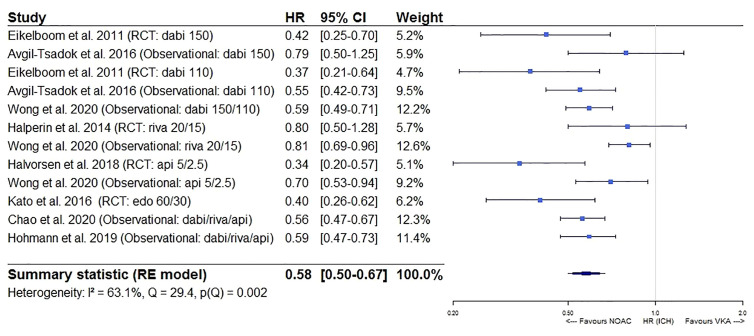
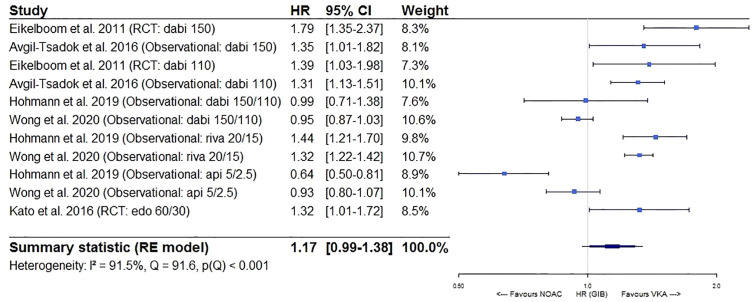
Methods and results: This systematic review provides an overview of the literature on the impact of increased age (≥75 years), multimorbidity, polypharmacy, increased falling risk, frailty and dementia on the effectiveness and safety of NOACs as compared to VKAs, after searching the Medline database. Moreover, a meta-analysis on the impact of increased age ≥75 years old was performed after pooling results from 6 post hoc analyses of RCTs and 6 longitudinal observational cohort studies, highlighting the superior effectiveness (hazard ratio (HR) 0.83, 95% confidence interval (CI) [0.74-0.94] for stroke/SE; HR 0.77, 95%CI [0.65-0.92] for mortality) and non-inferior safety (HR 0.93, 95%CI [0.86-1.01] for major bleeding; HR 0.58, 95%CI [0.50-0.67] for intracranial bleeding; HR 1.17, 95%CI [0.99-1.38] for gastrointestinal bleeding) of NOACs versus VKAs in older AF patients.

Conclusion: Across geriatric subgroups, apixaban was consistently associated with the most favourable benefit-risk profile and should therefore be preferred in geriatric patients with AF. However, research gaps on the impact of increased falling risk, frailty and baseline dementia were identified, requiring careful consideration while awaiting more results.

Keywords: atrial fibrillation; dementia; fall; frailty; increased age; multimorbidity; oral anticoagulant; polypharmacy.


Figures

Figure 1
Figure 1
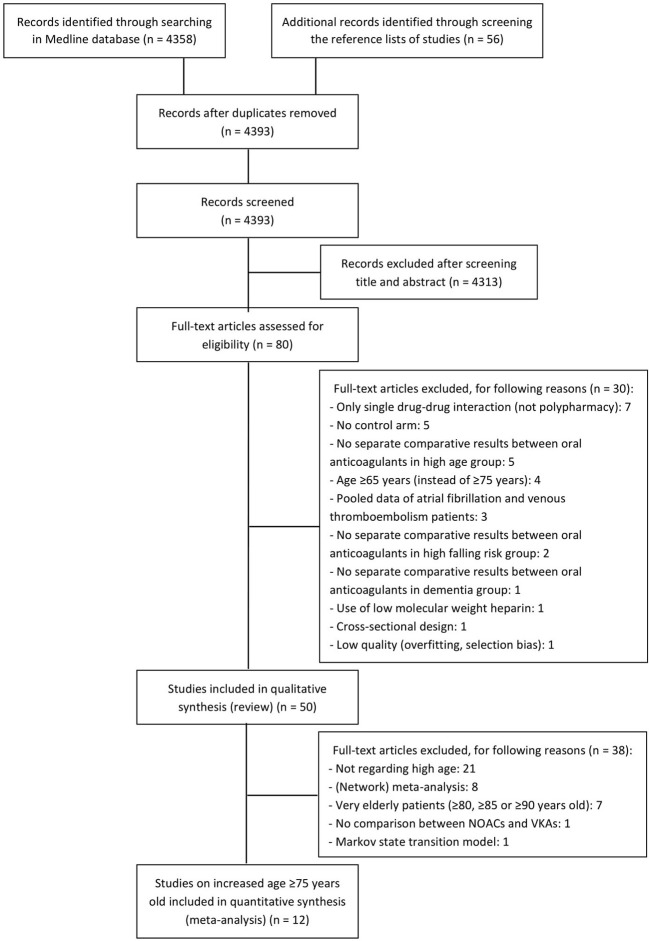
PRISMA flow diagram.
Figure 2
Figure 2
Forest plot of the risk of stroke or systemic embolism of NOACs versus VKAs in elderly atrial fibrillation patients ≥75 years old. Api 5/2.5, apixaban 5 mg (standard dose) and 2.5 mg (reduced dose); CI, confidence interval; Dabi 150, dabigatran 150 mg (standard dose); Dabi 110, dabigatran 110 mg (reduced dose); Edo 60/30, edoxaban 60 mg (standard dose) and 30 mg (reduced dose); HR, hazard ratio; NOAC, non-vitamin K antagonist oral anticoagulant; RCT, randomized controlled trial (post hoc analysis); RE model, random effects model; Riva, rivaroxaban; Riva 20/15, rivaroxaban 20 mg (standard dose) and 15 mg (reduced dose); Riva 15/10, rivaroxaban 15 mg (standard dose) and 10 mg (reduced dose); Stroke/SE, stroke/systemic embolism; VKA, vitamin K antagonist.
Figure 3
Figure 3
Forest plot of the risk of all-cause mortality of NOACs versus VKAs in elderly atrial fibrillation patients ≥75 years old. Api 5/2.5, apixaban 5 mg (standard dose) and 2.5 mg (reduced dose); CI, confidence interval; Dabi 150, dabigatran 150 mg (standard dose); Dabi 110, dabigatran 110 mg (reduced dose); Death, all-cause mortality; HR, hazard ratio; NOAC, non-vitamin K antagonist oral anticoagulant; RCT, randomized controlled trial (post hoc analysis); RE model, random effects model; Riva, rivaroxaban; Riva 20/15, rivaroxaban 20 mg (standard dose) and 15 mg (reduced dose); VKA, vitamin K antagonist.
Figure 4
Figure 4
Forest plot of the risk of major bleeding of NOACs versus VKAs in elderly atrial fibrillation patients ≥75 years old. Api 5/2.5, apixaban 5 mg (standard dose) and 2.5 mg (reduced dose); CI, confidence interval; Dabi 150, dabigatran 150 mg (standard dose); Dabi 110, dabigatran 110 mg (reduced dose); Edo 60/30, edoxaban 60 mg (standard dose) and 30 mg (reduced dose); HR, hazard ratio; MB, major bleeding; NOAC, non-vitamin K antagonist oral anticoagulant; RCT, randomized controlled trial (post hoc analysis); RE model, random effects model; Riva, rivaroxaban; Riva 20/15, rivaroxaban 20 mg (standard dose) and 15 mg (reduced dose); Riva 15/10, rivaroxaban 15 mg (standard dose) and 10 mg (reduced dose); VKA, vitamin K antagonist.
Figure 5
Figure 5
Forest plot of the risk of intracranial bleeding of NOACs versus VKAs in elderly atrial fibrillation patients ≥75 years old. Api 5/2.5, apixaban 5 mg (standard dose) and 2.5 mg (reduced dose); CI, confidence interval; Dabi 150, dabigatran 150 mg (standard dose); Dabi 110, dabigatran 110 mg (reduced dose); Edo 60/30, edoxaban 60 mg (standard dose) and 30 mg (reduced dose); HR, hazard ratio; ICH, intracranial bleeding; NOAC, non-vitamin K antagonist oral anticoagulant; RCT, randomized controlled trial (post hoc analysis); RE model, random effects model; Riva, rivaroxaban; Riva 20/15, rivaroxaban 20 mg (standard dose) and 15 mg (reduced dose); VKA, vitamin K antagonist.
Figure 6
Figure 6
Forest plot of the risk of gastrointestinal bleeding of NOACs versus VKAs in elderly atrial fibrillation patients ≥75 years old. Api 5/2.5, apixaban 5 mg (standard dose) and 2.5 mg (reduced dose); CI, confidence interval; Dabi 150, dabigatran 150 mg (standard dose); Dabi 110, dabigatran 110 mg (reduced dose); Edo 60/30, edoxaban 60 mg (standard dose) and 30 mg (reduced dose); GIB, gastrointestinal bleeding; HR, hazard ratio; NOAC, non-vitamin K antagonist oral anticoagulant; RCT, randomized controlled trial (post hoc analysis); RE model, random effects model; Riva, rivaroxaban; Riva 20/15, rivaroxaban 20 mg (standard dose) and 15 mg (reduced dose); VKA, vitamin K antagonist.

References

    1. Alcusky M., Tjia J., McManus D. D., Hume A. L., Fisher M., Lapane K. L. (2020). Comparative Safety and Effectiveness of Direct-Acting Oral Anticoagulants Versus Warfarin: a National Cohort Study of Nursing Home Residents. J. Gen. Internal Med. 35 (8), 2329–2337. 10.1007/s11606-020-05777-3 - DOI - PMC - PubMed
    1. Alexander K. P., Brouwer M. A., Mulder H., Vinereanu D., Lopes R. D., Proietti M., et al. (2019). Outcomes of apixaban versus warfarin in patients with atrial fibrillation and multi-morbidity: Insights from the ARISTOTLE trial. Am. Heart J. 208, 123–131. 10.1016/j.ahj.2018.09.017 - DOI - PubMed
    1. Arletti L., Coluccio V., Romagnoli E., Luppi M., Marietta M. (2019). Direct oral anticoagulants for atrial fibrillation in patients with congenital factor VII deficiency. Eur. J. Haematology 103 (1), 67–69. 10.1111/ejh.13246 - DOI - PubMed
    1. Avgil-Tsadok M., Jackevicius C. A., Essebag V., Eisenberg M. J., Rahme E., Behlouli H., et al. (2016). Dabigatran use in elderly patients with atrial fibrillation. Thromb. Haemost. 115 (1), 152–160. 10.1160/TH15-03-0247 - DOI - PubMed
    1. Avin K. G., Hanke T. A., Kirk-Sanchez N., McDonough C. M., Shubert T. E., Hardage J., et al. (2015). Management of falls in community-dwelling older adults: clinical guidance statement from the Academy of Geriatric Physical Therapy of the American Physical Therapy Association. Phys. Ther. 95 (6), 815–834. 10.2522/ptj.20140415 - DOI - PMC - PubMed

Publication types