Review
. 2020 Sep 3:11:1070.
doi: 10.3389/fphys.2020.01070. eCollection 2020.

Progress Update and Challenges on V . O2max Testing and Interpretation

Affiliations
Review

Progress Update and Challenges on V . O2max Testing and Interpretation

Marcos Martin-Rincon et al. Front Physiol. .

Abstract

The maximal oxygen uptake ( V . O2max) is the primary determinant of endurance performance in heterogeneous populations and has predictive value for clinical outcomes and all-cause mortality. Accurate and precise measurement of V . O2max requires the adherence to quality control procedures, including combustion testing and the use of standardized incremental exercise protocols with a verification phase preceded by an adequate familiarization. The data averaging strategy employed to calculate the V . O2max from the breath-by-breath data can change the V . O2max value by 4-10%. The lower the number of breaths or smaller the number of seconds included in the averaging block, the higher the calculated V . O2max value with this effect being more prominent in untrained subjects. Smaller averaging strategies in number of breaths or seconds (less than 30 breaths or seconds) facilitate the identification of the plateau phenomenon without reducing the reliability of the measurements. When employing metabolic carts, averaging intervals including 15-20 breaths or seconds are preferable as a compromise between capturing the true V . O2max and identifying the plateau. In training studies, clinical interventions and meta-analysis, reporting of V . O2max in absolute values and inclusion of protocols and the averaging strategies arise as imperative to permit adequate comparisons. Newly developed correction equations can be used to normalize V . O2max to similar averaging strategies. A lack of improvement of V . O2max with training does not mean that the training program has elicited no adaptations, since peak cardiac output and mitochondrial oxidative capacity may be increased without changes in V . O2max.

Keywords: breath-by-breath; calibration; cardiopulmonary exercise testing; indirect calorimetry; metabolic cart; performance; ramp exercise; reproducibility.


Figures

FIGURE 1
FIGURE 1
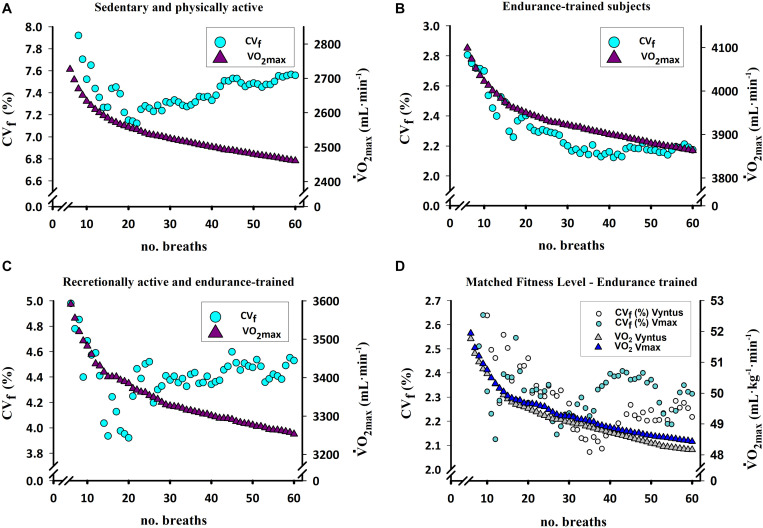
Change in the V.O2max value and its reproducibility in subjects divergent for fitness status using two different automated metabolic carts operated in breath-by-breath mode with different rolling breath-averages. (A) V.O2max response in a heterogeneous group of sedentary and physically active overweight and obese subjects (V.O2max range: 13–40 mL/kg/min) assessed with Vmax N29 Sensormedics (n = 51). (B) V.O2max response in a group of endurance-trained subjects (V.O2max range: 40–60 mL/kg/min) assessed with Vyntus CPX (n = 11). (C) V.O2max response in a group of recreationally active and endurance-trained subjects (V.O2max range: 35–60 mL/kg/min) performing one test with Vmax N29 and a duplicate test with Vyntus CPX in random order (n = 11). (D) V.O2max response assessed with the Vmax N29 and Vyntus metabolic carts in two groups of nine subjects each of similar V.O2max (V.O2max range: 40–60 mL/kg/min) (B). CVf (%), coefficient of variation calculated as proposed by Forkman (2009). Note the clear trend for lower reproducibility and a larger decay of the V.O2max the lower the fitness of the subjects. Modified from Martin-Rincon et al. (2019) with kind permission.
FIGURE 2
FIGURE 2
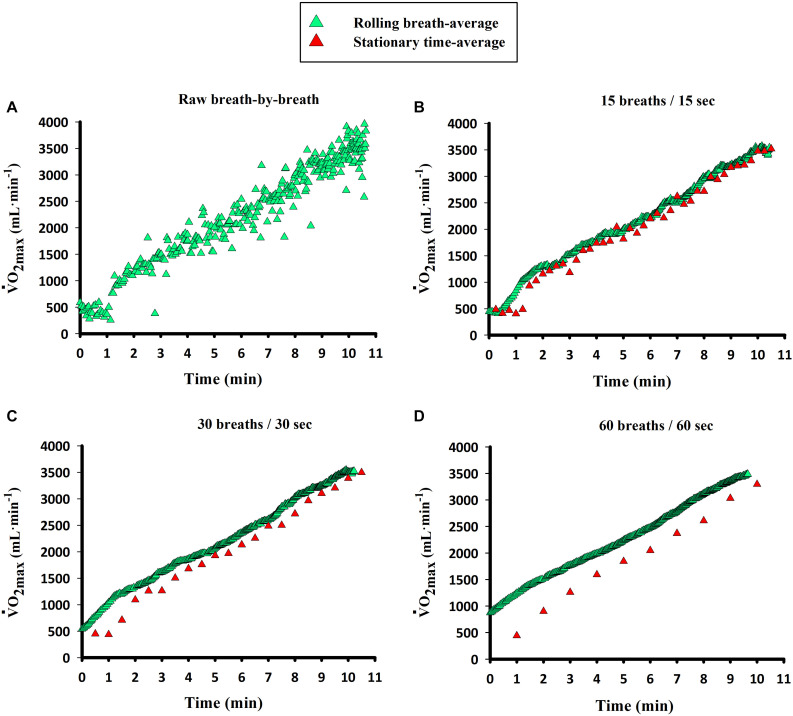
Representative V.O2 data during an incremental exercise to exhaustion in one demonstrative subject using different averaging blocks (breaths and seconds). Calculation of averaging blocks for the breath-based strategy refers to a “rolling” breath average, while time-based data were stationary time-averaged, both with the corresponding length of the block (e.g., 10 breaths or 10 s). Data are presented as (A) raw breath-by-breath, (B) 15 breaths and 15 s, (C) 30 breaths and 30 s, (D) 60 breaths and 60 s. Note the slightly higher values of breath-based averages compared to time-based averages of the same number, although a high concordance (concordance correlation coefficient = CCC > 0.97) is present. Modified from Martin-Rincon et al. (2019) with kind permission.

References

    1. Achten J., Gleeson M., Jeukendrup A. E. (2002). Determination of the exercise intensity that elicits maximal fat oxidation. Med. Sci. Sports Exerc. 34 92–97. 10.1097/00005768-200201000-00015 - DOI - PubMed
    1. Astorino T. A. (2009). Alterations in VO2max and the VO2 plateau with manipulation of sampling interval. Clin. Physiol. Funct. Imaging 29 60–67. 10.1111/j.1475-097X.2008.00835.x - DOI - PubMed
    1. Astrand I. (1960). Aerobic work capacity in men and women with special reference to age. Acta Physiol. Scand. Suppl. 49 1–92. - PubMed
    1. Balke B., Ware R. W. (1959). An experimental study of physical fitness of air force personnel. U.S. Armed Forces Med. J. 10 675–688. - PubMed
    1. Beaver W. L., Lamarra N., Wasserman K. (1981). Breath-by-breath measurement of true alveolar gas exchange. J. Appl. Physiol. 51 1662–1675. 10.1152/jappl.1981.51.6.1662 - DOI - PubMed

LinkOut - more resources