An official website of the United States government
The .gov means it’s official.
Federal government websites often end in .gov or .mil. Before
sharing sensitive information, make sure you’re on a federal
government site.
The site is secure.
The https:// ensures that you are connecting to the
official website and that any information you provide is encrypted
and transmitted securely.
1 Biomedical Research Center, Interamerican Open University (CAECIHS-UAI), National Research Council (CONICET), Buenos Aires, Argentina.
2 Centro de Investigaciones en Psicología y Psicopedagogía (CIPP), Facultad de Psicología y Psicopedagogía, Pontificia Universidad Católica Argentina (UCA), Buenos Aires, Argentina.
3 Instituto Universitario de Ciencias de la Salud, Fundación H.A Barceló, Buenos Aires, Argentina.
4 Department of Biology, John F. Kennedy University, Buenos Aires, Argentina.
5 Facultad de Medicina, Universidad Autónoma de Chile, Santiago, Chile.
6 Faculty of Medical Sciences, Pontificia Universidad Católica Argentina, Buenos Aires, Argentina.
1 Biomedical Research Center, Interamerican Open University (CAECIHS-UAI), National Research Council (CONICET), Buenos Aires, Argentina.
2 Centro de Investigaciones en Psicología y Psicopedagogía (CIPP), Facultad de Psicología y Psicopedagogía, Pontificia Universidad Católica Argentina (UCA), Buenos Aires, Argentina.
3 Instituto Universitario de Ciencias de la Salud, Fundación H.A Barceló, Buenos Aires, Argentina.
4 Department of Biology, John F. Kennedy University, Buenos Aires, Argentina.
5 Facultad de Medicina, Universidad Autónoma de Chile, Santiago, Chile.
6 Faculty of Medical Sciences, Pontificia Universidad Católica Argentina, Buenos Aires, Argentina.
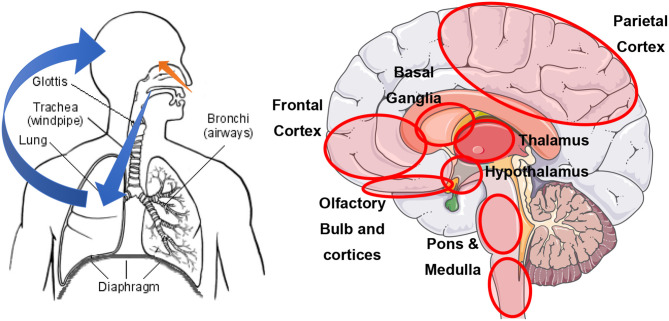
Schematic representation of the most likely routes to neural invasion by SARS-CoV-2. Left:…
Figure 1
Schematic representation of the most likely routes to neural invasion by SARS-CoV-2. Left: orange depicts the olfactory neuroepithelium route; blue depicts the bloodstream route after lung invasion (reproduced from https://sq.wikipedia.org/wiki/Lemza). Right: red circles indicate brain areas with the highest SARS-CoV titers (figure kindly provided by the Servier Medical Art Department). All figures are reproduced under a CC BY-SA license.
Bohmwald K, Galvez NMS, Rios M, Kalergis AM. Neurologic alterations due to respiratory virus infections. Front Cell Neurosci. (2018) 12:386. 10.3389/fncel.2018.00386
-
DOI
-
PMC
-
PubMed
Li YC, Bai WZ, Hashikawa T. The neuroinvasive potential of SARS-CoV2 may play a role in the respiratory failure of COVID-19 patients. J Med Virol. (2020) 92:552–5. 10.1002/jmv.25728
-
DOI
-
PMC
-
PubMed
Moro E, Priori A, Beghi E, Helbok R, Campiglio L, Bassetti CL, et al. The international EAN survey on neurological symptoms in patients with COVID-19 infection. Eur J Neurol. (2020). 10.1111/ene.14407
-
DOI
-
PMC
-
PubMed
Bullen CK, Hogberg HT, Bahadirli-Talbott A, Bishai WR, Hartung T, Keuthan C, et al. Infectability of human BrainSphere neurons suggests neurotropism of SARS-CoV-2. ALTEX. (2020). 10.14573/altex.2006111
-
DOI
-
PubMed
Kanberg N, Ashton NJ, Andersson LM, Yilmaz A, Lindh M, Nilsson S, et al. Neurochemical evidence of astrocytic and neuronal injury commonly found in COVID-19. Neurology. (2020). 10.1212/WNL.0000000000010111
-
DOI
-
PubMed