


Bubble Nasal Continuous Positive Airway Pressure (bNCPAP): An Effective Low-Cost Intervention for Resource-Constrained Settings
- PMID: 33014078
- PMCID: PMC7519183
- DOI: 10.1155/2020/8871980
Bubble Nasal Continuous Positive Airway Pressure (bNCPAP): An Effective Low-Cost Intervention for Resource-Constrained Settings
Abstract
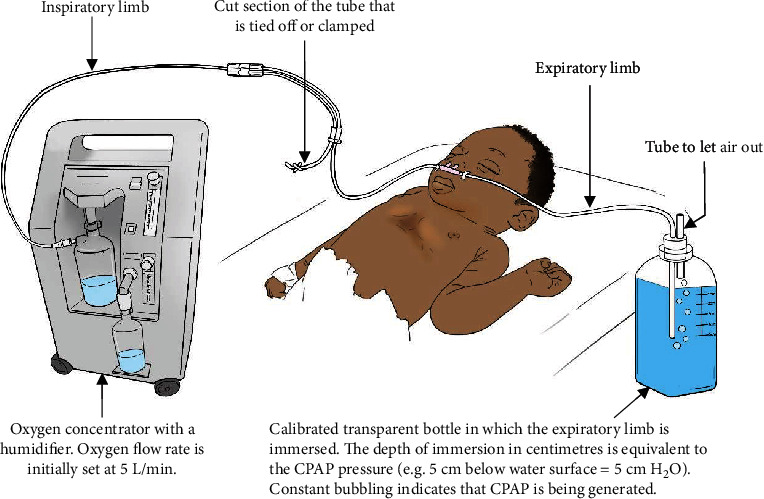
Preterm birth complications are responsible for almost one-third of the global neonatal mortality burden, and respiratory distress syndrome remains the single most common cause of these preventable deaths. Since its inception, almost half a century ago, nasal continuous positive airway pressure (NCPAP) has evolved to become the primary modality for neonatal respiratory care in both the developed and developing world. Although evidence has demonstrated the effectiveness of low-cost bubble NCPAP in reducing newborn mortality, its widespread use is yet to be seen in resource-constrained settings. Moreover, many tertiary hospitals in developing countries still utilise an inexpensive locally assembled bNCPAP system of unknown efficacy and safety. This review provides a brief overview of the history, physiological benefits, indications, contraindications, and complications of bNCPAP. Evidence regarding the effectiveness of low-cost bNCPAP in the neonatal intensive care unit is also summarised. The article further details a locally assembled bNCPAP system used in resource-constrained settings and highlights the care package for neonates receiving bNCPAP, failure criteria, and strategies for weaning.
Copyright © 2020 Walufu Ivan Egesa and William Mugowa Waibi.
Conflict of interest statement
No conflict of interest to disclose.
Figures
References
-
- Blencowe H., Cousens S., Oestergaard M. Z., et al. National, regional, and worldwide estimates of preterm birth rates in the year 2010 with time trends since 1990 for selected countries: a systematic analysis and implications. Lancet. 2012;379(9832):2162–2172. doi: 10.1016/S0140-6736(12)60820-4. - DOI - PubMed
-
- UNICEF. Levels and trends in child mortality report 2019. Estimates developed by the UN Inter-agency Group for child mortality estimation. 2019, http://www.unicef.org/reports/levels-and-trends-child-mortality-report-2019.
Publication types
LinkOut - more resources
Full Text Sources
