


Expert recommendations on the management of patients with metastatic castration-resistant prostate cancer who progress after CHAARTED or LATITUDE
- PMID: 33014145
- PMCID: PMC7517999
- DOI: 10.1177/1758835920920067
Expert recommendations on the management of patients with metastatic castration-resistant prostate cancer who progress after CHAARTED or LATITUDE
Abstract
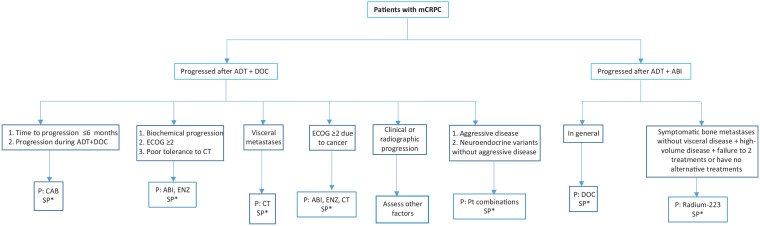
Objective: Our aim was to provide practical recommendations on the management of patients with metastatic castration-resistant prostate cancer (mCRPC) who have progressed after docetaxel plus androgen-deprivation therapy (ADT) or abiraterone plus ADT.
Methods: Systematic literature review (SLR), nominal group meeting, and Delphi process. A panel of 12 experts was established who defined the scope, users, and sections of the document. We performed an SLR in order to assess the efficacy and safety of available drugs in patients with mCRPC. Abstracts from the American Society of Oncology and European Society for Medical Oncology meetings were also examined. The results were discussed during an expert meeting in which 14 recommendations were generated. The level of agreement with the recommendations was also tested by 13 additional experts following the Delphi process. Recommendations were voted by means of scores ranging from 0 (total disagreement) to 10 (total agreement). We defined agreement when at least 70% of the experts voted ⩾7. Next, we assigned a level of evidence and grade to the recommendation using the Oxford Centre for Evidence-based Medicine Levels of Evidence, following which the final document was drafted.
Results: The literature search did not find any articles meeting the inclusion criteria. Finally, 13 out of 14 recommendations were accepted after two Delphi rounds (two were modified after the first round). They pertain to general and individual case-based treatment recommendations.
Conclusions: In mCRPC patients who have progressed after docetaxel or abiraterone plus ADT in the metastatic hormone-sensitive prostate cancer setting, these recommendations may support treatment decision-making, due to the lack of evidence or other globally accepted sequencing algorithms.
Keywords: abiraterone acetate; androgen-deprivation therapy; chemotherapy; enzalutamide; metastatic castration-resistant prostate cancer; radium-223.
© The Author(s), 2020.
Conflict of interest statement
Conflict of interest statement: Javier Puente has received honoraria as consultant on advisory boards from Pfizer, Astellas, Janssen, MSD, Bayer, Roche, BMS, Boehringer, Astra Zeneca, Ipsen, Novartis, Eusa Pharma, Eisai and Sanofi; and as speaker from Kyowa, Celgene, Lilly and Merck; Aranzazu González del Alba has received honoraria for advisory boards, consultancy, speaker and for travel support from Pierre Fabre, Roche, Bristol-Myers Squibb, MSD, Pfizer, Novartis, Bayer, Janssen, Sanofi, Astellas, EUSA pharma, Ipsen, EISAI and Astra-Zeneca; Pablo Maroto has received honoraria for consulting or advisory role from Sanofi, Janssen, Astellas, and Bayer. Urbano Anido has received honoraria from Pfizer, Novartis, Bayer, Bristol-Myers Squibb, EUSA Pharma, and Eisai; Nuria Lainez has received honoraria for consulting or advisory role from Pfizer, Sanofi, Ipsen, BMS, Roche, and Astra Zéneca. The rest of authors declare no conflicts of interest.
Figures
References
-
- Fizazi K, Scher HI, Molina A, et al. Abiraterone acetate for treatment of metastatic castration-resistant prostate cancer: final overall survival analysis of the COU-AA-301 randomised, double-blind, placebo-controlled phase 3 study. Lancet Oncol 2012; 13: 983–992. - PubMed
LinkOut - more resources
Full Text Sources
