


Antidepressant drug use in glioblastoma patients: an epidemiological view
- PMID: 33014392
- PMCID: PMC7516105
- DOI: 10.1093/nop/npaa022
Antidepressant drug use in glioblastoma patients: an epidemiological view
Abstract
Background: Antidepressant drugs have shown antitumor activity in preclinical glioblastoma studies. Antidepressant drug use, as well as its association with survival, in glioblastoma patients has not been well characterized on a population level.
Methods: Patient characteristics, including the frequency of antidepressant drug use, were assessed in a glioblastoma cohort diagnosed in a 10-year time frame between 2005 and 2014 in the Canton of Zurich, Switzerland. Cox proportional hazards regression models were applied for multivariate analysis. Kaplan-Meier survival curves were used to estimate overall survival (OS) data and the log-rank test was performed for comparisons.
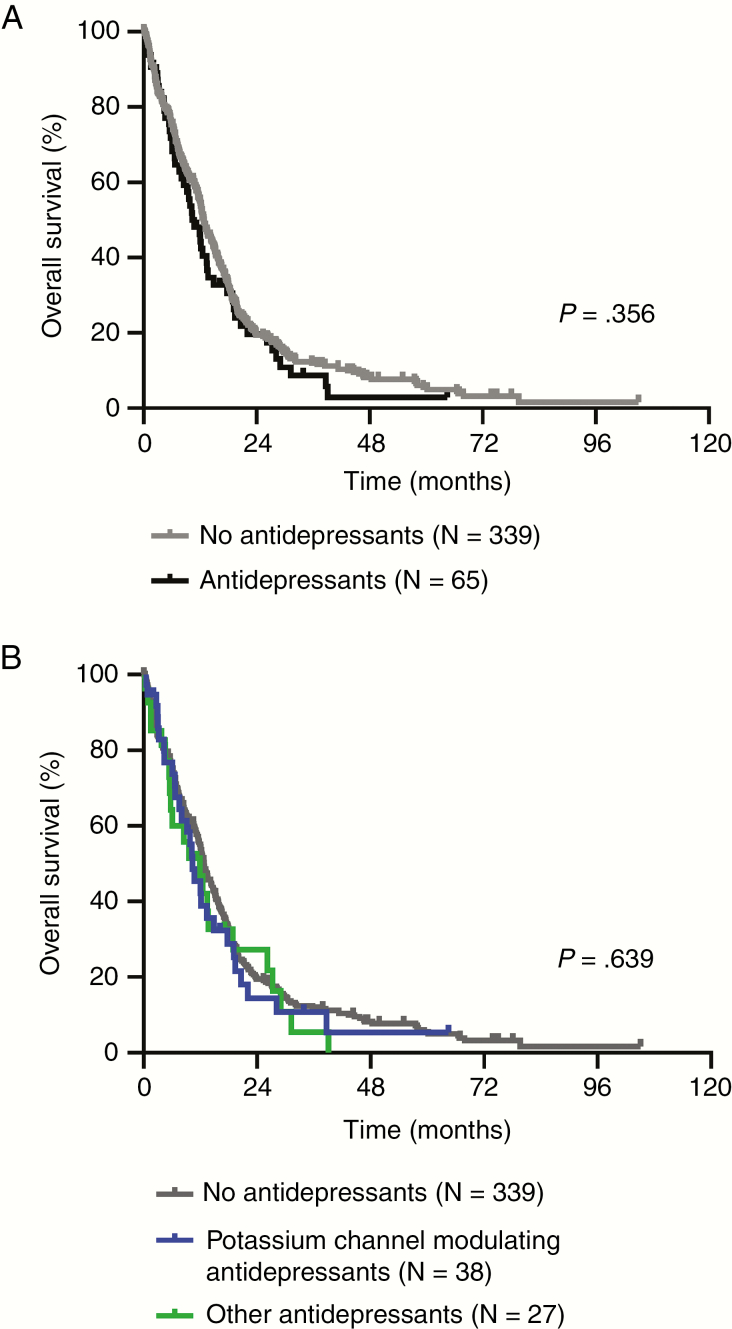
Results: A total of 404 patients with isocitrate dehydrogenase wild-type glioblastoma were included in this study. Sixty-five patients (16.1%) took antidepressant drugs at some point during the disease course. Patients were most commonly prescribed selective serotonin reuptake inhibitors at any time (N = 46, 70.8%). Nineteen patients (29.2%) were on antidepressant drugs at the time of their tumor diagnosis. No differences were observed in OS between those patients who had taken antidepressants at some point in their disease course and those who had not (P = .356). These data were confirmed in a multivariate analysis including age, Karnofsky Performance Scale (KPS), sex, extent of resection, O6-methylguanine DNA methyltransferase (MGMT) promoter methylation status, and first-line treatment as cofounders (P = .315). Also, there was no association of use of drugs modulating voltage-dependent potassium channels (citalopram; escitalopram) with survival (P = .639).
Conclusions: This signal-seeking study does not support the hypothesis that antidepressants have antitumor efficacy in glioblastoma on a population level.
Keywords: antidepressants; depression; epidemiology; glioblastoma; survival.
© The Author(s) 2020. Published by Oxford University Press on behalf of the Society for Neuro-Oncology and the European Association of Neuro-Oncology. All rights reserved. For permissions, please e-mail: journals.permissions@oup.com.
Figures
References
-
- Weller M, van den Bent M, Tonn JC, et al. ; European Association for Neuro-Oncology (EANO) Task Force on Gliomas European Association for Neuro-Oncology (EANO) guideline on the diagnosis and treatment of adult astrocytic and oligodendroglial gliomas. Lancet Oncol. 2017;18(6):e315–e329. - PubMed
-
- Gramatzki D, Dehler S, Rushing EJ, et al. Glioblastoma in the Canton of Zurich, Switzerland revisited: 2005 to 2009. Cancer. 2016;122(14):2206–2215. - PubMed
-
- Gramatzki D, Roth P, Rushing EJ, et al. Bevacizumab may improve quality of life, but not overall survival in glioblastoma: an epidemiological study. Ann Oncol. 2018;29(6):1431–1436. - PubMed
LinkOut - more resources
Full Text Sources
Research Materials
