


Infrapatellar Fat Pad and Knee Osteoarthritis
- PMID: 33014539
- PMCID: PMC7505265
- DOI: 10.14336/AD.2019.1116
Infrapatellar Fat Pad and Knee Osteoarthritis
Abstract
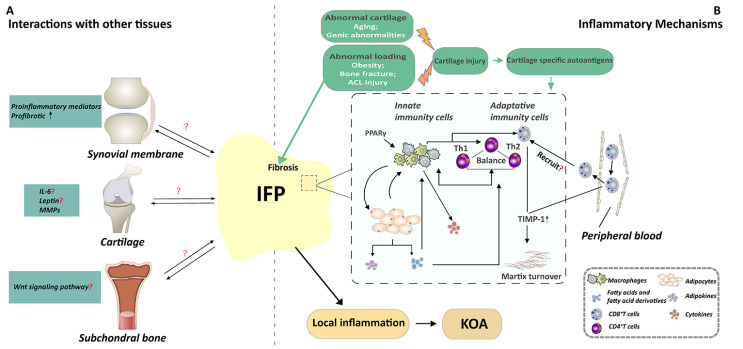
Osteoarthritis is the most prevalent arthritis typically characterized by degradation of cartilage. However, its pathogenesis is not fully understood. Currently, osteoarthritis is best considered a disease of the whole "joint organ". Infrapatellar fat pad (IFP), an adipose tissue near synovium, is now attaching importance to researchers for its inflammatory phenotype. In this narrative review, a large body of evidence has been gathered for the involvement of IFP in the development of knee osteoarthritis. Additionally, the underlying mechanisms of how IFP can be involved in this process have been proposed. However, further investigations are needed to better understand its precise role in this process and its underlying mechanism, and beyond that, to develop new strategies to slow down the degenerative process and explore an effective and timely diagnosis of the disease.
Keywords: crosstalk; infrapatellar fat pad; knee osteoarthritis; local inflammation.
copyright: © 2020 Zeng et al.
Conflict of interest statement
Competing interests The authors declare that they have no competing interests.
Figures
References
-
- Favero M, El-Hadi H, Belluzzi E, Granzotto M, Porzionato A, Sarasin G, et al. (2017). Infrapatellar fat pad features in osteoarthritis: a histopathological and molecular study. Rheumatology (Oxford), 56:1784-1793. - PubMed
-
- Pan F, Han W, Wang X, Liu Z, Jin X, Antony B, et al. (2015). A longitudinal study of the association between infrapatellar fat pad maximal area and changes in knee symptoms and structure in older adults. Ann Rheum Dis, 74:1818-1824. - PubMed
-
- Bos SD, Slagboom PE, Meulenbelt I (2008). New insights into osteoarthritis: early developmental features of an ageing-related disease. Curr Opin Rheumatol, 20:553-559. - PubMed
-
- Zhu Z, Otahal P, Wang B, Jin X, Laslett LL, Wluka AE, et al. (2017). Cross-sectional and longitudinal associations between serum inflammatory cytokines and knee bone marrow lesions in patients with knee osteoarthritis. Osteoarthritis Cartilage, 25:499-505. - PubMed
Publication types
LinkOut - more resources
Full Text Sources