Case Reports
. 2020 Sep 2:10:1625.
doi: 10.3389/fonc.2020.01625. eCollection 2020.

Anti-PD-1 Immunotherapy Combined With Stereotactic Body Radiation Therapy and GM-CSF as Salvage Therapy in a PD-L1-Negative Patient With Refractory Metastatic Esophageal Squamous Cell Carcinoma: A Case Report and Literature Review

Affiliations
Case Reports

Anti-PD-1 Immunotherapy Combined With Stereotactic Body Radiation Therapy and GM-CSF as Salvage Therapy in a PD-L1-Negative Patient With Refractory Metastatic Esophageal Squamous Cell Carcinoma: A Case Report and Literature Review

Xiangrong Zhao et al. Front Oncol. .

Abstract

Esophageal squamous cell carcinoma (ESCC) is a malignancy with poor prognosis, which is often diagnosed at a late stage. Effective treatment options are limited when patients fail standard systemic therapy. The application of PD-1 inhibitors have led to a paradigm shift in the treatment of ESCC, but its efficacy as monotherapy is limited. Previous studies have shown that the antitumor effects may be reinforced when a PD-1 inhibitor is combined with radiotherapy or GM-CSF. This study aimed to report a case of a patient about advanced unresectable ESCC negative expression of PD-L1, who experienced tumor progression after chemoradiotherapy and targeted therapy.A significant systemic effect was seen after PD-1 inhibitor combined with GM-CSF and stereotactic body radiotherapy (SBRT) for metastatic lesions, however, severe pneumonia occurred after the triple-combination therapy. This study also reviewed several reports about the efficacy and safety of combination therapy.

Keywords: GM-CSF; PD-L1; esophageal squamous cell carcinoma; immunotherapy; radiotherapy.


Figures

Figure 1
Figure 1
Timeline of five cycles treatment for the patient and the whole treatment process. Dx indicates diagnosis. PR, Partial Response; PD, Progressive Disease. (A) The patient received the PD-1 inhibitor on the first day and then was treated with SBRT (3 doses of 8 Gy, daily) for one metastatic lesion in the right lung. On the second day after SBRT, GM-CSF 200 μg daily was subcutaneously injected for 2 weeks. This course was repeated every 3 weeks and three courses of triple-combination therapy were administrated in total. Then the patient continued to receive two cycles of sintilimab (200 mg/q3w) after triple-combination therapy. (B) The patient experienced tumor progression after chemoradiotherapy and targeted therapy. After three cycles of triple-combination therapy and two cycles of sintilimab, the patient's progression-free survival period reached 4 months and eventually died of respiratory failure.
Figure 2
Figure 2
Chest CT scans before and after three cycles of triple-combination therapy and two cycles of sintilimab treatment. (A–D) CT revealed that the irradiated right lung lesions shrunk or even disappeared. The arrow in A is the first lesion of the right lung SBRT. The arrow in (B,C) are the second lesions of the right lung SBRT. The arrow in (D) is the third lesion of the right lung SBRT. (E,F) The unirradiated metastatic lesion of the lung was significantly smaller than that before treatment. (G) After five cycles of treatment, the CT scan showed that the unirradiated lesions in right lung had disappeared.
Figure 3
Figure 3
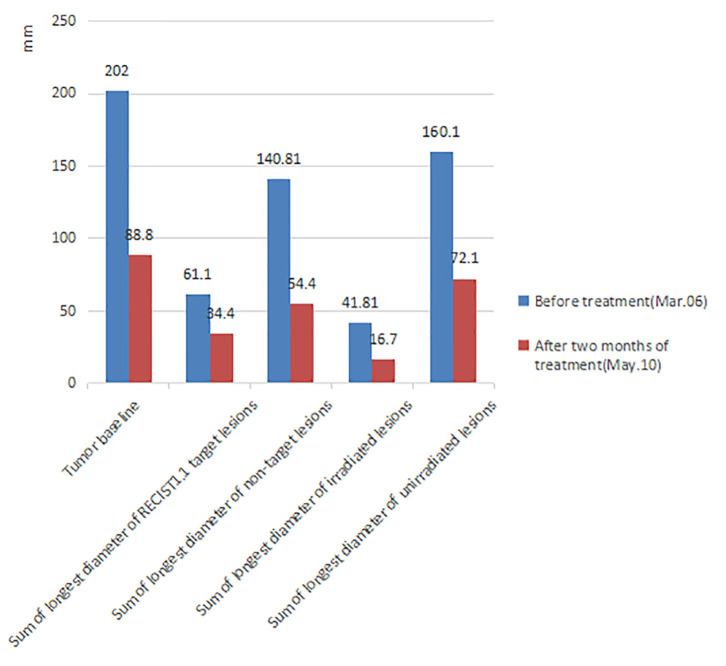
Comparison of tumor burden before treatment and after 2 months of triple-combination therapy. After 2 months of treatment, the patient's tumor burden significantly reduced (The tumor volume data was measured by two doctors, the measurement error of each lesion is <2 mm and we finally took the average value). Tumor baseline: Sum of longest diameter of all measurable lesions. RECIST1.1 Target lesions: According to the standard of RECIST1.1, each organ can select at most two lesions as target lesions, so we randomly selected two lung metastatic lesions as target lesions before treatment. Non-target lesions: All measurable metastatic lesions except target lesions. Irradiated lesions: All the SBRT lesions. Considering that the regression of the lesion after radiotherapy will affect the real curative effect, the target lesions is not selected as the SBRT lesions. Unirradiated lesions: All measurable metastatic lesions except SBRT lesions.
Figure 4
Figure 4
CT comparison of the patient's lung inflammation during anti-infective treatment. (A) After three cycles of triple-combination therapy and two cycles of sintilimab monotherapy, chest computed tomography showed inflammatory changes in the lungs and partial lung consolidation. (B,C) The chest CT showed that pulmonary infiltration was absorbed after taking a sufficient amount of steroids and antibiotics. (D) The patient had a “flare” of pneumonitis symptoms when quickly tapered off steroids.

References

    1. Fitzmaurice C, Abate D, Abbasi N, Abbastabar H, Abd-Allah F, Abdel-Rahman O, et al. Global, Regional, and National Cancer incidence, mortality, years of life lost, years lived with disability, and disability-adjusted life-years for 29 cancer groups, 1990 to 2017: a systematic analysis for the global Burden of Disease Study. JAMA Oncol. (2019) 5:1749–68. 10.1001/jamaoncol.2019.2996 - DOI - PMC - PubMed
    1. Prithviraj GK, Baksh K, Fulp W, Meredith K, Hoffe S, Shridhar R, et al. Carboplatin and paclitaxel as first-line treatment of unresectable or metastatic esophageal or gastric cancer. Dis Esophagus. (2015) 28:782–7. 10.1111/dote.12279 - DOI - PubMed
    1. Liu Y, Ren Z, Yuan L, Xu S, Yao Z, Qiao L, et al. Paclitaxel plus cisplatin vs. 5-fluorouracil plus cisplatin as first-line treatment for patients with advanced squamous cell esophageal cancer. Am J Cancer Res. (2016) 6:2345–50. - PMC - PubMed
    1. Hiramoto S, Kato K, Shoji H, Okita N, Takashima A, Honma Y, et al. A retrospective analysis of 5-fluorouracil plus cisplatin as first-line chemotherapy in the recent treatment strategy for patients with metastatic or recurrent esophageal squamous cell carcinoma. Int J Clin Oncol. (2018) 23:466–72. 10.1007/s10147-018-1239-x - DOI - PubMed
    1. Li J, Wang L. Efficacy and safety of apatinib treatment for advanced esophageal squamous cell carcinoma. Onco Targets Ther. (2017) 10:3965–9. 10.2147/OTT.S132756 - DOI - PMC - PubMed

Publication types