


Predictors Associated With Knowledge and Practice of Helminthic Infection Prevention Among Rural School-Aged Children's Parents in Bangladesh: A Cross-Sectional Study
- PMID: 33014978
- PMCID: PMC7498543
- DOI: 10.3389/fpubh.2020.00484
Predictors Associated With Knowledge and Practice of Helminthic Infection Prevention Among Rural School-Aged Children's Parents in Bangladesh: A Cross-Sectional Study
Abstract
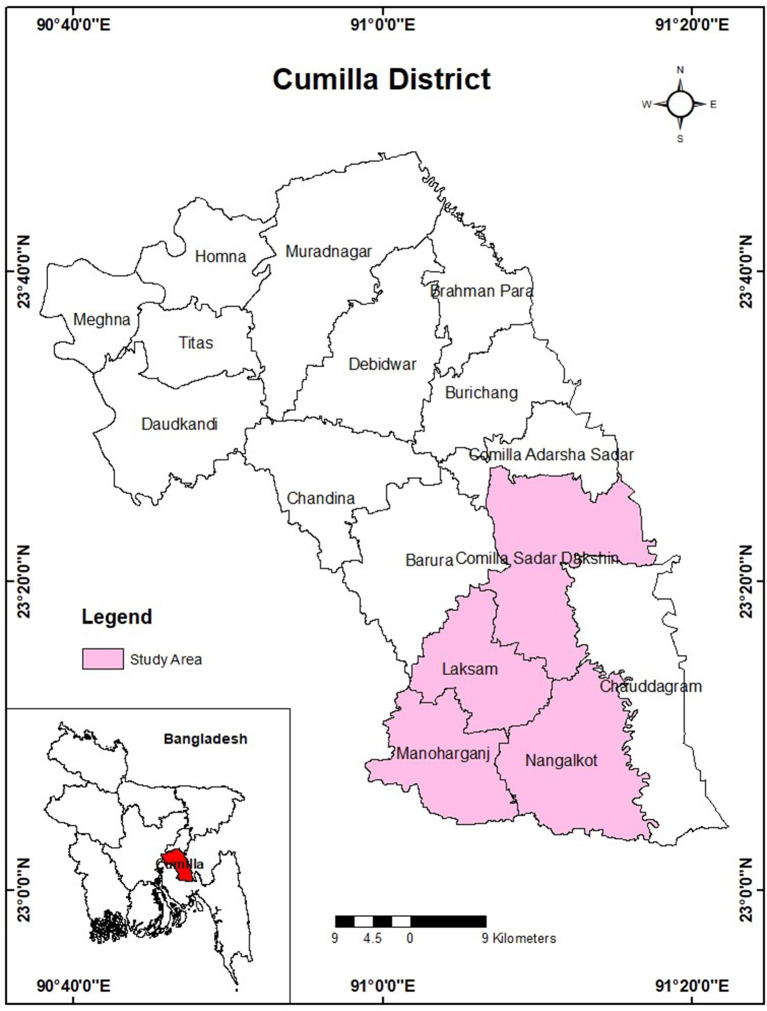
Background: Parasitic infection has become a major public health concern in light of its increasing prevalence in developing countries, particularly in rural settings. Helminthic infections disproportionately affect children, and therefore appropriate parental knowledge and practical approaches to transmission prevention are essential. The objective of this study was to evaluate the level of knowledge and implementation measures aimed at preventing helminthic infection among rural school-aged children's parents in Bangladesh. Methods: A cross-sectional survey was conducted among the parents of 449 rural school-aged children residing in 17 villages of the Cumilla district in Bangladesh. Participants completed the survey examining socio-demographic variables as well as questions regarding knowledge and practice of helminthic infection prevention (HIP). Results: Local knowledge about children's HIP was inadequate among their parents (81.5%). Furthermore, actual implementation of HIP measures was poor (42.1%). Knowledge of HIP was significantly associated with parental religion, education, occupation, number of family members, family income, housing conditions, and sanitation system. In addition, practice of HIP was significantly associated with the aforementioned factors, as well as with water source and knowledge of HIP. Conclusion: Lack of concern about parasitic infection among children's parents and their untoward effects on children's health is pervasive in rural parental settings, along with ignorance on helminthic transmission and its prevention. Public education programs aimed at addressing these glaring HIP awareness deficits are needed in Bangladesh.
Keywords: Bangladesh; helminths; infection prevention; rural area; school-age children.
Copyright © 2020 Sujan, Islam, Naher, Banik and Gozal.
References
-
- Karagiannis-Voules DA, Biedermann P, Ekpo UF, Garba A, Langer E, Mathieu E, et al. Spatial and temporal distribution of soil-transmitted helminth infection in sub-Saharan Africa: a systematic review and geostatistical meta-analysis. Lancet Infect Dis. (2015) 15:74–84. 10.1016/S1473-3099(14)71004-7 - DOI - PubMed
-
- World Health Organization Soil-Transmitted Helminth Infections. (2020). Retrieved from: https://www.who.int/news-room/fact-sheets/detail/soil-transmitted-helmin... (accessed July 15, 2020).
-
- Mukutmoni M, Khanum H. Prevalence and risk factors of intestinal Helminthiasis among the children of Begun Bari slum, Tejgaon, Dhaka. Bangladesh J Zool. (2018) 45:123–9. 10.3329/bjz.v45i2.35707 - DOI
-
- Nath TC, Padmawati RS, Alam MS, Das S, Murhandarwati EH. Elimination of soil-transmitted helminthiasis infection in Bangladesh: knowledge, attitudes, and practices regarding mass drug administration. J Glob Health. (2018) 2:e2018017 10.29392/joghr.2.e2018017 - DOI
MeSH terms
LinkOut - more resources
Full Text Sources
