. 2020 Sep 9:7:138.
doi: 10.3389/fnut.2020.00138. eCollection 2020.

The Impact of Individualizing Sodium Bicarbonate Supplementation Strategies on World-Class Rowing Performance

Affiliations

The Impact of Individualizing Sodium Bicarbonate Supplementation Strategies on World-Class Rowing Performance

Susan Boegman et al. Front Nutr. .

Abstract

Contemporary meta-analyses have generally demonstrated a positive effect of sodium bicarbonate (NaHCO3) supplementation on exercise performance. However, despite these claims, there is limited data on contrasting individualized and standardized timing of NaHCO3 ingestion prior to exercise to further enhance performance outcomes. Purpose: To determine whether NaHCO3 ingestion timing impacts 2,000-m rowing time-trial (TT) performance in elite-level rowers (Senior National team including Olympic/World Championships level) adhering to their own individualized pre-race strategies (e.g. nutrition, warm-up, etc.). Methods: Twenty three (n = 23) rowers across two research centers (using the exact same methods/protocols) completed three trials: NaHCO3 loading profile at rest to determine the individual's time-to-peak bicarbonate concentration [ HCO 3 - ], followed by two randomized 0.3 g·kgBM-1 NaHCO3 supplementation experimental trials conducted at different time points [consensus timing (CON): TT performed 60 min post-NaHCO3 ingestion; and individualized peak (IP): TT performed at the rower's individual peak [ HCO 3 - ] determined from the profiling trial post-NaHCO3 ingestion]. Results: There was a significant mean difference of +2.9 [± 0.4 mmol·L-1 HCO 3 - for IP vs. CON (95% CI 2.0 to 3.8 mmol·L-1); p = 0.02; d = 1.08] at pre warm-up, but not immediately prior to the TT (post warm-up). Performance times were significantly different between IP (367.0 ± 10.5 s) vs. CON (369.0 ± 10.3 s); p = 0.007; d = 0.15). Conclusions: The present study demonstrated a small but significant performance effect of an individualized NaHCO3 ingestion strategy. Similarities after warm-up between pre-TT sHCO 3 - values (CON ~ + 5.5 mmol·L-1; IP ~ + 6 mmol·L-1), however, would suggest this effect was not a result of any meaningful differences in blood alkalinity.

Keywords: elite athletes; individualized nutrition; performance; sodium bicarbonate ingestion; time trial performance.


Figures

Figure 1
Figure 1
Study overview.
Figure 2
Figure 2
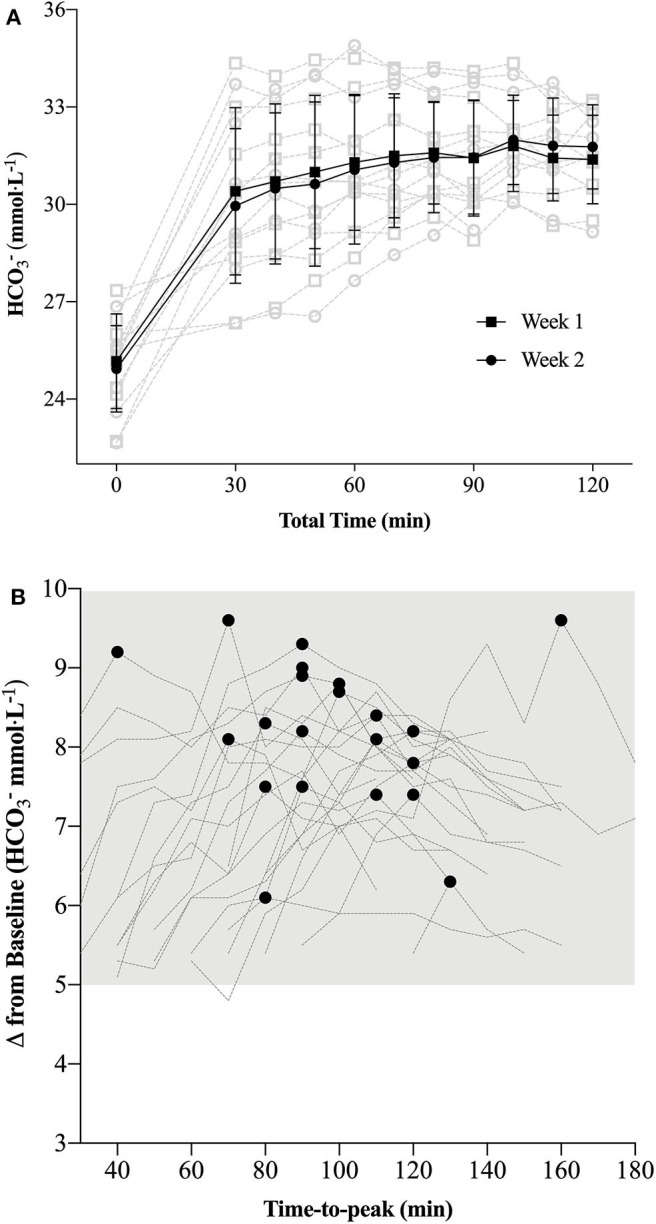
(A) Week-to-week standard bicarbonate concentrations ([sHCO3-]) (mean ± SD: black; individual data: light gray) observed during the pilot study [n = 8; (A)]; (B): Individual (n = 23) participant measurements of peak and corresponding time-to-peak as observed during the Individualized NaHCO3 Loading Profile trial. Each individual's time-to-peak was subsequently used to demarcate the time frame prior to commencing the time trial (TT) in the Individualized Peak (IP) trial.
Figure 3
Figure 3
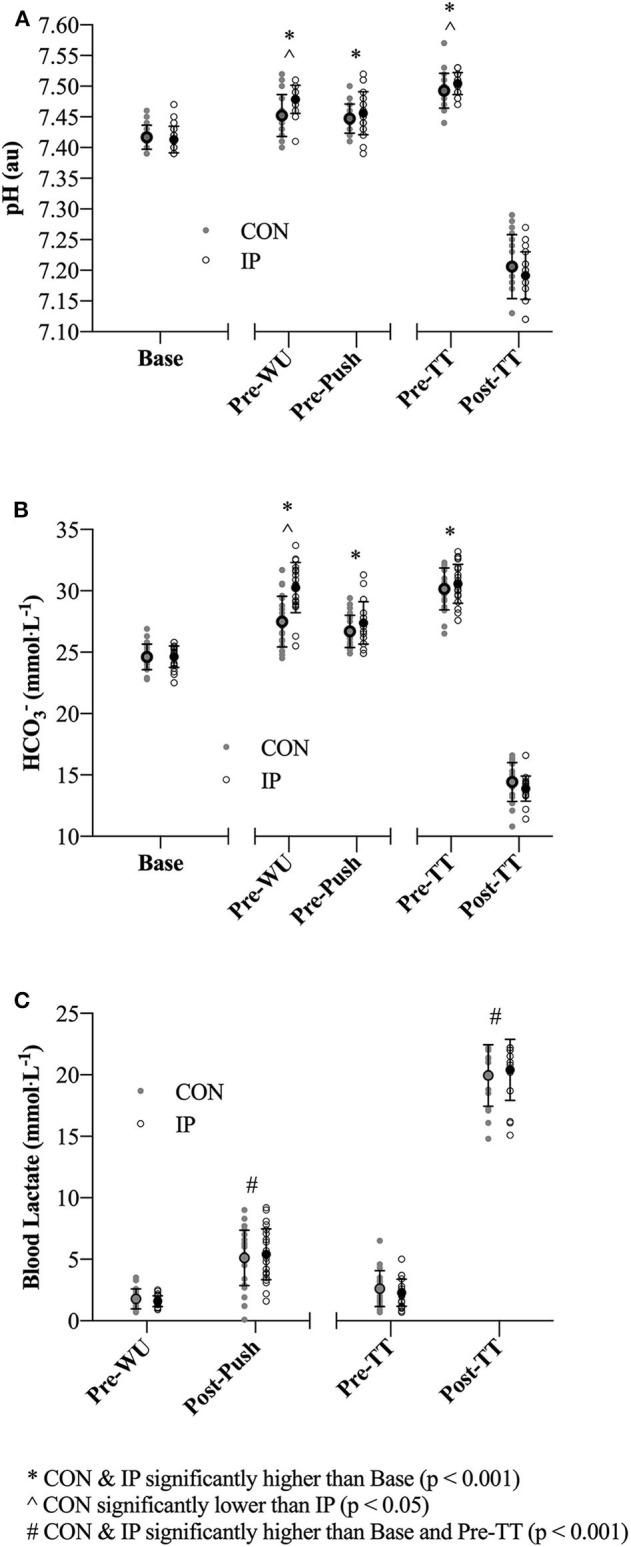
(A–C) Blood acid-base and lactate (BLa) measurements obtained at baseline (Base; with the exception of BLa), pre-warm-up (Pre-WU), 1 min post lactate push (Post-Push), pre time trial (Pre-TT) and 1 min post completion of the TT (Post-TT). Individual and mean ± SD data are presented for both the consensus standard (CON; gray dots) and individualized peak (IP; open black circles) trials.
Figure 4
Figure 4
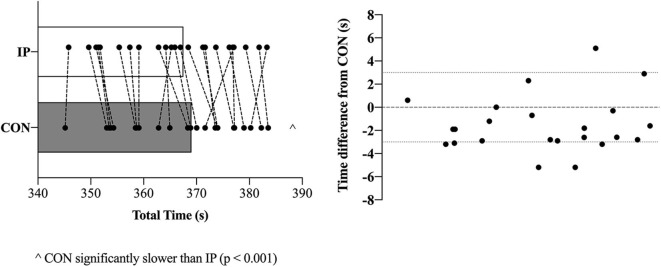
Two thousand-metres rowing time trial (TT) performance times in seconds (individual and mean ± SD data) for both the consensus standard (CON; gray bar) and individualized peak (IP; open black border) trials (left). Individual time differences (+ or – in (s) from CON) are presented in the figure on the right.
Figure 5
Figure 5
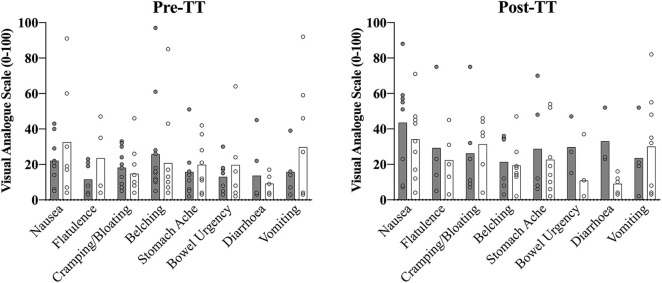
Summed descriptive (individual and mean ± SD) symptom data collated from the GI questionnaire (0–100 point visual analog scale) prior to the start of the 2,000-m TT (Pre-TT) and upon completion (Post-TT) for both the consensus standard (CON; gray bar) and individualized peak (IP; open black border) trials.

References

    1. Maughan RJ, Burke LM, Dvorak J, Larson-Meyer DE, Peeling P, Phillips SM, et al. . IOC consensus statement: dietary supplements and the high-performance athlete. Br J Sports Med. (2018) 52:439–55. 10.1136/bjsports-2018-099027 - DOI - PMC - PubMed
    1. Carr AJ, Hopkins WG, Gore CJ. Effects of acute alkalosis and acidosis on performance: a meta-analysis. Sports Med. (2011) 41:801–14. 10.2165/11591440-000000000-00000 - DOI - PubMed
    1. Hadzic M, Eckstein ML, Schugardt M. The impact of sodium bicarbonate on performance in response to exercise duration in athletes: a systematic review. J Sports Sci Med. (2019) 18:271–281. - PMC - PubMed
    1. Lopes-Silva JP, Reale R, Franchini E. Acute and chronic effect of sodium bicarbonate ingestion on Wingate test performance: a systematic review and meta-analysis. J Sports Sci. (2019) 37:762–71. 10.1080/02640414.2018.1524739 - DOI - PubMed
    1. Peart DJ, Siegler JC, Vince RV. Practical recommendations for coaches and athletes: a meta-analysis of sodium bicarbonate use for athletic performance. J Strength Cond Res. (2012) 26:1975–83. 10.1519/JSC.0b013e3182576f3d - DOI - PubMed

LinkOut - more resources