


Pre- and Post-harvest Factors Affecting Glucosinolate Content in Broccoli
- PMID: 33015121
- PMCID: PMC7511755
- DOI: 10.3389/fnut.2020.00147
Pre- and Post-harvest Factors Affecting Glucosinolate Content in Broccoli
Abstract
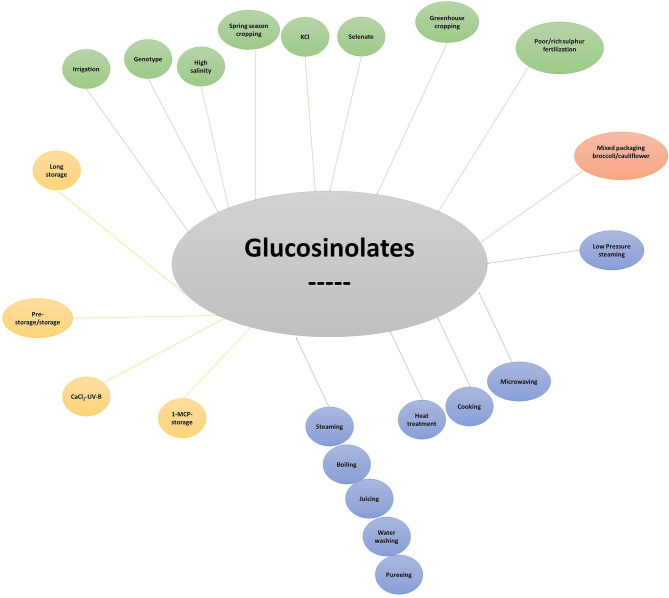
Owing to several presumed health-promoting biological activities, increased attention is being given to natural plant chemicals, especially those frequently entering the human diet. Glucosinolates (GLs) are the main bioactive compounds found in broccoli (Brassica oleracea L. var. italica Plenck). Their regular dietary assumption has been correlated with reduced risk of various types of neoplasms (lung, colon, pancreatic, breast, bladder, and prostate cancers), some degenerative diseases, such as Alzheimer's, and decreased incidence of cardiovascular pathologies. GL's synthesis pathway and regulation mechanism have been elucidated mainly in Arabidopsis. However, nearly 56 putative genes have been identified as involved in the B. oleracea GL pathway. It is widely recognized that there are several pre-harvest (genotype, growing environment, cultural practices, ripening stage, etc.) and post-harvest (harvesting, post-harvest treatments, packaging, storage, etc.) factors that affect GL synthesis, profiles, and levels in broccoli. Understanding how these factors act and interact in driving GL accumulation in the edible parts is essential for developing new broccoli cultivars with improved health-promoting bioactivity. In this regard, any systematic and comprehensive review outlining the effects of pre- and post-harvest factors on the accumulation of GLs in broccoli is not yet available. Thus, the goal of this paper is to fill this gap by giving a synoptic overview of the most relevant and recent literature. The existence of substantial cultivar-to-cultivar variation in GL content in response to pre-harvest factors and post-harvest manipulations has been highlighted and discussed. The paper also stresses the need for adapting particular pre- and post-harvest procedures for each particular genotype in order to maintain nutritious, fresh-like quality throughout the broccoli value chain.
Keywords: Brassica oleracea L var. italica; aliphatic; biosynthetic pathways; broccoli; indole and aromatic glucosinolates; pre-harvest and post-harvest management.
Copyright © 2020 Ilahy, Tlili, Pék, Montefusco, Siddiqui, Homa, Hdider, R'Him, Lajos and Lenucci.
Figures
References
-
- Gad N, Abd El-Moez MR. Broccoli growth, yield quantity and quality as affected by cobalt nutrition. Agric Biol J N Am. (2011) 2:226–31. 10.5251/abjna.2011.2.2.226.231 - DOI
-
- Maggioni L, von Bothmer R, Poulsen G, Lipman E. Domestication, diversity and use of Brassica oleracea L., based on ancient Greek and Latin texts. Genet Resour Crop Evol. (2018) 65:137–59. 10.1007/s10722-017-0516-2 - DOI
-
- Díaz-Pérez JC. Root zone temperature, plant growth and yield of broccoli [Brassica oleracea (Plenck) var. italica] as affected by plastic film mulches. Sci Hort. (2009) 123:156–63. 10.1016/j.scienta.2009.08.014 - DOI
-
- Nooprom K, Santipracha Q. Growth and yield of broccoli planted year round in Songkhla province, Thailand. AJABS. (2014) 7:4157–61. 10.19026/rjaset.7.781 - DOI
-
- Kałuzewicz A, Krzesiński W, Knaflewski M, Lisiecka J, Spizewski T, Fraszczak B. Effect of temperature on the growth of broccoli (Brassica oleracea L. var. italica Plenck) cv. Fiesta. Veg Crop Res Bull. (2012) 77:129–41. 10.2478/v10032-012-0021-2 - DOI
Publication types
LinkOut - more resources
Full Text Sources
Miscellaneous
