


Comparison Between Surgical and Nonsurgical Treatment for Primary Patellar Dislocations in Adolescents: A Systematic Review and Meta-analysis of Comparative Studies
- PMID: 33015209
- PMCID: PMC7513014
- DOI: 10.1177/2325967120946446
Comparison Between Surgical and Nonsurgical Treatment for Primary Patellar Dislocations in Adolescents: A Systematic Review and Meta-analysis of Comparative Studies
Abstract
Background: Whether surgical or nonsurgical management is more appropriate for primary patellar dislocations (PPDs) in adolescents (younger than 18 years) remains controversial.
Purpose: To compare the clinical outcomes of surgical versus nonsurgical treatment for adolescents and children with PPDs.
Study design: Systematic review; Level of evidence, 3.
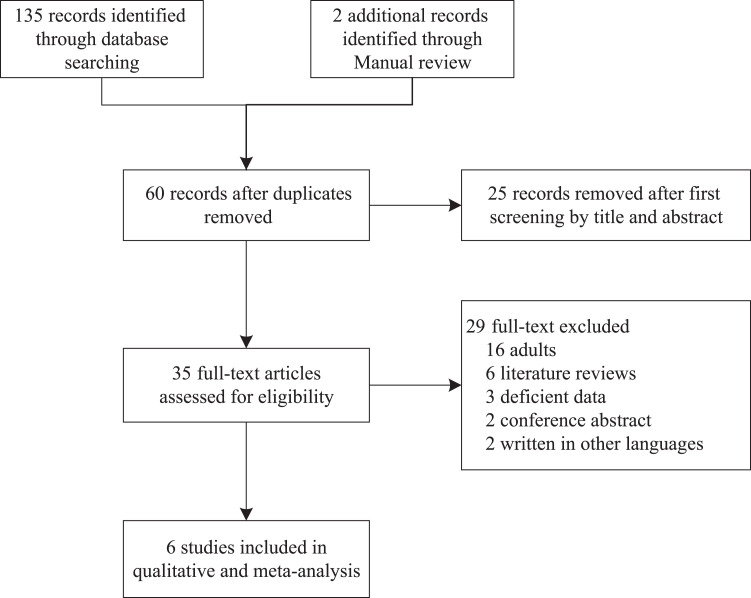
Methods: There were 2 reviewers who independently searched the PubMed, Embase, Ovid, and Cochrane databases for English-language studies of randomized controlled trials (RCTs), quasi-RCTs, and observational studies comparing surgical with nonsurgical treatment for PPDs. The primary outcomes were redislocations, the Kujala score, and the Knee injury and Osteoarthritis Outcome Score (KOOS), and the secondary outcome was subsequent surgery.
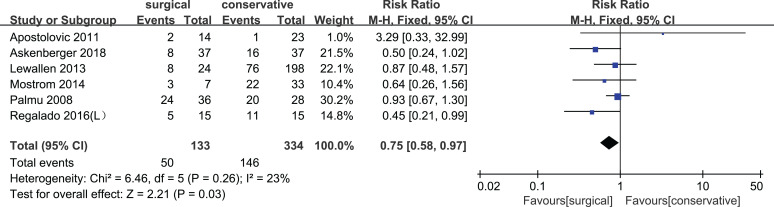
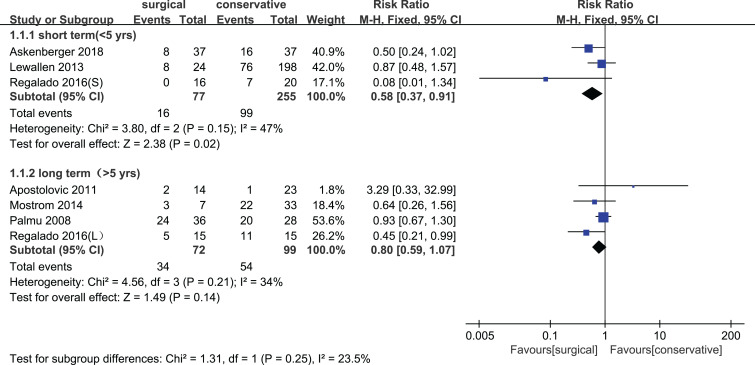
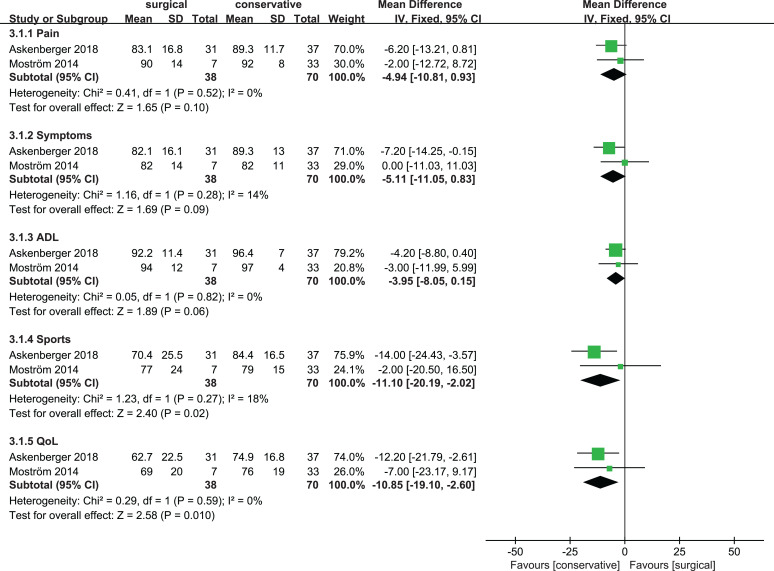
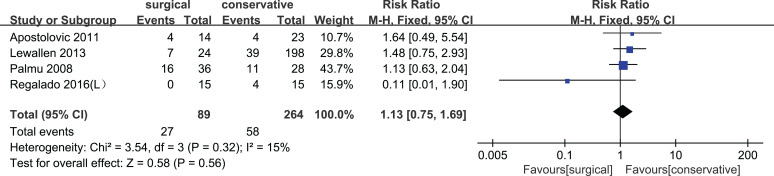
Results: A total of 6 studies were included in our systematic review and meta-analysis. Among patients younger than 18 years, surgery was associated with a lower redislocation rate compared with nonsurgical treatment within 5 years of treatment (risk ratio [RR], 0.58 [95% CI, 0.37-0.91]; P = .02; I 2 = 47%) but not beyond 5 years (RR, 0.80 [95% CI, 0.59-1.07]; P = .14; I 2 = 34%). However, surgery resulted in worse Kujala and KOOS scores compared with nonsurgical treatment. Yet, the treatment difference between the 2 groups tended to decrease over time.
Conclusion: The available evidence suggests that for adolescents with PPDs, surgery was superior to nonsurgical treatment in the short term to reduce the redislocation rate but resulted in poorer outcomes of knee function based on the Kujala and KOOS scores. However, the superiority of either surgical or nonsurgical treatment in adolescents did not appear to persist in the long term.
Keywords: adolescents; nonsurgical treatment; primary patellar dislocation; surgery.
© The Author(s) 2020.
Conflict of interest statement
The authors declared that there are no conflicts of interest in the authorship and publication of this contribution. AOSSM checks author disclosures against the Open Payments Database (OPD). AOSSM has not conducted an independent investigation on the OPD and disclaims any liability or responsibility relating thereto.
Figures

References
-
- Askenberger M, Bengtsson ME, Ekström W, et al. Operative repair of medial patellofemoral ligament injury versus knee brace in children with an acute first-time traumatic patellar dislocation: a randomized controlled trial. Am J Sports Med. 2018;46(10):2328–2340. - PubMed
-
- Bitar AC, D’Elia CO, Demange MK, Viegas AC, Camanho GL. Randomized prospective study on traumatic patellar dislocation: conservative treatment versus reconstruction of the medial patellofemoral ligament using the patellar tendon, with a minimum of two years of follow-up. Rev Bras Ortop. 2011;46(6):675–683. - PMC - PubMed
-
- Camanho GL, Viegas AC, Bitar AC, Demange MK, Hernandez AJ. Conservative versus surgical treatment for repair of the medial patellofemoral ligament in acute dislocations of the patella. Arthroscopy. 2009;25(6):620–625. - PubMed
-
- Cofield RH, Bryan RS. Acute dislocation of the patella: results of conservative treatment. J Trauma. 1977;17(7):526–531. - PubMed
Publication types
LinkOut - more resources
Full Text Sources
