. 2020 Sep 17;5(38):24574-24583.
doi: 10.1021/acsomega.0c03075. eCollection 2020 Sep 29.

Synthesis of Submicron SSZ-13 with Tunable Acidity by the Seed-Assisted Method and Its Performance and Coking Behavior in the MTO Reaction

Affiliations

Synthesis of Submicron SSZ-13 with Tunable Acidity by the Seed-Assisted Method and Its Performance and Coking Behavior in the MTO Reaction

Zhiqiang Xu et al. ACS Omega. .

Abstract

Submicron SSZ-13 with different acidities was synthesized successfully with the assistance of nanosized SSZ-13 seeds. The methanol-to-olefins (MTO) properties of submicron SSZ-13 were evaluated. The lifetime of submicron SSZ-13 was enhanced because of the crystal size reduction. The selectivity of light olefins was improved evidently at the early stage of the MTO reaction as the acidity density decreased. TG, GC-MS, and in situ UV/vis spectra were utilized to investigate coking behavior during the MTO reaction. It was found that the acidity density influences the nature and rate of coke formation. The majority of the hydrocarbon pool species over SSZ-13 with a low acidity density (125.2 μmol/g) were methylated benzene carbocations, while that over SSZ-13 with a high acidity density (330.2 μmol/g) were methylated naphthalene carbocations. The low acidity density of SSZ-13 can suppress the hydrogen transfer reaction and polyaromatic generation.


Conflict of interest statement

The authors declare no competing financial interest.

Figures

Figure 1
Figure 1
XRD patterns of the as-synthesized samples (a); XRD patterns of S-20-40-0 (b) and S-20-40-0.5 (c) after different hydrothermal treatment times.
Figure 2
Figure 2
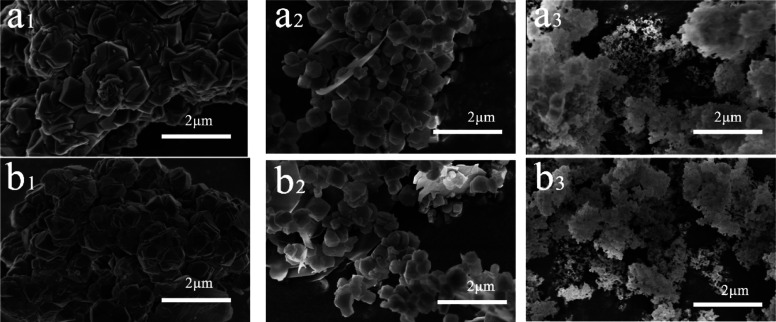
SEM images of S-20-20-0 (a1), S-20-20-0.5 (a2), S-20-20-1 (a3), S-20-40-0 (b1), S-20-40-0.5 (b2), S-20-40-1 (b3), S-20-80-0 (c1), S-20-80-0.5 (c2), and S-20-80-1 (c3).
Figure 3
Figure 3
XRD of the as-synthesized samples.
Figure 4
Figure 4
SEM images of S-10-40-0.25 (a1), S-5-40-0.25 (a2), S-0-40-0.25 (a3), S-10-40-0.5 (b1), S-5-40-0.5 (b2), and S-0-40-0.5 (b3).
Scheme 1
Scheme 1. Putative Crystallization Mechanism of Submicron SSZ-13 Prepared with the Aid of Seeds
Figure 5
Figure 5
Methanol conversion and selectivity of C2= + C3= with time on stream (TOS) over S-20-20-0, S-20-20-0.5, and S-20-20-1 (a) and S-20-40-0.5, S-10-40-0.5, S-10-40-0.25, and S-5-40-0.5 (b). Reaction conditions: T = 350 °C, WHSV =1.2 h–1, and catalyst weight = 500 mg.
Figure 6
Figure 6
Methanol conversion and selectivity of C2= + C3= with time on stream (TOS) over S-20-20-0, S-20-40-0.5, S-20-80-0.5, and SAPO-34. Reaction conditions: T = 350 °C, WHSV =1.2 h–1, and catalyst weight = 500 mg.
Figure 7
Figure 7
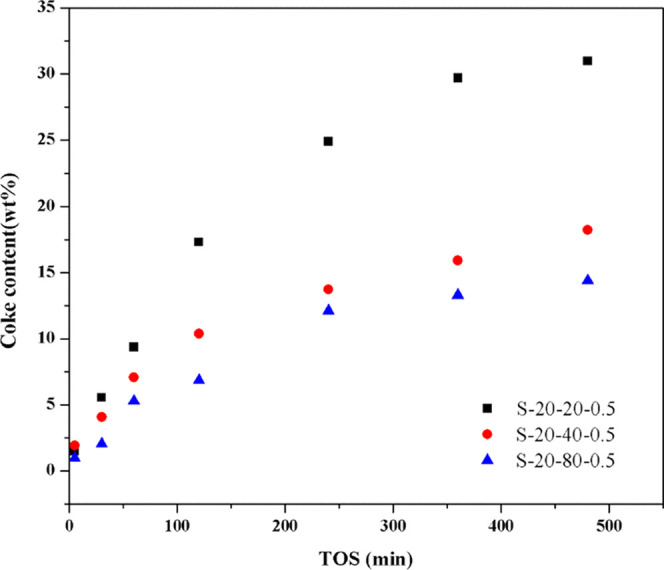
Coke content of the spent zeolite after different times on stream. Reaction conditions: T = 350 °C, WHSV = 2.0 h–1, and catalyst weight = 300 mg.
Figure 8
Figure 8
Coke distribution (based on FID) of polymethylbenzenes (a), naphthalene (b), methylnaphthalene (c), polymethylnaphthalene (d), and phenanthrene (e). Reaction condition: T = 350 °C, WHSV = 2.0 h–1, and catalyst weight = 300 mg.
Figure 9
Figure 9
In situ UV–vis spectra on S-20-20-0.5 (a), S-20-40-0.5 (b), and S-20-80-0.5 (c). Reaction condition: T = 350 °C, catalyst weight = 15 mg, and methanol was fed by the Ar flow (17.1 mL/min) through a saturator kept at 30 °C.
Scheme 2
Scheme 2. Putative Mechanism of Coke Species Deposition on Submicron SSZ-13 with Different Acidity Densities

References

    1. Shi J.; Wang Y.; Yang W.; Tang Y.; Xie Z. Recent advances of pore system construction in zeolite-catalyzed chemical industry processes. Chem. Soc. Rev. 2015, 44, 8877–8903. 10.1039/C5CS00626K. - DOI - PubMed
    1. Tian P.; Wei Y.; Ye M.; Liu Z. Methanol to Olefins (MTO): From Fundamentals to Commercialization. ACS Catal. 2015, 5, 1922–1938. 10.1021/acscatal.5b00007. - DOI
    1. Stöcker M. Methanol-to-hydrocarbons: catalytic materials and their behavior1. Microporous Mesoporous Mater. 1999, 29, 3–48. 10.1016/S1387-1811(98)00319-9. - DOI
    1. Wilson S. T.; Lok B. M.; Messina C. A.; Cannan T. R.; Flanigen E. M. Aluminophosphate molecular sieves: a new class of microporous crystalline inorganic solids. J. Am. Chem. Soc. 1982, 104, 1146–1147. 10.1021/ja00368a062. - DOI
    1. Li J.; Ma H.; Chen Y.; Xu Z.; Li C.; Ying W. Conversion of methanol to propylene over hierarchical HZSM-5: the effect of Al spatial distribution. Chem. Commun. 2018, 54, 6032–6035. 10.1039/C8CC02042F. - DOI - PubMed