


Global variation in the prevalence of suicidal ideation, anxiety and their correlates among adolescents: A population based study of 82 countries
- PMID: 33015595
- PMCID: PMC7525128
- DOI: 10.1016/j.eclinm.2020.100395
Global variation in the prevalence of suicidal ideation, anxiety and their correlates among adolescents: A population based study of 82 countries
Abstract
Background: Suicidal ideation and anxiety are common among adolescents although their prevalence has predominantly been studied in high income countries. This study estimated the population prevalence of suicidal ideation and anxiety and their correlates with peer support, parent-adolescent relationship, peer victimization, conflict, isolation and loneliness across a range of low-income, lower-middle-income, upper-middle-income countries and high-income countries (LMIC-HICs).
Methods: Data were drawn from the Global School-based Student Health Survey (GSHS) of adolescents aged 12-17 years between 2003 and 2015 in 82 LM-HICs from the six World Health Organization (WHO) regions. For those countries with repeated time point data in this study, we used data from the most recent survey. We estimated weighted prevalence of suicidal ideation and anxiety by country, region and at a global level with the following questions:-"Did you ever seriously consider attempting suicide during the past 12 months?" and "During the past 12 months, how often have you been so worried about something that you could not sleep at night?". We used multiple binary logistic regression to estimate the adjusted association between adolescent age, sex, socioeconomic status, peer support, parent-adolescent relationship, peer victimization, conflict, isolation and loneliness with suicidal ideation and anxiety.
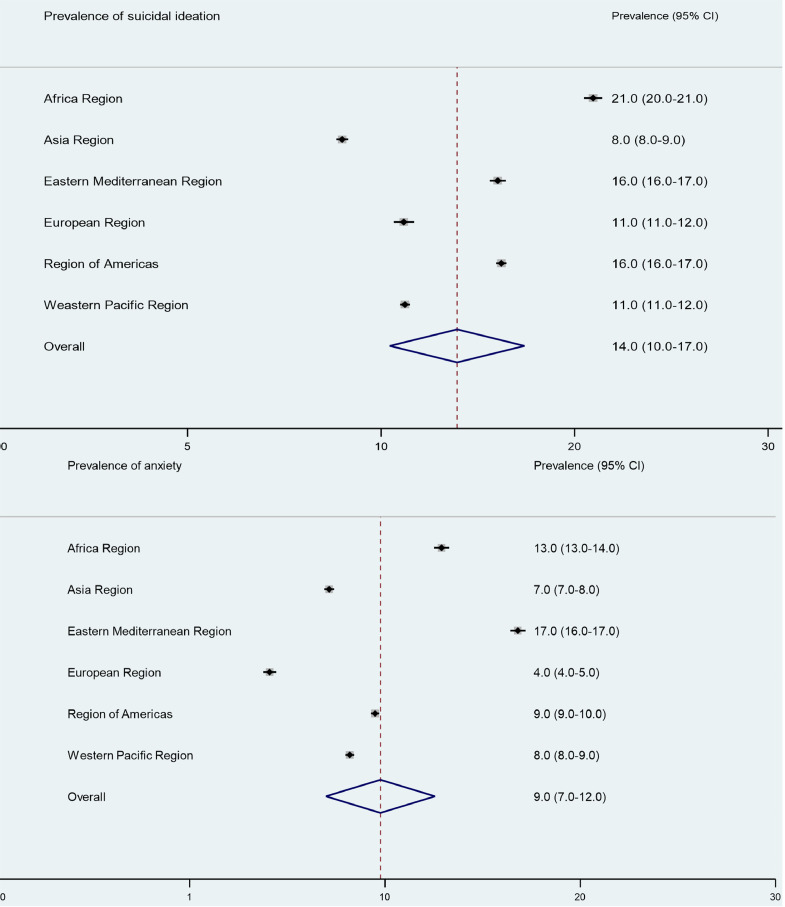
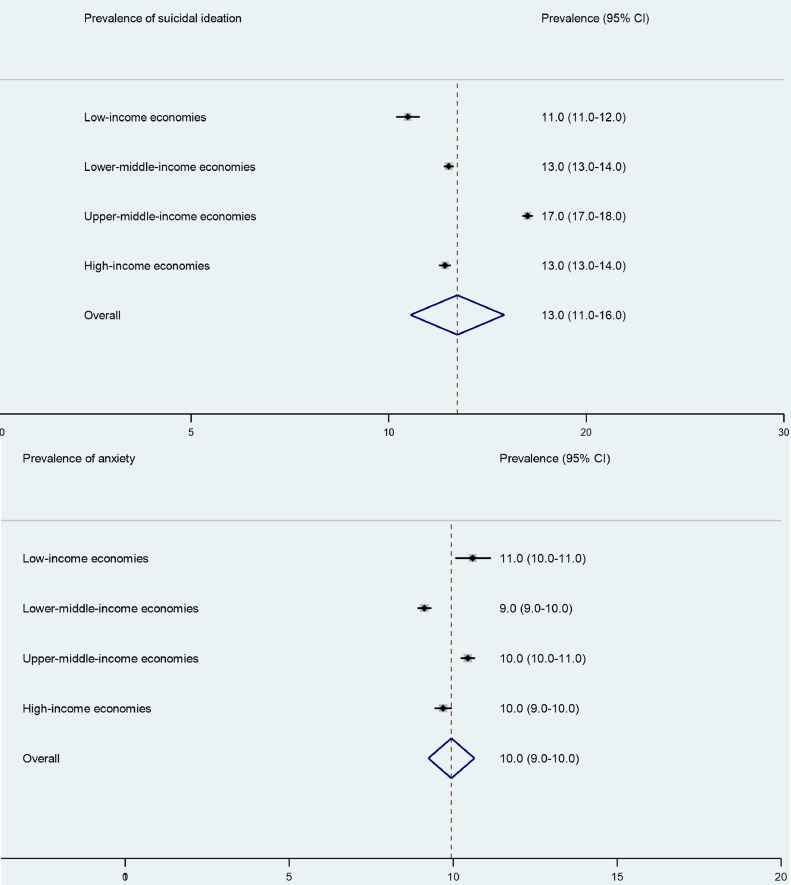
Findings: The sample comprised of 275,057 adolescents aged 12-17 years (mean age was 14.6 (SD 1.18) years of whom 51.8% were females). The overall 12 months pooled prevalence of suicidal ideation and anxiety were 14.0% (95% CI 10.0-17.0%) and 9.0% (7.0-12.0%) respectively. The highest pooled prevalence of suicidal ideation was observed in the Africa Region (21.0%; 20.0-21.0%) and the lowest was in the Asia region (8.0%, 8.0-9.0%). For anxiety, the highest pooled prevalence was observed in Eastern Mediterranean Region (17.0%, 16.0-17.0%) the lowest was in the European Region (4.0%, 4.0-5.0%). Being female, older age, having a lower socioeconomic status and having no close friends were associated with a greater risk of suicidal ideation and anxiety. A higher levels of parental control was positively associated with a greater likelihood of experiencing suicidal ideation (OR: 1.65, 1.45-1.87) and anxiety (1.53, 1.30-1.80). Parental understanding and monitoring were negatively associated with mental health problems. Similarly, the odds of experiencing suicidal ideation and anxiety were higher among adolescents who had been experiencing peer conflict (1.36, 1.24-1.50; 1.54, 1.40-1.70), peer victimization (1.26, 1.15-1.38; 1.13, 1.02-1.26), peer isolation (1.69, 1.53-1.86; 1.76, 1.61-1.92) and reported loneliness (2.56, 2.33-2.82; 5.63, 5.21-6.08).
Interpretations: Suicidal ideation and anxiety are prevalent among adolescents although there is significant global variation. Parental and peer supports are protective factors against suicidal ideation and anxiety. Peer based interventions to enhance social connectedness and parent skills training to improve parent-child relationships may reduce suicidal ideation and anxiety. Research to inform the factors that influence country and regional level differences in adolescent mental health problems may inform preventative strategies.
Funding: None.
© 2020 Published by Elsevier Ltd.
Conflict of interest statement
All other authors declare no competing interests.
Figures
References
-
- Magadi MA. multilevel determinants of teenage childbearing in sub-saharan Africa in the context of Hiv/aids. Health & place. 2017;46:37–48. - PubMed
-
- Weiss HA, Ferrand RAJTL. Improving adolescent health: an evidence-based call to action 2019;393(10176): 1073-5. - PubMed
-
- Steinberg L, Morris AS. Adolescent development. Annual review of psychology. 2001;52(1) - PubMed
-
- Patton GC, Olsson CA, Skirbekk V, et al. Adolescence and the next generation 2018;554(7693): 458. - PubMed
-
- The LJL Health an afterthought in a single-issue election 2017;389(10080):1670. - PubMed
LinkOut - more resources
Full Text Sources
Miscellaneous
