An official website of the United States government
The .gov means it’s official.
Federal government websites often end in .gov or .mil. Before
sharing sensitive information, make sure you’re on a federal
government site.
The site is secure.
The https:// ensures that you are connecting to the
official website and that any information you provide is encrypted
and transmitted securely.
Declaration of Conflicting Interests: The author(s) declared the following potential conflicts of interest with respect to the research, authorship, and/or publication of this article: Dr. Giacobbe has received research support from the CIHR, NIH and Veteran’s Affairs Canada. He has been an unpaid consultant for St. Jude Medical and has served on an advisory board for Janssen and Bristol Myers Squibb. Dr. Ng reports no financial relationships with commercial interests. Dr. Blumberger has received research support from CIHR, NIH, Brain Canada, and the Temerty Family through the CAMH Foundation and the Campbell Family Research Institute. He received research support and in-kind equipment support for an investigator-initiated study from Brainsway Ltd. He is the site principal investigator for three sponsor-initiated studies for Brainsway Ltd. He also receives in-kind equipment support from Magventure for two investigator-initiated research. He received medication supplies for an investigator-initiated trial from Indivior. Dr. Daskalakis has received research support from CIHR, NIH, Brain Canada, and the Temerty Family through the CAMH Foundation and the Campbell Family Research Institute. He received research support and in-kind equipment support for an investigator-initiated study from Brainsway Ltd. He is the site principal investigator for sponsor-initiated studies for Brainsway Ltd. He also receives in-kind equipment support from Magventure for investigator-initiated research. Dr. Downar has received research support from CIHR, NIMH, Brain Canada, the Canadian Biomarker Integration Network in Depression, the Ontario Brain Institute, the Klarman Family Foundation, the Arrell Family Foundation, the Edgestone Foundation, a travel stipend from Lundbeck and from ANT Neuro, an advisor to BrainCheck and in-kind equipment support for this investigator-initiated trial from MagVenture. Dr. Garcia reports no financial relationships with commercial interests. Dr. Hamani was part of an advisory board for Medtronic unrelated to this work. Dr. Lipsman reports no financial relationships with commercial interests. Dr. Vila-Rodriguez receives research support from CIHR, Brain Canada, Michael Smith Foundation for Health Research, Vancouver Coastal Health Research Institute, and in-kind equipment support for this investigator-initiated trial from MagVenture. He has participated in an advisory board for Janssen. Dr. Watling has received an honorarium from Lundbeck in the past 2 years.
Figures
Figure 1.
(A) Percentage of participants agreeing…
Figure 1.
(A) Percentage of participants agreeing with statements regarding their training in recommended 1st-line…
Figure 1.
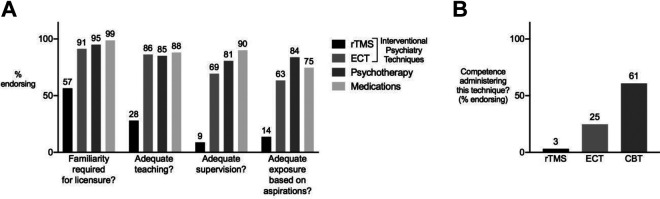
(A) Percentage of participants agreeing with statements regarding their training in recommended 1st-line treatment options for MDD during their residency. (B) Percentage of participants endorsing competence in administering rTMS, ECT, or CBT at the end of their residency. CBT = cognitive behavioural therapy; ECT = electroconvulsive therapy; MDD = Major Depressive Disorder; rTMS = repetitive transcranial magnetic stimulation.
Williams NR, Taylor JJ, Snipes JM, Short EB, Kantor EM, George MS. Interventional psychiatry: how should psychiatric educators incorporate neuromodulation into training. Acad Psychiatry. 2014;38(2):168–176.
-
PMC
-
PubMed
Yuzda E, Parker K, Parker V, Geagea J, Goldbloom D. Electroconvulsive therapy training in Canada: a call for greater regulation. Can J Psychiatry. 2002;47(10):938–944.
-
PubMed
Patry S, Graf P, Delva NJ, et al. Electroconvulsive therapy teaching in Canada: cause for concern. J ECT. 2013;29(2):109–112.
-
PubMed
Danilewitz M, Ainsworth NJ, Liu C, Vila-Rodriguez F. Towards competency-based medical education in neurostimulation. Acad Psychiatry. 2020;44(6):775–778. doi:10.1007/s40596-020-01195-z.
-
PubMed
Hassan T, Prasad B, Meek BP, Modirrousta M. Attitudes of psychiatry residents in Canadian universities toward neuroscience and its implication in psychiatric practice. Can J Psychiatry. 2020;65(3):174–183.
-
PMC
-
PubMed