


Family embeddedness and older adult mortality in the United States
- PMID: 33016247
- PMCID: PMC7642151
- DOI: 10.1080/00324728.2020.1817529
Family embeddedness and older adult mortality in the United States
Abstract
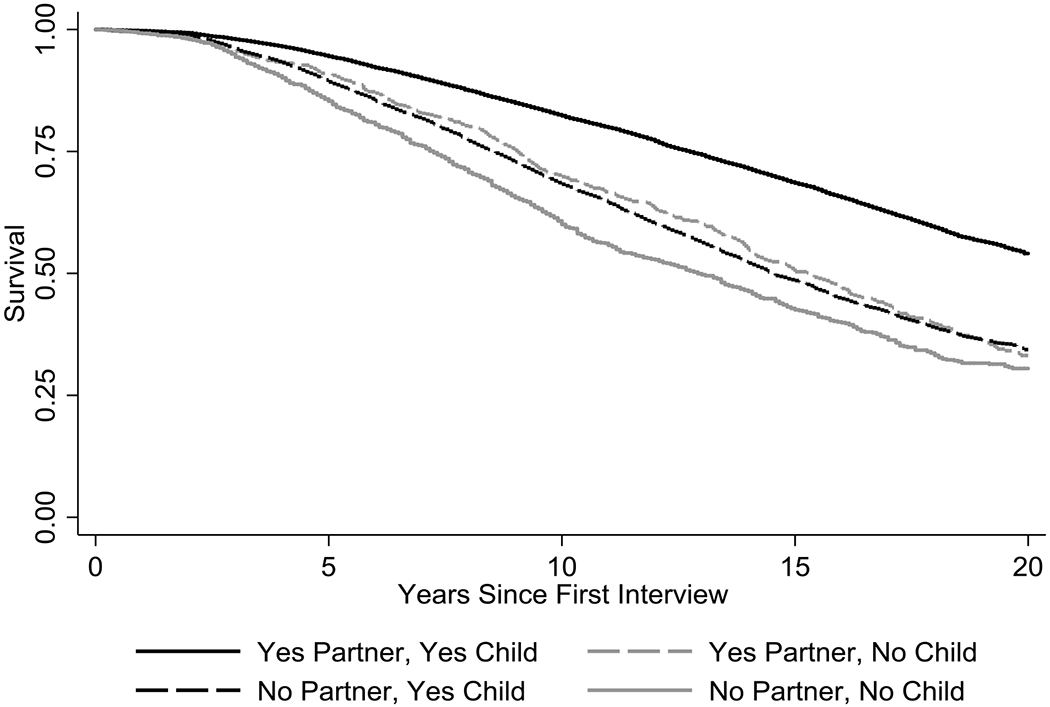
Do different operationalizations of family structure offer different understandings of the links between family structure and older adult mortality? Using the American Health and Retirement Study (N = 29,665), we examine mortality risks by three measures of family structure: whether respondents have different family statuses (e.g. married vs. unmarried), volume of family members available (e.g. having one vs. two living immediate family members), and family embeddedness (e.g. having neither spouse nor child vs. having spouse but no child). We focus on three kin types: partner/spouse, children, and siblings. We find that differences in empirical estimates across measures of family structure are not dramatic, but that family embeddedness can show some additional heterogeneity in mortality patterns over family status variables or the volume of ties. This paper tests different ways of operationalizing family structure to study mortality outcomes and advances our understanding of how family functions as a key social determinant of health.
Keywords: family; health; kinless; kinship; mortality; social networks.
Figures
References
-
- Bengtson Vern L. 2001. Beyond the Nuclear Family: The Increasing Importance of Multigenerational Bonds, Journal of Marriage and Family 63(1): 1–16.
-
- Benson Jacquelyn J. and Coleman Marilyn. 2016. Older Adults Developing a Preference for Living Apart Together, Journal of Marriage and Family 78(3): 797–812.
Publication types
MeSH terms
Grants and funding
LinkOut - more resources
Full Text Sources
Medical