


Early Life Trauma, Suicide Ideation, and Suicide Attempts: The Role of Rumination and Impulsivity
- PMID: 33017263
- PMCID: PMC8019678
- DOI: 10.1080/13811118.2020.1828208
Early Life Trauma, Suicide Ideation, and Suicide Attempts: The Role of Rumination and Impulsivity
Abstract
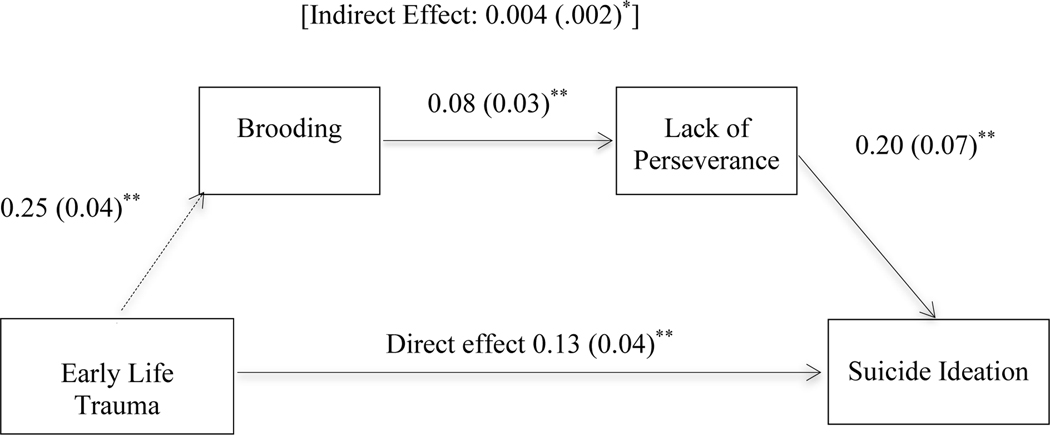
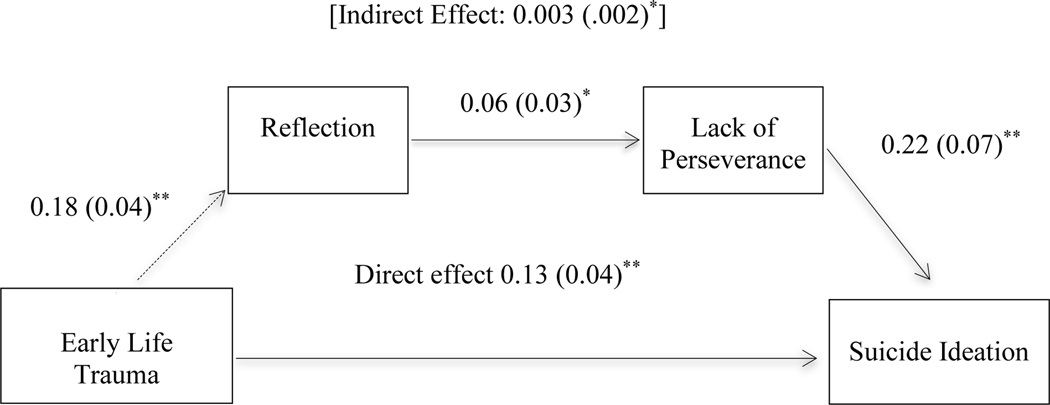
Suicide is the second leading cause of death for young adults in the United States. One of the many risk factors for suicide includes exposure to early life trauma. The present study examined whether rumination and impulsivity play a role in the relationship between early life trauma and increased risk for suicidal behavior (i.e., suicide ideation and suicide attempts) among 426 young adults. Early life trauma was associated with brooding, reflective rumination, and impulsivity in the form of negative urgency. Current or recent suicide ideators self-reported greater early life trauma, ruminative thinking, and impulsivity than non-ideators and non-attempters. Further, a multinomial logistic regression found that early life trauma, reflection, lack of premeditation, and lack of perseverance were associated with higher odds of reporting suicide ideation in the previous 6 months. We also found indirect relationships between early life trauma and suicide ideation through brooding or reflection and lack of perseverance in serial mediation analyses. These findings suggest that early life trauma may increase risk of suicide ideation to the degree that it leads to ruminative thinking and lack of follow-through with difficult tasks. How early life trauma might increase risk for ruminative thinking, impulsivity, and subsequent suicidal behavior is discussed.
Keywords: Early life trauma; impulsivity; rumination; suicide attempts; suicide ideation.
Figures
References
-
- Anestis MD, & Joiner TE (2011). Examining the role of emotion in suicidality: Negative urgency as an amplifier of the relationship between components of the interpersonal–psychological theory of suicidal behavior and lifetime number of suicide attempts. Journal of Affective Disorders, 129, 261–269 - PubMed
-
- Anestis MD, Soberay KA, Gutierrez PM, Hernandez TD, & Joiner TE (2014). Reconsidering the link between impulsivity and suicidal behavior. Personality and Social Psychology Review, 18, 366–386. - PubMed
-
- Anestis MD, Tull MT, Lavender JM, & Gratz KL (2014). The mediating role of nonsuicidal self-injury in the relationship between impulsivity and suicidal behavior among inpatients receiving treatment for substance use disorders. Psychiatry Research, 218, 166–173. - PubMed
-
- Bremner JD, Vermetten E, Mazure CM. (2000) Development and preliminary Psychometric properties of an instrument for the measurement of childhood trauma: The Early Trauma Inventory. Depression and Anxiety, 12, 1–12. - PubMed
Publication types
MeSH terms
Grants and funding
LinkOut - more resources
Full Text Sources
Medical
