Review
. 2021 Apr 19;60(17):9247-9262.
doi: 10.1002/anie.202010963. Epub 2020 Dec 3.

Alkali-Metal Mediation: Diversity of Applications in Main-Group Organometallic Chemistry

Affiliations
Review

Alkali-Metal Mediation: Diversity of Applications in Main-Group Organometallic Chemistry

Thomas X Gentner et al. Angew Chem Int Ed Engl. .

Abstract

Organolithium compounds have been at the forefront of synthetic chemistry for over a century, as they mediate the synthesis of myriads of compounds that are utilised worldwide in academic and industrial settings. For that reason, lithium has always been the most important alkali metal in organometallic chemistry. Today, that importance is being seriously challenged by sodium and potassium, as the alkali-metal mediation of organic reactions in general has started branching off in several new directions. Recent examples covering main-group homogeneous catalysis, stoichiometric organic synthesis, low-valent main-group metal chemistry, polymerization, and green chemistry are showcased in this Review. Since alkali-metal compounds are often not the end products of these applications, their roles are rarely given top billing. Thus, this Review has been written to alert the community to this rising unifying phenomenon of "alkali-metal mediation".

Keywords: alkali metals; catalysis; metallation; organolithium compounds; π-arene interactions.


Conflict of interest statement

The authors declare no conflict of interest.

Figures
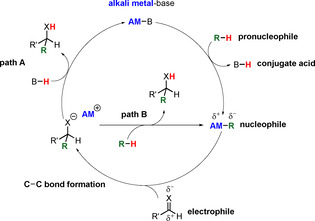
Scheme 1
Scheme 1
General mechanism for Brønsted base catalysed C−C addition reactions.
Scheme 2
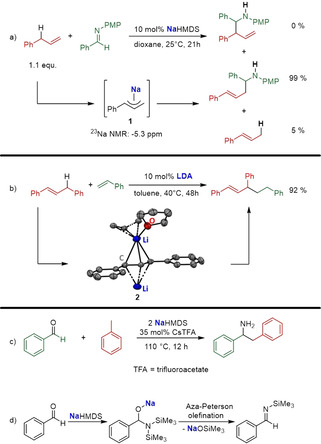
Scheme 2
C−C bond formation between a) an imine and an allyl compound catalysed by NaHMDS; b) styrene and an allyl compound catalysed by LDA; c) an aldehyde and toluene by activation of the benzylic group through cation–π interaction; d) conversion of benzaldehyde into N‐(trimethylsilyl)benzaldimine by NaHMDS.
Figure 1
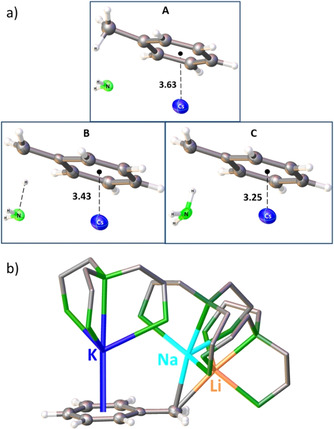
Figure 1
a) Calculated Cs–centroid distances (Å) for toluene upon benzylic C−H cleavage: reactant (A), transition state (B), product (C). b) Superimposition of the solid‐state structures of benzyl complexes of Li(orange), Na (turquoise), and K (blue). Methyl groups and all protons from the M6‐TREN ligand are omitted for clarity.
Figure 2
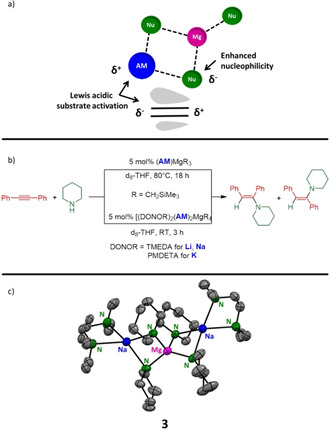
Figure 2
a) General illustration of the cooperativity between an alkali metal and Mg. b) Intermolecular hydroamination of diphenylacetylene with piperidine catalysed by (AM)MgR3 and (AM)2MgR4. c) Molecular structure of compound 3.
Scheme 3
Scheme 3
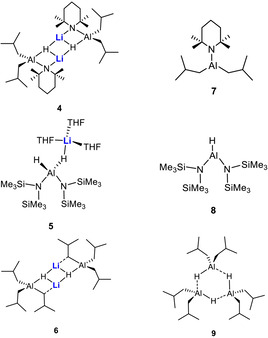
Hydroboration catalysts 49.
Scheme 4
Scheme 4
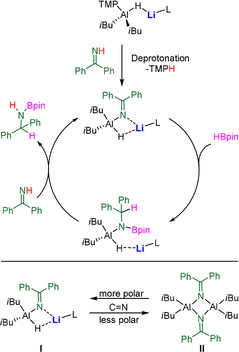
Top: Proposed catalytic cycle for the hydroboration of benzophenone imine catalysed by 4; bottom: proposed intermediates I and II formed by catalysts 4 and 7, respectively.
Scheme 5
Scheme 5
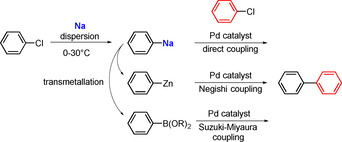
Sequential preparation of arylsodium compounds, transmetallations to arylzinc and arylboron compounds, and Pd‐catalysed C−C coupling reactions.
Scheme 6
Scheme 6
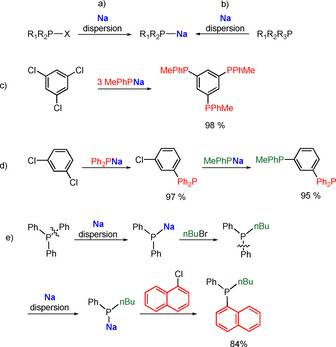
Synthesis of sodium phosphides R1R2PNa starting from a) R1R2P‐X; b) R1R2R3P. c) One‐pot synthesis of multidentate arylphosphines. d) One‐pot synthesis of unsymmetrical, multidentate arylphosphines. e) One‐pot sequential synthesis of an unsymmetrical, tertiary phosphine.
Scheme 7
Scheme 7
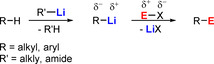
General equation for the classical two‐step metallation and electrophilic interception process.
Scheme 8
Scheme 8
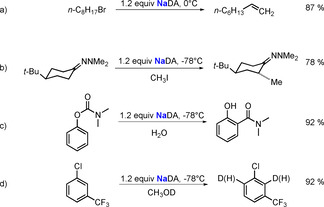
Reactions of various organic substrates with NaDA.
Scheme 9
Scheme 9
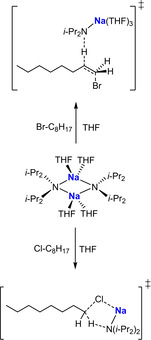
Transition states for the sodiation of bromooctane (top) and chlorooctane (bottom) with NaDA.
Scheme 10
Scheme 10
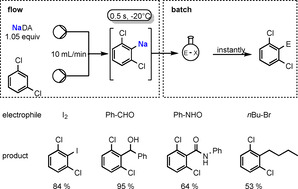
Sodiation of 1,3‐dichlorobenzene using a microflow reactor. Quenching of the sodium intermediate with various assorted electrophiles using an alternative batch method gives functionalized dichlorobenzenes.
Scheme 11
Scheme 11
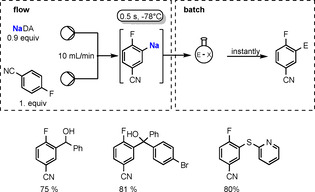
Sodiation of 4‐fluorobenzonitrile (flow). Quenching of sodium intermediate with different electrophiles (batch) gives functionalized benzonitriles.
Scheme 12
Scheme 12
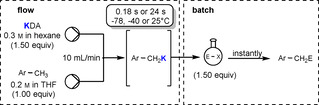
Metallation of methyl‐substituted (hetero)arenes by using KDA/TMEDA in continuous flow (flow). Quenching of the potassium intermediate with electrophiles (batch) gives access to functionalized methyl‐substituted (hetero)arenes.
Scheme 13
Scheme 13
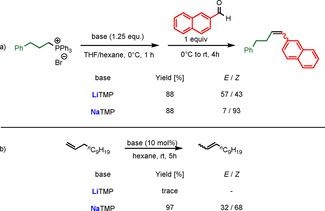
a) Wittig reaction carried out with LiTMP and NaTMP. b) Li/NaTMP‐catalysed isomerization of 1‐dodecene.
Figure 3
Figure 3
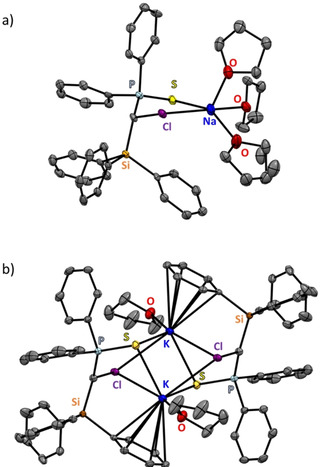
Molecular structures of a) sodium carbenoid and b) potassium carbenoid. Hydrogen atoms are omitted for clarity.
Scheme 14
Scheme 14
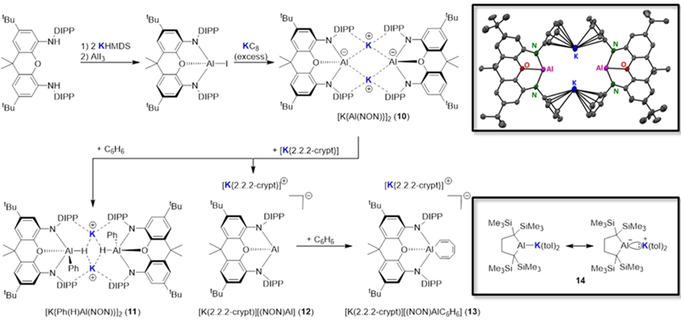
Synthesis of complexes 1013; solid‐state structure of 10 and resonance structures of 14.
Scheme 15
Scheme 15
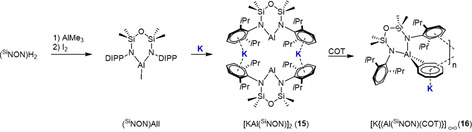
Synthesis of (SiNON)AlI, [KAl(SiNON)]2 (15) and [K{Al(SiNON)(COT)}] (16).
Scheme 16
Scheme 16
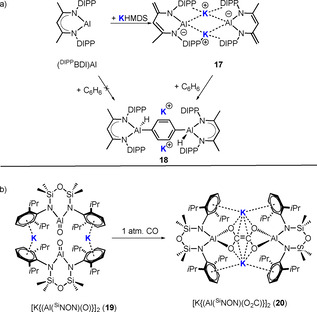
Synergistic reactions between K and Al: a) (DIPPBDI)Al reduces in the presence of KHMDS/benzene at the 1,4‐positions. b) Reaction of aluminoxane [K{Al(NONDipp)(O)}]2 (19) with 1 atm CO.
Figure 4
Figure 4
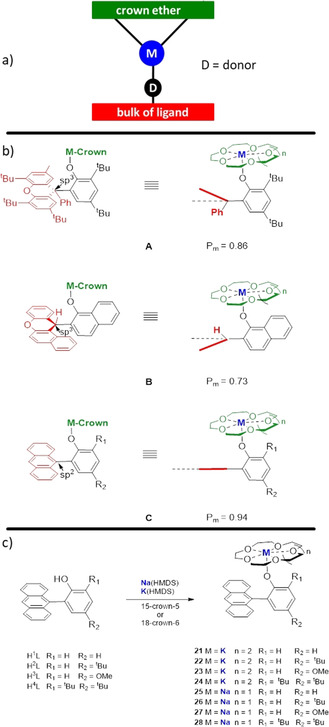
a) General design of an alkali‐metal‐based catalyst for ROP of lactide; b) A: complex where the substituent in the ortho position points towards the metal centre; B: complex where the substituent in the ortho position points away from the metal centre; C: complex where the substituent in the ortho position and crown ether confine the metal centre perfectly. c) Synthesis of complexes 2128.
Scheme 17
Scheme 17
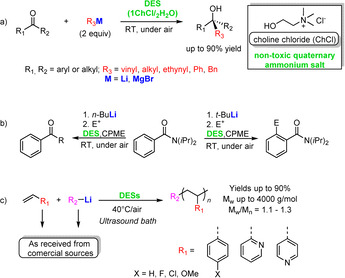
Representative reactions in ethereal/eutectic mixtures in the presence of air and moisture: a) nucleophilic additions of organometallic reagents to ketones, b) ortho‐lithiation and nucleophilic acyl substitution of a benzamide derivative, and c) organolithium‐promoted anionic polymerization of olefins.

References

    1. Schlenk W., Holtz J., Ber. Dtsch. Chem. Ges. 1917, 50, 262–274.
    1. None
    1. Wakefield B. J., The chemistry of organolithium compounds, Pergamon, Oxford, 1974;
    1. Clayden J., Organolithiums: selectivity for synthesis, Pergamon, Oxford, 2002;
    1. Rappoport Z., Marek I., The chemistry of organolithium compounds, Wiley, Chichester, 2005;