


Co-Occurrence of Cyanobacteria and Cyanotoxins with Other Environmental Health Hazards: Impacts and Implications
- PMID: 33019550
- PMCID: PMC7601082
- DOI: 10.3390/toxins12100629
Co-Occurrence of Cyanobacteria and Cyanotoxins with Other Environmental Health Hazards: Impacts and Implications
Abstract
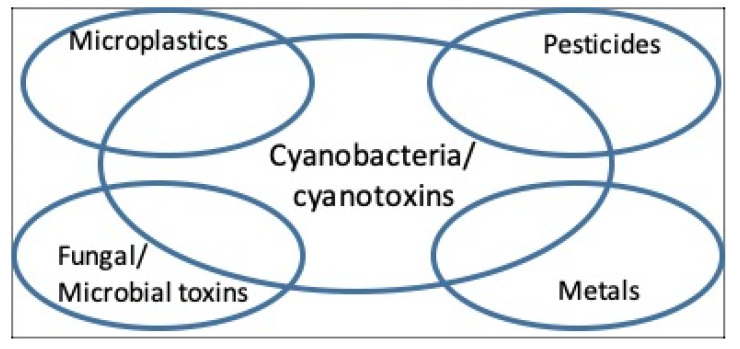
Toxin-producing cyanobacteria in aquatic, terrestrial, and aerial environments can occur alongside a wide range of additional health hazards including biological agents and synthetic materials. Cases of intoxications involving cyanobacteria and cyanotoxins, with exposure to additional hazards, are discussed. Examples of the co-occurrence of cyanobacteria in such combinations are reviewed, including cyanobacteria and cyanotoxins plus algal toxins, microbial pathogens and fecal indicator bacteria, metals, pesticides, and microplastics. Toxicity assessments of cyanobacteria, cyanotoxins, and these additional agents, where investigated in bioassays and in defined combinations, are discussed and further research needs are identified.
Keywords: biocide; co-occurrence; cyanobacteria; metals; plastics; toxicity.
Conflict of interest statement
The authors declare no conflict of interest.
Figures
References
-
- Carmichael W.W., editor. The Water Environment: Algal Toxins and Health. Plenum Press; New York, NY, USA: 1981. p. 491.
-
- Falconer I.R., editor. Algal Toxins in Seafood and Drinking Water. Academic Press; London, UK: 1993. p. 224.
-
- Codd G.A., Jefferies T.M., Keevil C.W., Potter E., editors. Detection Methods for Cyanobacterial Toxins. Royal Society of Chemistry; Cambridge, UK: 1994. p. 191.
-
- Huisman J., Matthijs H.C.P., Visser P.M., editors. Harmful Cyanobacteria. Springer; Dordrecht, The Netherlands: 2005. p. 241.
-
- Meriluoto J., Spoof L., Codd G.A., editors. Handbook of Cyanobacterial Monitoring and Cyanotoxin Analysis. Wiley; Chichester, UK: 2017. p. 548.
Publication types
MeSH terms
Substances
LinkOut - more resources
Full Text Sources
