


Relationship between jumping to conclusions and clinical outcomes in people at clinical high-risk for psychosis
- PMID: 33019957
- PMCID: PMC9226382
- DOI: 10.1017/S0033291720003396
Relationship between jumping to conclusions and clinical outcomes in people at clinical high-risk for psychosis
Abstract
Background: Psychosis is associated with a reasoning bias, which manifests as a tendency to 'jump to conclusions'. We examined this bias in people at clinical high-risk for psychosis (CHR) and investigated its relationship with their clinical outcomes.
Methods: In total, 303 CHR subjects and 57 healthy controls (HC) were included. Both groups were assessed at baseline, and after 1 and 2 years. A 'beads' task was used to assess reasoning bias. Symptoms and level of functioning were assessed using the Comprehensive Assessment of At-Risk Mental States scale (CAARMS) and the Global Assessment of Functioning (GAF), respectively. During follow up, 58 (16.1%) of the CHR group developed psychosis (CHR-T), and 245 did not (CHR-NT). Logistic regressions, multilevel mixed models, and Cox regression were used to analyse the relationship between reasoning bias and transition to psychosis and level of functioning, at each time point.
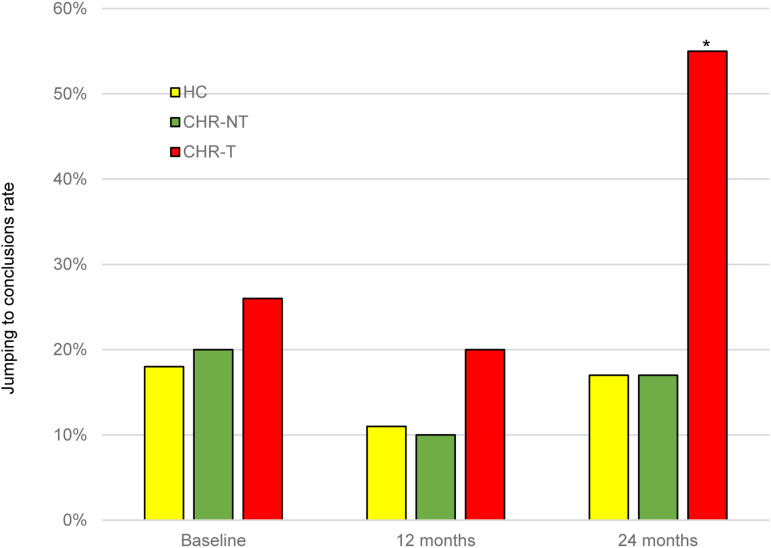
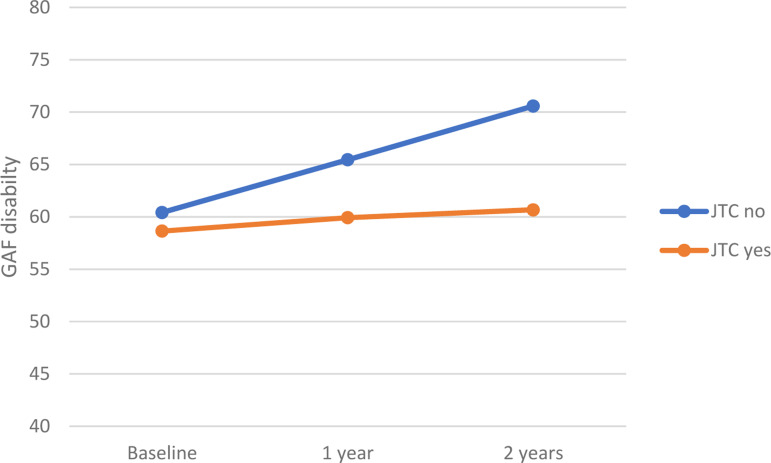
Results: There was no association between reasoning bias at baseline and the subsequent onset of psychosis. However, when assessed after the transition to psychosis, CHR-T participants showed a greater tendency to jump to conclusions than CHR-NT and HC participants (55, 17, 17%; χ2 = 8.13, p = 0.012). There was a significant association between jumping to conclusions (JTC) at baseline and a reduced level of functioning at 2-year follow-up in the CHR group after adjusting for transition, gender, ethnicity, age, and IQ.
Conclusions: In CHR participants, JTC at baseline was associated with adverse functioning at the follow-up. Interventions designed to improve JTC could be beneficial in the CHR population.
Keywords: Functioning; psychosis; transition to psychosis; ultra high-risk.
Conflict of interest statement
None.
Figures
References
-
- American Psychiatric Association. (2000). Diagnostic and Statistical Manual of Mental Disorders, Fourth Edition, Text Revision (DSM-IV-TR). Washington, DC: American Psychiatric Association.
-
- Andreasen, N. C. (1982). Negative symptoms in schizophrenia. Definition and reliability. Archives of General Psychiatry, 39(784), 788. - PubMed
-
- Bentall, R. (1999). Commentary on Garety and Freeman: III: Three psychological investigators and an elephant. British Journal of Clinical Psychology, 38, 323–327. - PubMed
-
- Brown, H., & Prescott, R. (2015). Applied mixed models in medicine (3rd ed.). Chichester, West Sussex: Hoboken: John Wiley & Sons Inc.
Publication types
MeSH terms
Grants and funding
LinkOut - more resources
Full Text Sources
Medical
Research Materials
