


KPC Beta-Lactamases Are Permissive to Insertions and Deletions Conferring Substrate Spectrum Modifications and Resistance to Ceftazidime-Avibactam
- PMID: 33020157
- PMCID: PMC7674030
- DOI: 10.1128/AAC.01175-20
KPC Beta-Lactamases Are Permissive to Insertions and Deletions Conferring Substrate Spectrum Modifications and Resistance to Ceftazidime-Avibactam
Abstract
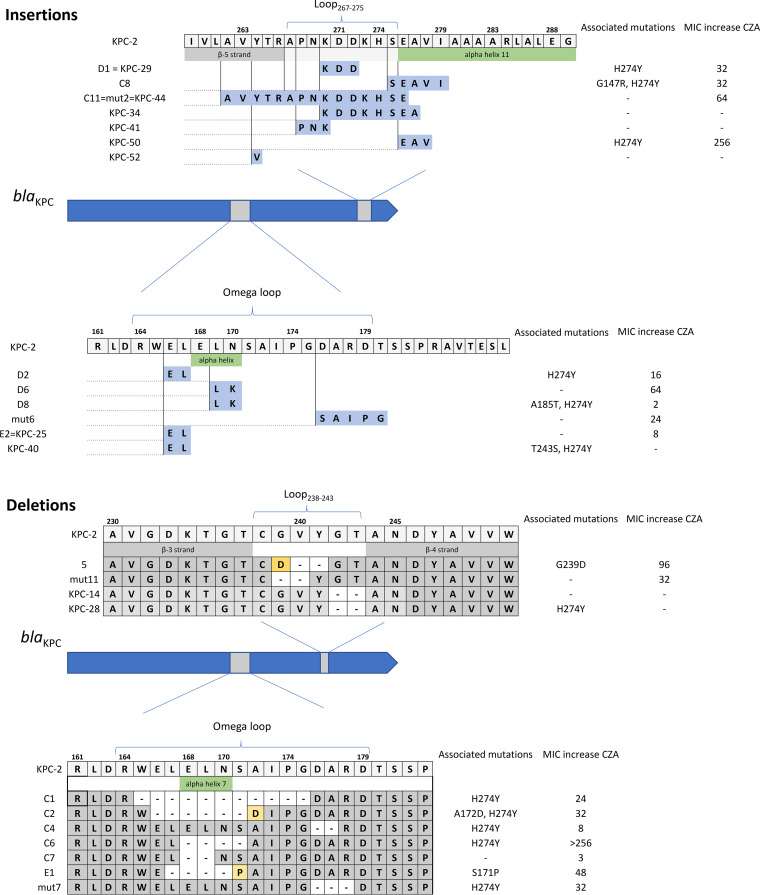
To explore the mutational possibilities of insertions and deletions (indels) in the Klebsiella pneumoniae carbapenemase (KPC) beta-lactamase, we selected for ceftazidime-avibactam-resistant mutants. Of 96 screened mutants, we obtained 19 indels (2 to 15 amino acids), all located in the loops surrounding the active site. Three antibiotic susceptibility phenotypes emerged: an extended-spectrum-beta-lactamase-like phenotype, an activity restricted to ceftazidime, and a carbapenem-susceptible KPC-like phenotype. Tolerance for indels reflects the evolvability of KPC beta-lactamase, which could challenge the therapeutic management of patients.
Keywords: KPC; carbapenemase; ceftazidime-avibactam; deletion; hydrolysis spectrum; insertion; mutation; mutational tolerance; omega loop.
Copyright © 2020 American Society for Microbiology.
Figures
References
-
- Levitt PS, Papp-Wallace KM, Taracila MA, Hujer AM, Winkler ML, Smith KM, Xu Y, Harris ME, Bonomo RA. 2012. Exploring the role of a conserved class A residue in the Ω-Loop of KPC-2 β-lactamase. A mechanism for ceftazidime hydrolysis. J Biol Chem 287:31783–31793. doi: 10.1074/jbc.M112.348540. - DOI - PMC - PubMed
-
- Galdadas I, Lovera S, Pérez-Hernández G, Barnes MD, Healy J, Afsharikho H, Woodford N, Bonomo RA, Gervasio FL, Haider S. 2018. Defining the architecture of KPC-2 Carbapenemase: identifying allosteric networks to fight antibiotics resistance. Sci Rep 8:12916. doi: 10.1038/s41598-018-31176-0. - DOI - PMC - PubMed
Publication types
MeSH terms
Substances
LinkOut - more resources
Full Text Sources
Molecular Biology Databases
