. 2020 Oct 20;117(42):26031-26039.
doi: 10.1073/pnas.2012999117. Epub 2020 Oct 5.

Real-time observation of ligand-induced allosteric transitions in a PDZ domain

Affiliations

Real-time observation of ligand-induced allosteric transitions in a PDZ domain

Olga Bozovic et al. Proc Natl Acad Sci U S A. .

Abstract

While allostery is of paramount importance for protein regulation, the underlying dynamical process of ligand (un)binding at one site, resulting time evolution of the protein structure, and change of the binding affinity at a remote site are not well understood. Here the ligand-induced conformational transition in a widely studied model system of allostery, the PDZ2 domain, is investigated by transient infrared spectroscopy accompanied by molecular dynamics simulations. To this end, an azobenzene-derived photoswitch is linked to a peptide ligand in a way that its binding affinity to the PDZ2 domain changes upon switching, thus initiating an allosteric transition in the PDZ2 domain protein. The subsequent response of the protein, covering four decades of time, ranging from ∼1 ns to ∼μs, can be rationalized by a remodeling of its rugged free-energy landscape, with very subtle shifts in the populations of a small number of structurally well-defined states. It is proposed that structurally and dynamically driven allostery, often discussed as limiting scenarios of allosteric communication, actually go hand-in-hand, allowing the protein to adapt its free-energy landscape to incoming signals.

Keywords: PDZ domains; allostery; molecular dynamics simulations; transient infrared spectroscopy.


Conflict of interest statement

The authors declare no competing interest.

Figures
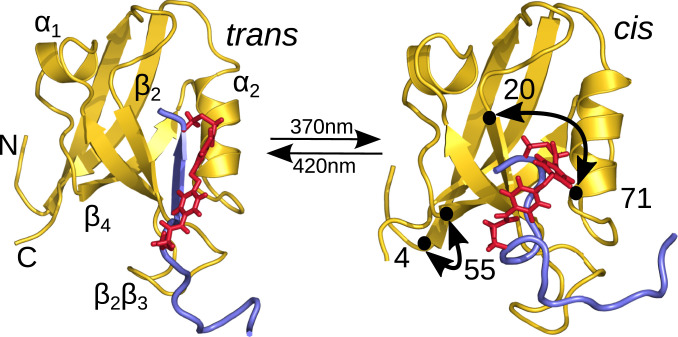
Fig. 1.
Fig. 1.
Ligand-switched PDZ2 domain. Main secondary structural elements and Cα distances d20,71 and d4,55 discussed below (Results, MD Simulations) are indicated. In the trans conformation of the photoswitch (red), the ligand (blue) fits well in the binding pocket, while it starts to move out when switching to cis.
Fig. 2.
Fig. 2.
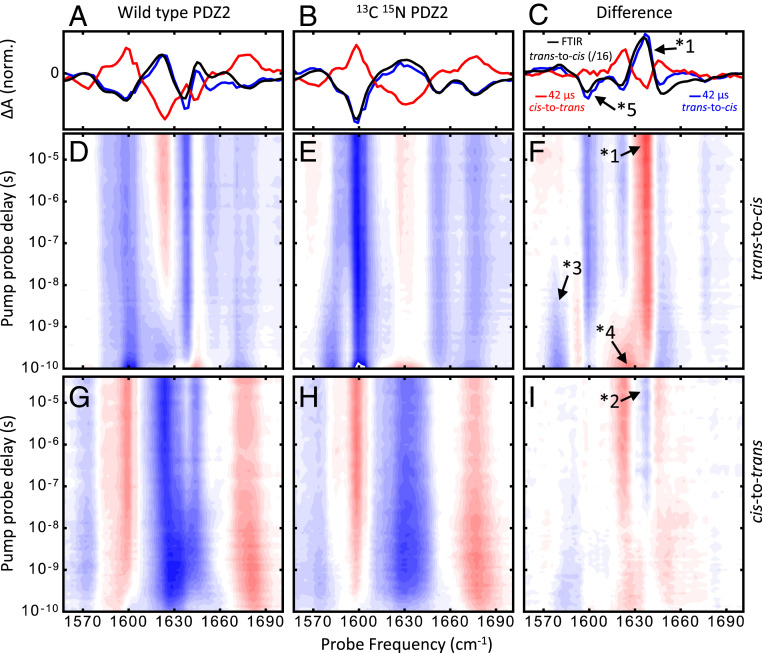
Transient IR spectra of PDZ2 in the region of the amide I band. AC compare transient data at long pump–probe delay times (averaged from 20 μs to 42 μs to increase signal-to-noise) for trans-to-cis (blue) and cis-to-trans (red) switching, together with a properly scaled trans-to-cis FTIR difference spectrum (black). DF show the complete transient data for trans-to-cis switching and GI show that for cis-to-trans switching. The left graphs show the data for the WT protein, middle graphs show that for the sample with the protein C1513N-labeled (the peptide ligand contains naturally abundant C1412N), and right graphs show the C1513N-WT difference data. Red colors in DI indicate positive-absorbance changes, and blue colors indicate negative-absorbance changes. The relative scaling of the datasets and the labeled features are discussed in Experimental.
Fig. 3.
Fig. 3.
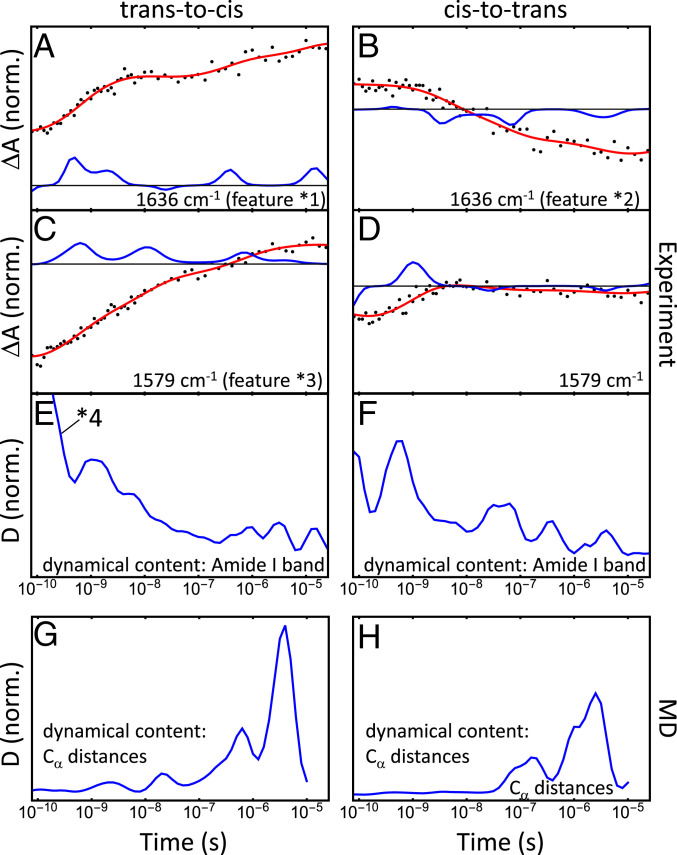
Transient C1513N-WT difference data at 1,636 cm1 (A and B) and 1,579 cm1 (C and D) for trans-to-cis (Left) and cis-to-trans (Right) switching, highlighting features labeled as *1 to *3 in Fig. 2. Red lines are fits obtained from the time-scale analysis in Eq. 1, and blue lines represent the resulting time-scale spectra a(ωi,τj). E and F show the corresponding dynamical content; the heat signal labeled as *4 is discussed in Experimental. G and H show the MD dynamical content, obtained from a time-scale analysis of the nonequilibrium time evolution of the mean Cα distances (SI Appendix, Fig. S5).
Fig. 4.
Fig. 4.
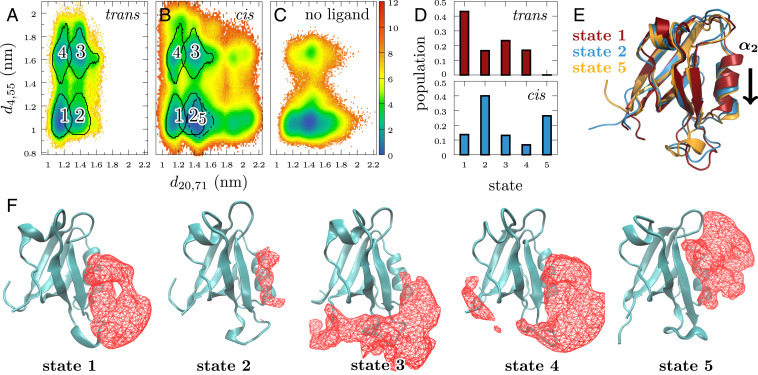
Identification of metastable conformational states. Free-energy landscapes (in units of kBT) obtained from the trans (A), cis (B), and ligand-free (61) (C) equilibrium simulations of PDZ2, plotted as a function of two essential interresidue distances. The unlabeled state-like feature at the bottom right of B represents weakly populated (1%) subregions of states 2 and 5. (D) Histogram of the state populations in trans and cis equilibrium, revealing the ligand-induced population shift of PDZ2. (E) Comparison of minimum-energy structures the of states 1, 2, and 5, revealing an increased opening of the ligand-binding pocket by a downward motion of α2. (F) Structures of states together with position densities of the ligand. The isosurface encloses a volume with a minimal probability of 0.4 to find a ligand atom within in all simulation snapshots belonging to a specific state. Fixed points for the comparison are the Cα atoms of strands β4 and β6.
Fig. 5.
Fig. 5.
Time evolution of various structural descriptors, following trans-to-cis ligand-switching of PDZ2. Shown are means (blue) and rmsd (orange) of Cα distances d20,71 (A) and d4,55 (B), as well as populations of conformational states (C, D, and F). For easier representation, all MD data were smoothed. Starting at time t=0 almost completely in state 1, we compare results from the nonequilibrium MD simulations (C) with the corresponding predictions of an MSM (D). (E) Network representation of the MSM. The size of the states indicate their population, the thickness of the arrows and numbers indicate the transition times (in microseconds). For clarity, we discard transitions that take longer than 2.5 μs. (F) MSM simulations of the trans-to-cis transition, using trans equilibrium initial conditions.

References

    1. Wodak S. J., et al. , Allostery in its many disguises: From theory to applications. Structure 27, 566–578 (2019). - PMC - PubMed
    1. Changeux J. P., Allostery and the Monod-Wyman-changeux model after 50 years. Annu. Rev. Biophys. 41, 103–133 (2012). - PubMed
    1. Cooper A., Dryden D. T. F., Allostery without conformational change. Eur. Biophys. J. 11, 103–109 (1984). - PubMed
    1. Fuentes E. J., Gilmore S. A., Mauldin R. V., Lee A. L., Evaluation of energetic and dynamic coupling networks in a PDZ domain protein. J. Mol. Biol. 364, 337–351 (2006). - PubMed
    1. Bahar I., Chennubhotla C., Tobi D., Intrinsic dynamics of enzymes in the unbound state and relation to allosteric regulation. Curr. Opin. Struct. Biol. 17, 633–640 (2007). - PMC - PubMed

Publication types

LinkOut - more resources