


The interplay between mast cells, pineal gland, and circadian rhythm: Links between histamine, melatonin, and inflammatory mediators
- PMID: 33020940
- PMCID: PMC9275476
- DOI: 10.1111/jpi.12699
The interplay between mast cells, pineal gland, and circadian rhythm: Links between histamine, melatonin, and inflammatory mediators
Abstract
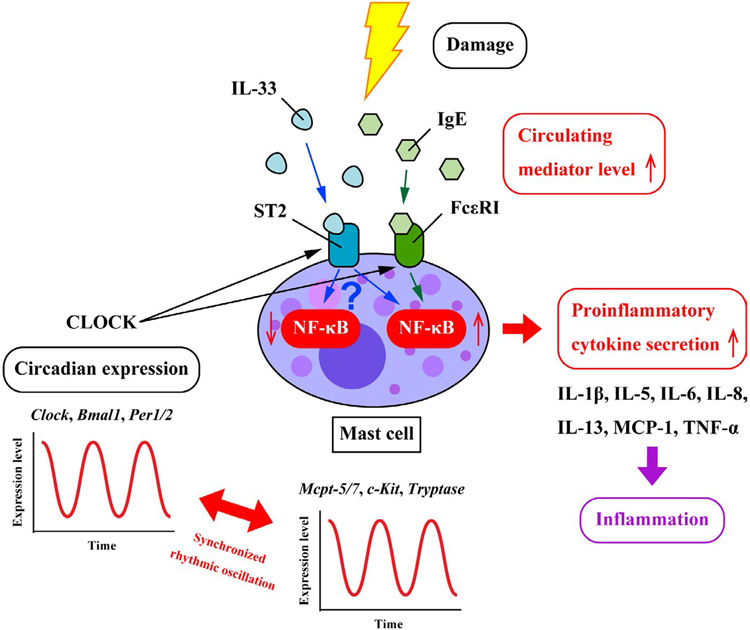
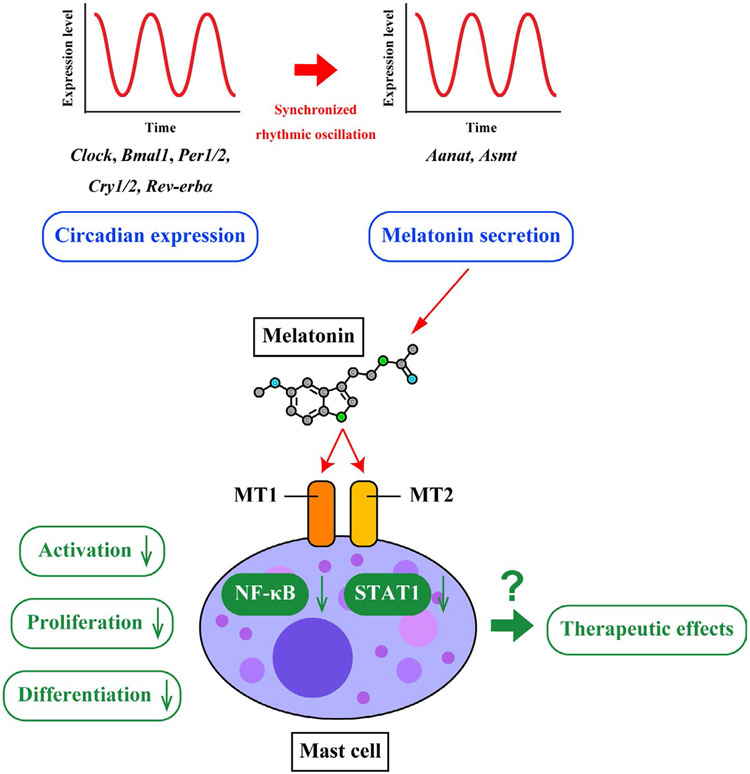
Our daily rhythmicity is controlled by a circadian clock with a specific set of genes located in the suprachiasmatic nucleus in the hypothalamus. Mast cells (MCs) are major effector cells that play a protective role against pathogens and inflammation. MC distribution and activation are associated with the circadian rhythm via two major pathways, IgE/FcεRI- and IL-33/ST2-mediated signaling. Furthermore, there is a robust oscillation between clock genes and MC-specific genes. Melatonin is a hormone derived from the amino acid tryptophan and is produced primarily in the pineal gland near the center of the brain, and histamine is a biologically active amine synthesized from the decarboxylation of the amino acid histidine by the L-histidine decarboxylase enzyme. Melatonin and histamine are previously reported to modulate circadian rhythms by pathways incorporating various modulators in which the nuclear factor-binding near the κ light-chain gene in B cells, NF-κB, is the common key factor. NF-κB interacts with the core clock genes and disrupts the production of pro-inflammatory cytokine mediators such as IL-6, IL-13, and TNF-α. Currently, there has been no study evaluating the interdependence between melatonin and histamine with respect to circadian oscillations in MCs. Accumulating evidence suggests that restoring circadian rhythms in MCs by targeting melatonin and histamine via NF-κB may be promising therapeutic strategy for MC-mediated inflammatory diseases. This review summarizes recent findings for circadian-mediated MC functional roles and activation paradigms, as well as the therapeutic potentials of targeting circadian-mediated melatonin and histamine signaling in MC-dependent inflammatory diseases.
Keywords: circadian rhythm; clock genes; histamine; inflammation; mast cells; melatonin.
© 2020 John Wiley & Sons A/S. Published by John Wiley & Sons Ltd.
Conflict of interest statement
CONFLICT OF INTEREST
This material is the result of work supported by resources at Richard L. Roudebush VA Medical Center. The content is the responsibility of the author(s) alone and does not necessarily reflect the views or policies of the Department of Veterans Affairs or the United States Government. The authors have no conflict of interests.
Figures
References
Publication types
MeSH terms
Substances
Grants and funding
LinkOut - more resources
Full Text Sources
Other Literature Sources
