


Association Between Exposure to Hurricane Irma and Mortality and Hospitalization in Florida Nursing Home Residents
- PMID: 33021652
- PMCID: PMC7539118
- DOI: 10.1001/jamanetworkopen.2020.19460
Association Between Exposure to Hurricane Irma and Mortality and Hospitalization in Florida Nursing Home Residents
Abstract
Importance: Nursing home residents are at heightened risk for morbidity and mortality following an exposure to a disaster such as a hurricane or the COVID19 pandemic. Previous research has shown that nursing home resident mortality related to disasters is frequently underreported. There is a need to better understand the consequences of disasters on nursing home residents and to differentiate vulnerability based on patient characteristics.
Objective: To evaluate mortality and morbidity associated with exposure to Hurricane Irma, a Category 4 storm that made landfall on September 10, 2017, in Cudjoe Key, Florida, among short-stay (<90-day residence) and long-stay (≥90-day residence) residents of nursing homes.
Design, setting, and participants: Cohort study of Florida nursing home residents comparing residents exposed to Hurricane Irma in September 2017 to a control group of residents residing at the same nursing homes over the same time period in calendar year 2015. Data were analyzed from August 28, 2019, to July 22, 2020.
Exposure: Residents who experienced Hurricane Irma were considered exposed; those who did not were considered unexposed.
Main outcome and measures: Outcome variables included 30-day and 90-day mortality and first hospitalizations after the storm in both the short term and the long term.
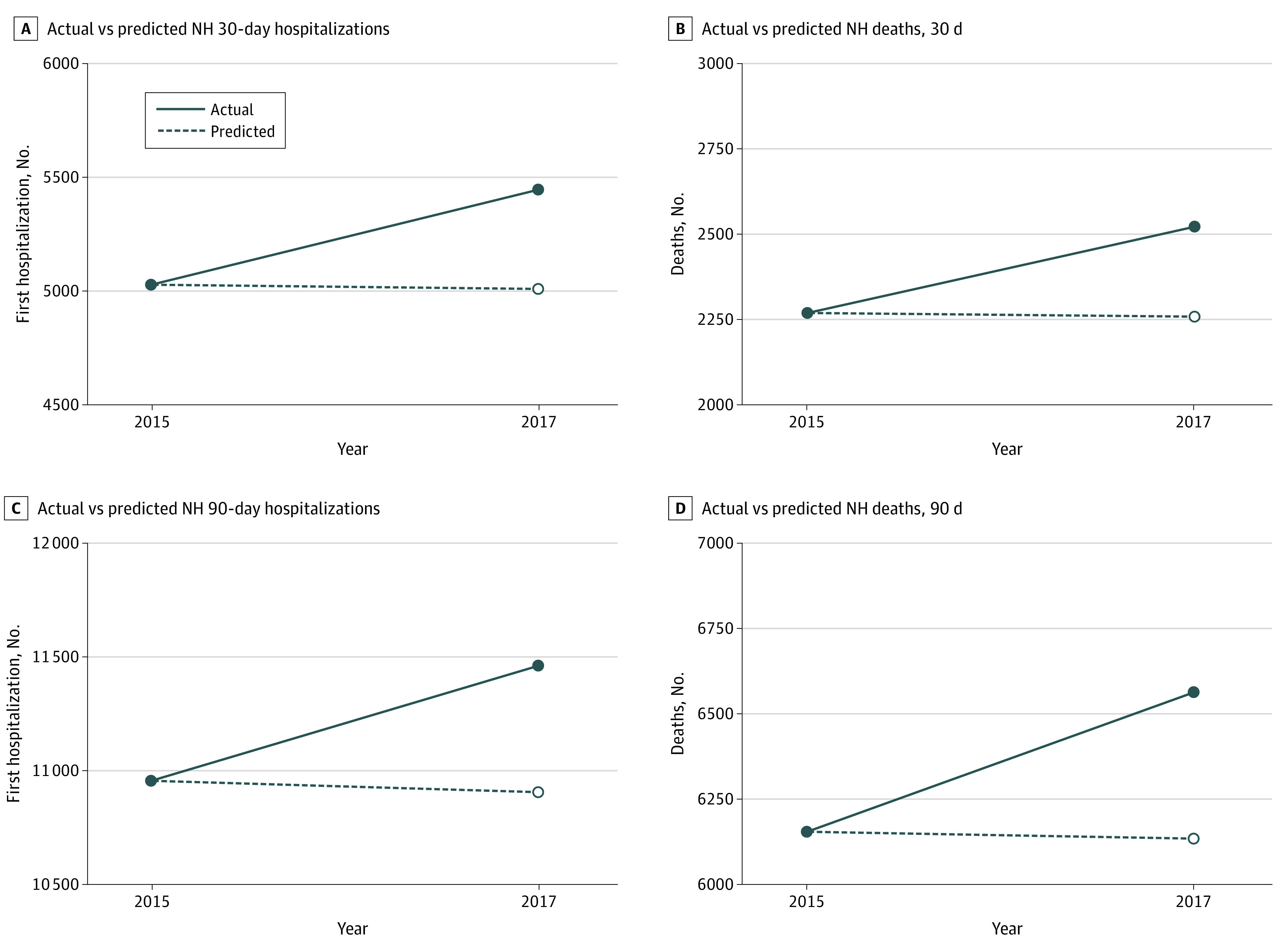
Results: A total of 61 564 residents who were present in 640 Florida nursing home facilities on September 7, 2017, were identified. A comparison cohort of 61 813 residents was evaluated in 2015. Both cohorts were mostly female (2015, 68%; 2017, 67%), mostly White (2015, 79%; 2017, 78%), and approximately 40% of the residents in each group were over the age of 85 years. Compared with the control group in 2015, an additional 262 more nursing home deaths were identified at 30 days and 433 more deaths at 90 days. The odds of a first hospitalization for those exposed (vs nonexposed) were 1.09 (95% CI, 1.05-1.13) within the first 30 days after the storm and 1.05 (95% CI, 1.02-1.08) at 90 days; the odds of mortality were 1.12 (95% CI, 1.05-1.18) at 30 days and 1.07 (95% CI, 1.03-1.11) at 90 days. Among long-stay residents, the odds of mortality for those exposed to Hurricane Irma were 1.18 (95% CI, 1.08-1.29) times those unexposed and the odds of hospitalization were 1.11 (95% CI, 1.04-1.18) times those unexposed in the post 30-day period.
Conclusions and relevance: The findings of this study suggest that nursing home residents are at considerable risk to the consequences of disasters. These risks may be underreported by state and federal agencies. Long-stay residents, those who have resided in a nursing home for 90 days or more, may be most vulnerable to the consequences of hurricane disasters.
Conflict of interest statement
Figures
References
-
- Provisional COVID-19 death counts by place of death. Centers for Disease Control and Prevention website. Accessed May 20, 2020. https://data.cdc.gov/NCHS/Provisional-COVID-19-Death-Counts-by-Place-of-...
Publication types
MeSH terms
Grants and funding
LinkOut - more resources
Full Text Sources
Medical
