Review
. 2020 Oct 5;30(19):R1189-R1202.
doi: 10.1016/j.cub.2020.08.028.

Evolutionary Ecology and Interplay of Prokaryotic Innate and Adaptive Immune Systems

Affiliations
Review

Evolutionary Ecology and Interplay of Prokaryotic Innate and Adaptive Immune Systems

Tatiana Dimitriu et al. Curr Biol. .

Abstract

Like many organisms, bacteria and archaea have both innate and adaptive immune systems to defend against infection by viruses and other parasites. Innate immunity most commonly relies on the endonuclease-mediated cleavage of any incoming DNA that lacks a specific epigenetic modification, through a system known as restriction-modification. CRISPR-Cas-mediated adaptive immunity relies on the insertion of short DNA sequences from parasite genomes into CRISPR arrays on the host genome to provide sequence-specific protection. The discovery of each of these systems has revolutionised our ability to carry out genetic manipulations, and, as a consequence, the enzymes involved have been characterised in exquisite detail. In comparison, much less is known about the importance of these two arms of the defence for the ecology and evolution of prokaryotes and their parasites. Here, we review our current ecological and evolutionary understanding of these systems in isolation, and discuss the need to study how innate and adaptive immune responses are integrated when they coexist in the same cell.


Figures

Figure 1
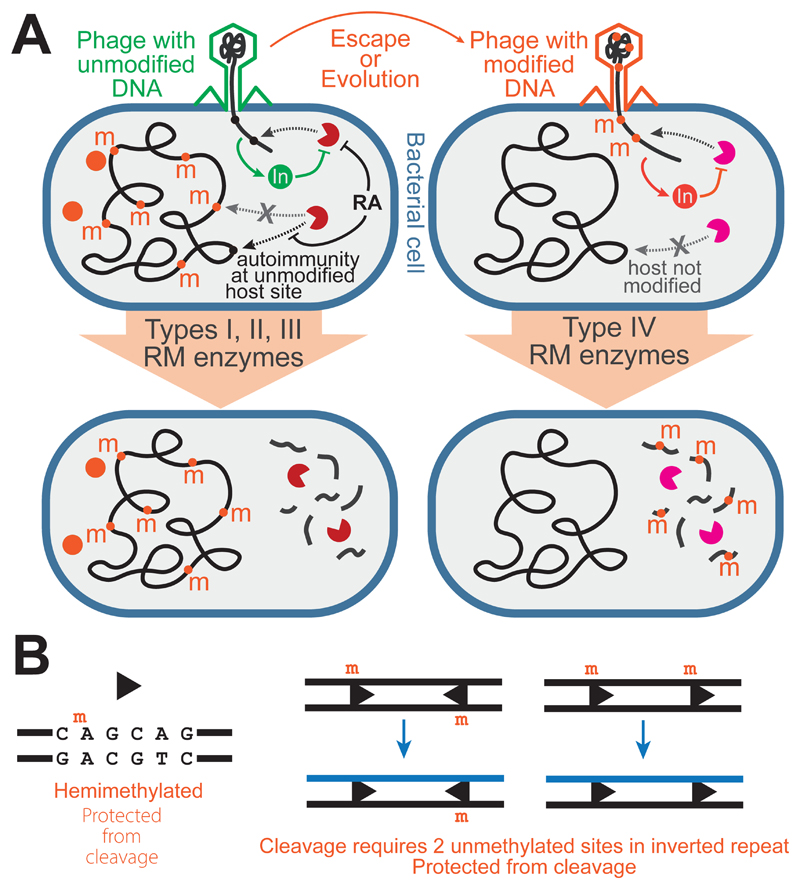
Figure 1. Fundamental mechanisms of RM immunity.
(A) Cartoons of bacterial cells infected by phage and the effect of Types I - III (left panel) and Type IV (right panel) RM systems. Types I - III comprise an endonuclease activity (Pacman) and methyltransferase (orange circle). DNA cleavage is targeted to specific sequences (circles) that are protected on the host genome by methylation (m). Appearance of unmethylated sites on the host leads to autoimmunity which is prevented for Type I systems by restriction alleviation (RA). Cleavage can be prevented by phage-encoded inhibitors (In). Type IV systems comprise only an endonuclease. (B) Asymmetric sites (arrowhead) that are only hemimethylated are protected following replication (one daughter DNA shown) by a necessity for interaction between two sites in inverted repeat to activate cleavage.
Figure 2
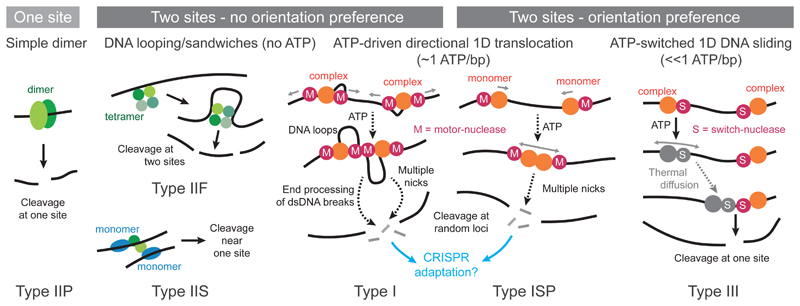
Figure 2. Mechanisms of DNA cleavage by Type I - III RM enzymes.
The majority of RM enzymes require communication between two target sites to activate cleavage, using either energy-independent DNA looping or ATP-dependent mechanisms.
Figure 3
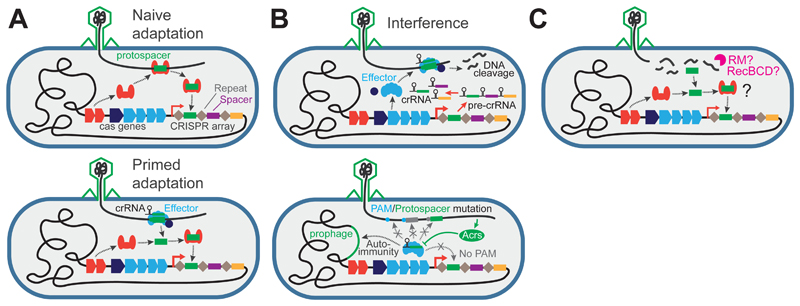
Figure 3. CRISPR-Cas adaptive immunity.
(A) Adaptation is the uptake of MGE sequences by the Cas1-Cas2 complex (orange) into the leader of the CRISPR array. Primed adaptation is facilitated by the effector complex. (B) Interference is the specific recognition and cleavage of an MGE using crRNA processed from the CRISPR array. The process can be blocked by mutation of the PAM and/or protospacer sequences, or by phage-encoded inhibitors (Acrs). Autoimmunity is avoided by an absence of PAMs in the CRISPR array but may occur where foreign sequences are recombined e.g. prophage. (C) Nucleic acid processing by RM enzyme activity or repair nucleases working on stalled replication forks (e.g. RecBCD, [17]) may provide polynucleotide fragments that feed into adaptation.
Figure 4
Figure 4. Polynucleotide cleavage by type I, II and III CRISPR-Cas effectors.
See main text for full details. Polynucleotide cleavage is shown by the orange arrowheads.
Figure 5
Figure 5. Summary of balancing factors that can affect immune system prevalence.
Figure 6
Figure 6. Generation of diversity in Type I RM systems by genetic recombination of the HsdS DNA recognition subunit.
(A) Computational model of the EcoKI HsdS subunit bound to DNA (PDB:2Y7H, [110]) demonstrating how the target recognition domains (TRDs) and coiled coil region (CCR) allow HsdS to recognise an asymmetric bipartite DNA sequence. (B) Changes in the number of TAEL amino acid repeats in CCR1 of EcoR124I and EcoR124II changes the number of non-specific nucleotides in the spacer. (C) Dimerisation of half HsdS subunits produces a Type I enzyme that recognises a palindrome sequence. (D) Shufflon system. Reversible site-specific inversion between recombination sequences within two inverted hsdS genes produces HsdS subunit that recognise one of two sequences as one of the TRDs is swapped.

References

    1. Labrie SJ, Samson JE, Moineau S. Bacteriophage resistance mechanisms. Nature Reviews Microbiology. 2010;8:317–327. - PubMed
    1. Roberts RJ, Vincze T, Posfai J, Macelis D. REBASE—a database for DNA restriction and modification: enzymes, genes and genomes. Nucleic Acids Research. 2010;38:D234–D236. - PMC - PubMed
    1. Koonin EV, Makarova KS, Wolf YI. Evolutionary genomics of defense systems in Archaea and Bacteria. Annual review of microbiology. 2017;71:233–261. - PMC - PubMed
    1. Loenen WAM, Raleigh EA. The other face of restriction: modification-dependent enzymes. Nucleic Acids Research. 2014;42:56–69. - PMC - PubMed
    1. Loenen WAM, Dryden DTF, Raleigh EA, Wilson GG. Type I restriction enzymes and their relatives. Nucleic Acids Research. 2014;42:20–44. - PMC - PubMed

Publication types

LinkOut - more resources