


Cross-sectional survey on impact of paediatric COVID-19 among Italian paediatricians: report from the SIAIP rhino-sinusitis and conjunctivitis committee
- PMID: 33023616
- PMCID: PMC7538039
- DOI: 10.1186/s13052-020-00906-4
Cross-sectional survey on impact of paediatric COVID-19 among Italian paediatricians: report from the SIAIP rhino-sinusitis and conjunctivitis committee
Abstract
Background: There is ample evidence that COVID-19 is significantly less severe in children than in adults and asthma and allergy, the most common chronic disorders in children, are not included in the top 10 comorbidities related to COVID-19 fatalities. Nevertheless, concerns about asthma and allergy are still high.. In order to evaluate the impact of paediatric COVID-19 among Italian paediatricians, we sent a 20-questions anonymous internet-based survey to 250 Italian paediatricians with particular address to allergic symptoms and those affecting the upper airways.
Methods: The questionnaire was conceived and pretested in April 2020, by a working group of experts of the Italian Paediatric Society for Allergy and Immunology (SIAIP), and structured into different sections of 20 categorized and multiple choice questions. The first part included questions about epidemiological data follows by a second part assessing the way to manage a suspected COVID-19 infection and personal experiences about that. The third part concerned questions about patients' clinical characteristics and clinical manifestations. The survey was emailed once between April and mid-May 2020.
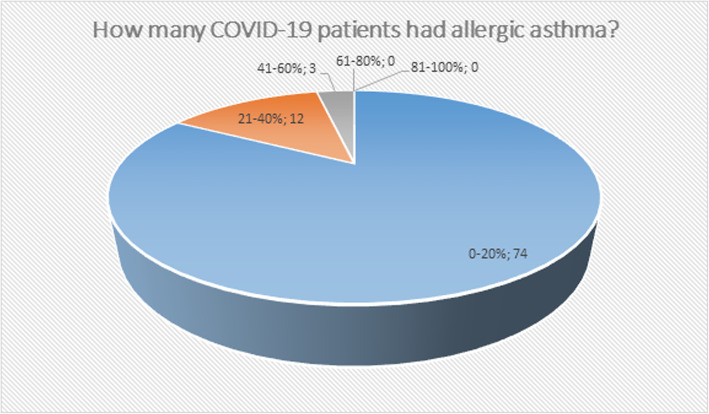
Results: A total 99 participants had participated in our survey and provided responses to our electronic questionnaire. The distribution of patients reported per month varies significantly according to the geographical area (P = 0.02). Data confirmed that in the North part of Italy the rate of patients referred is higher than in the rest of Italy. Almost all respondents (98%) reported caring for up to a maximum of 10 infected children and the last 2% more than twenty. Among these patients, according to the 75% of responders, a maximum rate of 20% were affected by allergic rhino-conjunctivitis and in particular in the North of Italy while in the Centre and in the South there was a higher incidence (P = 0.09). Almost the same applies for asthma, 83% of responders declared that up to a maximum of 20% of affected children were asthmatic, from 20 to 40% for the 13,5% of responders and from 40 to 60% for the last 3,5%. As for the allergic conjunctivitis also for asthma, we found a higher incidence in the Centre and in South than in the North (P = 0.03).
Conclusions: This study is the first to provide a comprehensive review of COVID-19 knowledge and impact among paediatricians in Italy about allergic asthma and upper airway involvement. From our point of view, it provides important information clearly useful for improving a good practice.
Keywords: Allergy; Asthma; COVID-19; Children; Coronavirus; Paediatricians; Survey; Upper airway.
Conflict of interest statement
The authors have no conflicts of interest to disclose that could be perceived as prejudicing the impartiality of the research reported.
Figures
References
-
- https://www.who.int/emergencies/diseases/novel-coronavirus-2019. Accessed 29th August 2020.
-
- Guan W, Ni Z, Hu Y, et al. Clinical characteristics of 2019 novel coronavirus infection in China. medRxiv. 2020;2020(02.06):20020974.
MeSH terms
LinkOut - more resources
Full Text Sources
Miscellaneous
