. 2020 Oct 7;17(1):51.
doi: 10.1186/s12989-020-00381-z.

Basal Ti level in the human placenta and meconium and evidence of a materno-foetal transfer of food-grade TiO2 nanoparticles in an ex vivo placental perfusion model

Affiliations

Basal Ti level in the human placenta and meconium and evidence of a materno-foetal transfer of food-grade TiO2 nanoparticles in an ex vivo placental perfusion model

A Guillard et al. Part Fibre Toxicol. .

Abstract

Background: Titanium dioxide (TiO2) is broadly used in common consumer goods, including as a food additive (E171 in Europe) for colouring and opacifying properties. The E171 additive contains TiO2 nanoparticles (NPs), part of them being absorbed in the intestine and accumulated in several systemic organs. Exposure to TiO2-NPs in rodents during pregnancy resulted in alteration of placental functions and a materno-foetal transfer of NPs, both with toxic effects on the foetus. However, no human data are available for pregnant women exposed to food-grade TiO2-NPs and their potential transfer to the foetus. In this study, human placentae collected at term from normal pregnancies and meconium (the first stool of newborns) from unpaired mothers/children were analysed using inductively coupled plasma mass spectrometry (ICP-MS) and scanning transmission electron microscopy (STEM) coupled to energy-dispersive X-ray (EDX) spectroscopy for their titanium (Ti) contents and for analysis of TiO2 particle deposition, respectively. Using an ex vivo placenta perfusion model, we also assessed the transplacental passage of food-grade TiO2 particles.

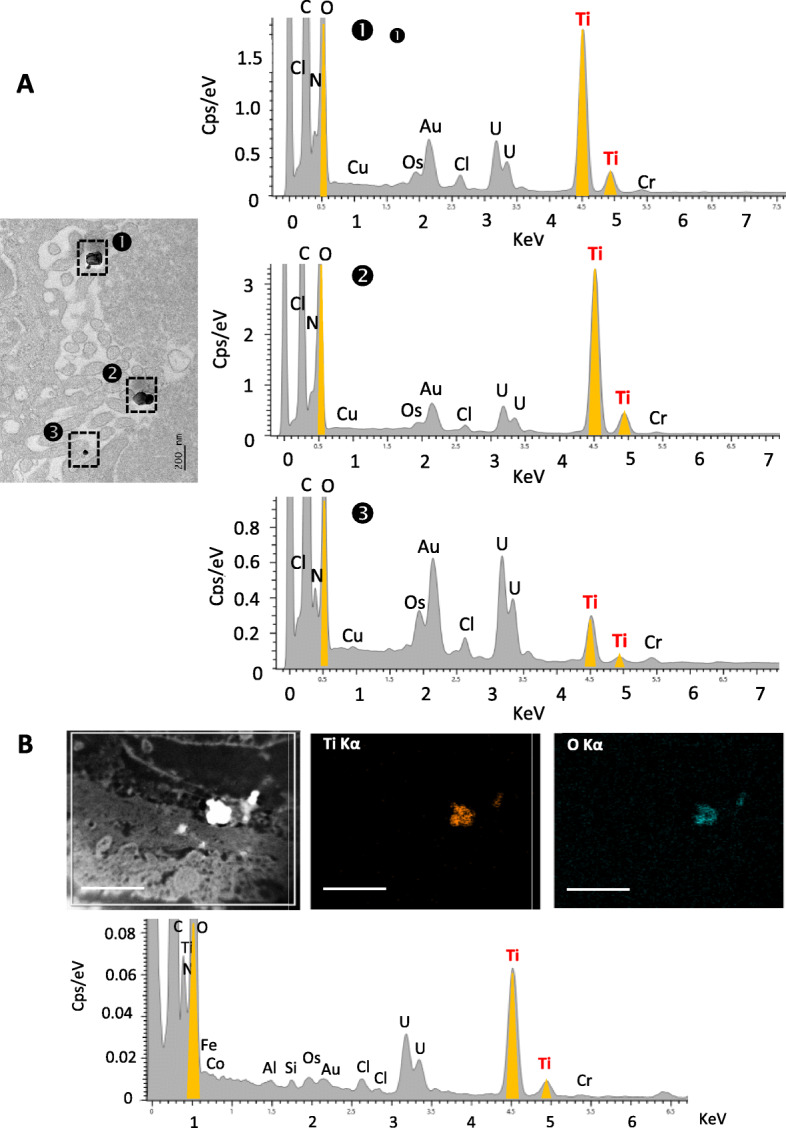
Results: By ICP-MS analysis, we evidenced the presence of Ti in all placentae (basal level ranging from 0.01 to 0.48 mg/kg of tissue) and in 50% of the meconium samples (0.02-1.50 mg/kg), suggesting a materno-foetal passage of Ti. STEM-EDX observation of the placental tissues confirmed the presence of TiO2-NPs in addition to iron (Fe), tin (Sn), aluminium (Al) and silicon (Si) as mixed or isolated particle deposits. TiO2 particles, as well as Si, Al, Fe and zinc (Zn) particles were also recovered in the meconium. In placenta perfusion experiments, confocal imaging and SEM-EDX analysis of foetal exudate confirmed a low transfer of food-grade TiO2 particles to the foetal side, which was barely quantifiable by ICP-MS. Diameter measurements showed that 70 to 100% of the TiO2 particles recovered in the foetal exudate were nanosized.

Conclusions: Altogether, these results show a materno-foetal transfer of TiO2 particles during pregnancy, with food-grade TiO2 as a potential source for foetal exposure to NPs. These data emphasize the need for risk assessment of chronic exposure to TiO2-NPs during pregnancy.

Keywords: E171 food additive; Foetus; Human placenta; Nanoparticles; Titanium dioxide.


Conflict of interest statement

Authors declare that they have no competing interests.

Figures
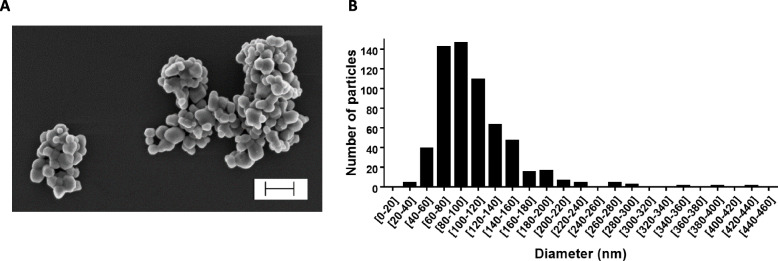
Fig. 1
Fig. 1
SEM analysis of size distribution of food-grade TiO2 particles. a Scanning electron microscopy image of TiO2 particles in E171 water suspension. Scale bar = 300 nm. b Primary size distribution by number of TiO2 particles, based on the diameters of 600 particles measured on SEM images
Fig. 2
Fig. 2
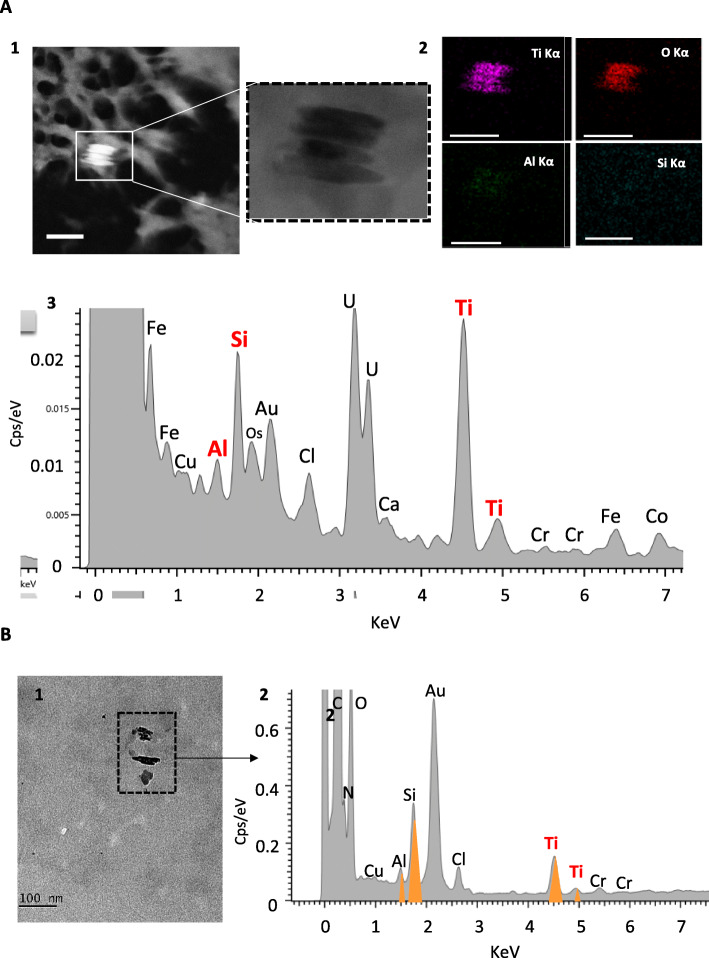
STEM-EDX analysis of TiO2 particles basal distribution in human placenta (a) and meconium (b). (A1) (S) TEM -micrographs showing cluster of four particles. Left hand corner micrograph is acquired in STEM-HAADF mode where particles appear brighter than biological matrix, due to the detection of elastic electron scattered by high Z number particles (chemical contrast). (A2) STEM-EDX elemental maps and sum spectrum identifying Ti, O, Al, and Si as main elements, and (A3) corresponding EDX analysis. All scale bars = 100 nm. (B1) TEM image illustrating particle content in meconium and coupled to EDX analysis (B2) with Ti, O, Al and Si identified as main elements over 3 particles
Fig. 3
Fig. 3
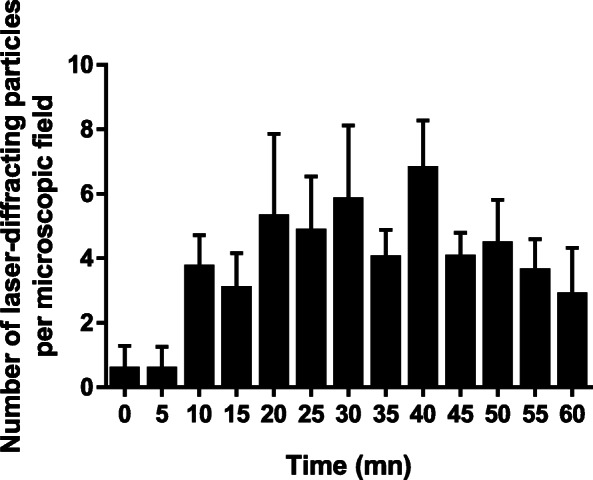
Mean transfer profile of particles during 1 h of placental perfusion with E171 using confocal microscopy. Placenta were perfused with food-grade TiO2 (E171, 15 μg/mL in PM) and counted as laser-diffracting particle spots over 1 h of experiment. Each data is the mean ± SEM of 4 to 6 independent experiments
Fig. 4
Fig. 4
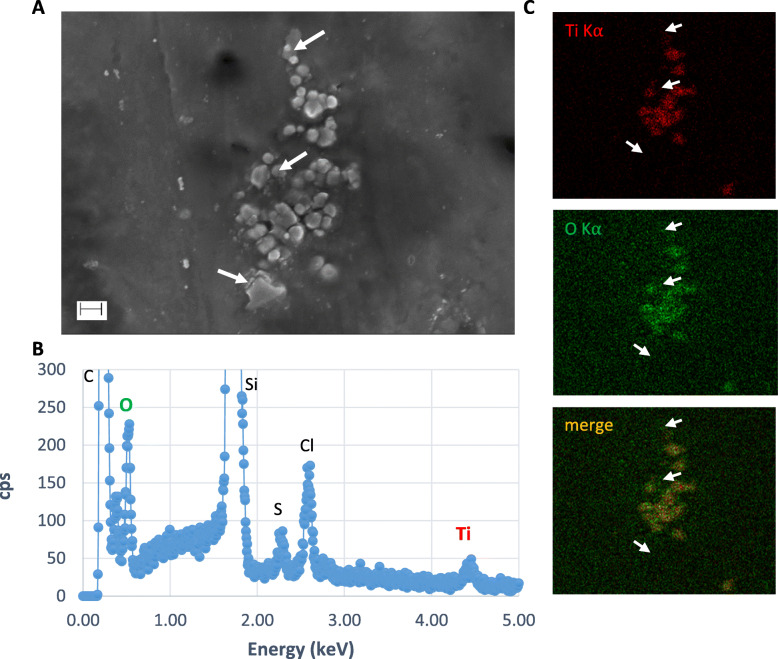
Analysis of TiO2 particles by SEM-EDX in foetal exudate. a SEM images of particles agglomerated in the dried PM after sample preparation of foetal exudate taken up from the 20–30 min period of perfusion. b Corresponding EDX analyses of particles into agglomerates showing the presence of C, Cl, S, Ti and O (Si signal from SEM wafer). c SEM-EDX cartography of particles showing Ti (red) and O (green) elements, and corresponding merge image. White arrows indicate examples of particles negative for Ti and O in this preparation. Scale bar = 200 nm
Fig. 5
Fig. 5
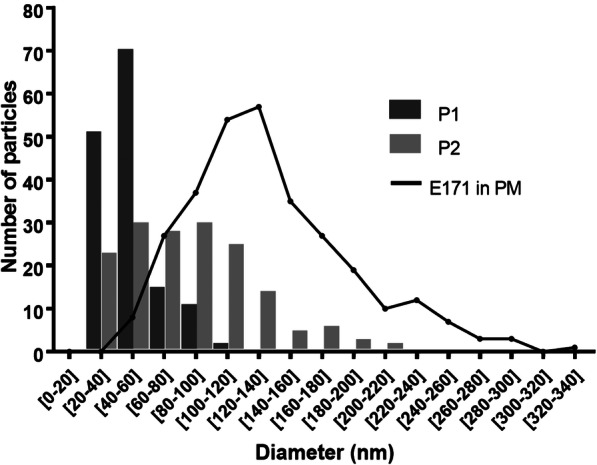
Size distribution of TiO2 particles in the maternal perfusion medium and the foetal exudate. Primary size distribution of TiO2 particles by number based on diameters measured on SEM-EDX images corresponding to samples of foetal exudate collected between 20 and 30 mn of E171 perfusion in 2 placentae, and compared to E171 suspension (solid line) in the perfusion medium (PM). P1 = 144 particles, P2 = 156 particles, and E171 in PM = 300 particles
Fig. 6
Fig. 6
Tissue distribution of TiO2 particles in the E171 perfused placenta. a TEM-Bright-Field micrographs coupled to EDX analysis showing food-grade TiO2 particles into the syncytiotrophoblast microvilli. b Chemical characterization of TiO2 particles by STEM-EDX mapping based on STEM-HAADF micrographs for particle detection, and elemental maps and sum spectrum. Scale bars in (B) = 1 μm

References

    1. Skocaj M, Filipic M, Petkovic J, Novak S. Titanium dioxide in our everyday life; is it safe? Radiol Oncol. 2011;45:227–247. doi: 10.2478/v10019-011-0037-0. - DOI - PMC - PubMed
    1. Weir A, Westerhoff P, Fabricius L, Hristovski K, von Goetz N. Titanium dioxide nanoparticles in food and personal care products. Environ Sci Technol. 2012;46:2242–2250. doi: 10.1021/es204168d. - DOI - PMC - PubMed
    1. Shakeel M, Jabeen F, Shabbir S, Asghar MS, Khan MS, Chaudhry AS. Toxicity of Nano-titanium dioxide (TiO2-NP) through various routes of exposure: a review. Biol Trace Elem Res. 2016;172:1–36. doi: 10.1007/s12011-015-0550-x. - DOI - PubMed
    1. Böckmann J, Lahl H, Eckert T, Unterhalt B. Blood levels of titanium before and after oral administration of titanium dioxide. Pharmazie. 2000;55:140–143. - PubMed
    1. Pele LC, Thoree V, Bruggraber SF, Koller D, Thompson RP, Lomer MC, et al. Pharmaceutical/food grade titanium dioxide particles are absorbed into the bloodstream of human volunteers. Part Fibre Toxicol. 2015;12:26. doi: 10.1186/s12989-015-0101-9. - DOI - PMC - PubMed

Publication types

LinkOut - more resources