Assessment of and Interventions for Women at High Risk for Breast or Ovarian Cancer: A Survey of Primary Care Physicians
- PMID: 33023915
- PMCID: PMC8021601
- DOI: 10.1158/1940-6207.CAPR-20-0407
Assessment of and Interventions for Women at High Risk for Breast or Ovarian Cancer: A Survey of Primary Care Physicians
Abstract
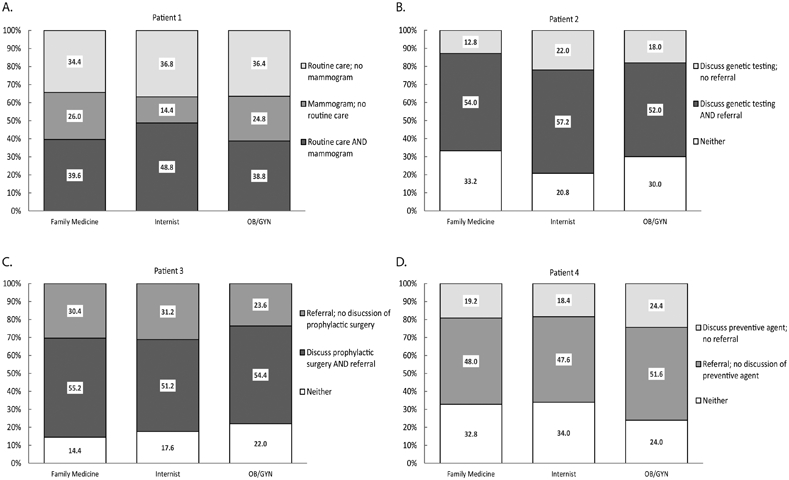
As clinical guidelines for cancer prevention refer individuals to primary care physicians (PCP) for risk assessment and clinical management, PCPs may be expected to play an increasing role in cancer prevention. It is crucial that PCPs are adequately supported to assess an individual's cancer risk and make appropriate recommendations. The objective of this study is to assess use, familiarity, attitude, and behaviors of PCPs regarding breast and ovarian cancer risk and prevention, to better understand the factors that influence their prescribing behaviors. We conducted a cross-sectional, web-based survey of PCPs in the United States, recruited from an opt-in healthcare provider panel. Invitations were sent in batches until the target sample size of 750 respondents (250 each for obstetrics/gynecology, internal medicine, and family medicine) was met. Self-reported use of breast/ovarian cancer risk assessments was low (34.7%-59.2%) compared with discussion of cancer family history (96.9%), breast exams (87.1%), and mammograms (92.8%). Although most respondents (48.0%-66.8%) were familiar with cancer prevention interventions, respondents who reported to be less familiar were more likely to report cautious attitudes. When presented with hypothetical cases depicting patients at different breast/ovarian cancer risks, up to 34.0% of respondents did not select any of the clinically recommended course(s) of action. This survey suggests that PCP use of breast/ovarian cancer risk assessment tools and ability to translate the perceived risks to clinical actions is variable. Improving implementation of cancer risk assessment and clinical management guidelines within primary care may be necessary to improve the appropriate prescribing of cancer prevention interventions.Prevention Relevance: Primary care physicians are becoming more involved in cancer prevention management, so it is important that cancer risk assessment and medical society guideline recommendations for cancer prevention are better integrated into primary care to improve appropriate prescribing of cancer prevention interventions and help reduce cancer risk.
©2020 American Association for Cancer Research.
Conflict of interest statement
The authors declare no potential conflicts of interest.
Figures
References
-
- Daly MB, Pilarski R, Yurgelun MB, Berry MP, Buys SS, Dickson P, et al. NCCN Guidelines Insights: Genetic/Familial High-Risk Assessment: Breast, Ovarian, and Pancreatic, Version 1.2020. J Natl Compr Canc Netw. 2020;18:380–91. - PubMed
-
- Force USPST, Owens DK, Davidson KW, Krist AH, Barry MJ, Cabana M, et al. Risk Assessment, Genetic Counseling, and Genetic Testing for BRCA-Related Cancer: US Preventive Services Task Force Recommendation Statement. JAMA : the journal of the American Medical Association. 2019;322:652–65. - PubMed
-
- Bevers TB, Helvie M, Bonaccio E, Calhoun KE, Daly MB, Farrar WB, et al. Breast Cancer Screening and Diagnosis, Version 3.2018, NCCN Clinical Practice Guidelines in Oncology. J Natl Compr Canc Netw. 2018;16:1362–89. - PubMed
-
- Siu AL, Force USPST. Screening for Breast Cancer: U.S. Preventive Services Task Force Recommendation Statement. Ann Intern Med. 2016;164:279–96. - PubMed
Publication types
MeSH terms
Grants and funding
LinkOut - more resources
Full Text Sources
Medical
Research Materials
Miscellaneous