Case Reports
. 2020 Oct 6;5(1):219.
doi: 10.1038/s41392-020-00329-x.

The efficacy assessment of convalescent plasma therapy for COVID-19 patients: a multi-center case series

Affiliations
Case Reports

The efficacy assessment of convalescent plasma therapy for COVID-19 patients: a multi-center case series

Hao Zeng et al. Signal Transduct Target Ther. .

Abstract

Convalescent plasma (CP) transfusion has been indicated as a promising therapy in the treatment for other emerging viral infections. However, the quality control of CP and individual variation in patients in different studies make it rather difficult to evaluate the efficacy and risk of CP therapy for coronavirus disease 2019 (COVID-19). We aimed to explore the potential efficacy of CP therapy, and to assess the possible factors associated with its efficacy. We enrolled eight critical or severe COVID-19 patients from four centers. Each patient was transfused with 200-400 mL of CP from seven recovered donors. The primary indicators for clinical efficacy assessment were the changes of clinical symptoms, laboratory parameters, and radiological image after CP transfusion. CP donors had a wide range of antibody levels measured by serology tests which were to some degree correlated with the neutralizing antibody (NAb) level. No adverse events were observed during and after CP transfusion. Following CP transfusion, six out of eight patients showed improved oxygen support status; chest CT indicated varying degrees of absorption of pulmonary lesions in six patients within 8 days; the viral load was decreased to a negative level in five patients who had the previous viremia; other laboratory parameters also tended to improve, including increased lymphocyte counts, decreased C-reactive protein, procalcitonin, and indicators for liver function. The clinical efficacy might be associated with CP transfusion time, transfused dose, and the NAb levels of CP. This study indicated that CP might be a potential therapy for severe patients with COVID-19.


Conflict of interest statement

The authors declare no competing interests.

Figures
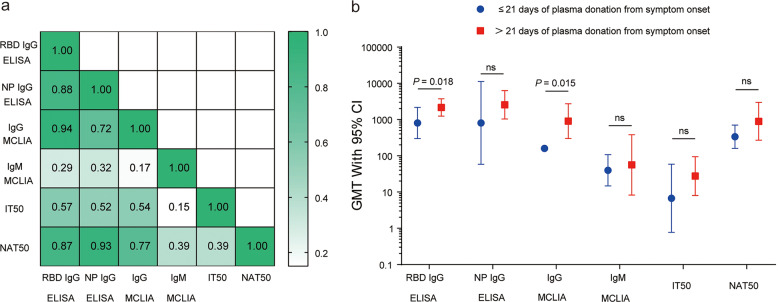
Fig. 1
Fig. 1
SARS-CoV-2 specific antibody levels of CP samples measured by serology tests, receptor-binding assay, and pseudovirus based neutralization assay. a The correlations among anti-SARS-CoV-2 specific IgG and IgM titers detected by commercial MCLIA kits, anti-S-RBD and anti-NP specific IgG titers determined by in-house ELISA assays, inhibition activity measured by a receptor-binding assay, and neutralizing antibody titer measured by a pseudovirus based neutralization assay. b Comparisons of antibody levels between CP samples collected before and after 21 days from symptom onset. MCLIA magnetic chemiluminescence enzyme immunoassay, ELISA enzyme-linked immunosorbent assay, RBD receptor binding domains, NP nucleoprotein, IT50 inhibitory titer which was calculated with the dilution of plasma that inhibits 50% RBD-Fc binding to receptor ACE2, NAT50 neutralizing antibody titer which was calculated with the highest dilution of plasma that resulted in a 50% reduction of virus infection, GMT geometric mean titer, CI confidence interval
Fig. 2
Fig. 2
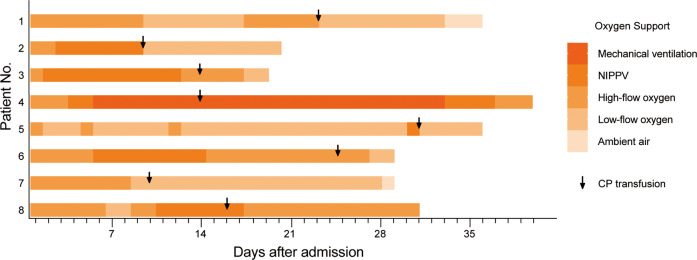
Changes in oxygen-support status from admission in individual patients. For each patient, the colors in the line represent the oxygen-support status of the patient over time. Invasive ventilation includes invasive mechanical ventilation. Noninvasive ventilation includes noninvasive positive pressure ventilation (NIPPV), high-flow oxygen therapy with nasal or face mask, and low-flow oxygen therapy with nasal. The vertical black arrows show the day of CP transfusion. The presentation of oxygen support status referred to a recent report
Fig. 3
Fig. 3
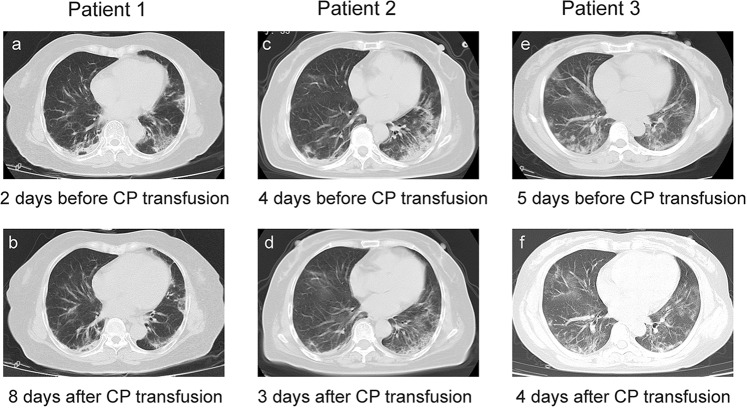
Chest CT scans of three patients. a Chest CT of patient 1 obtained on February 16 before CP transfusion (February 18) showed ground-glass opacity with uneven density, close to the pleura. b CT Image of patients 1 taken on February 26 showed partial absorption of bilateral ground-glass opacity. c Chest CT of patient 2 obtained on February 14 before CP transfusion (February 18) showed diffuse ground-glass opacity in both lungs. d CT Image of patients 2 taken on February 21 showed those lesions improved after CP transfusion. e CT Image of patients 3 taken on February 24 showed diffusion of bilateral ground-glass opacity before CP transfusion (February 29). f CT Image of patients 3 taken on March 4 showed those lesions improved after CP transfusion
Fig. 4
Fig. 4
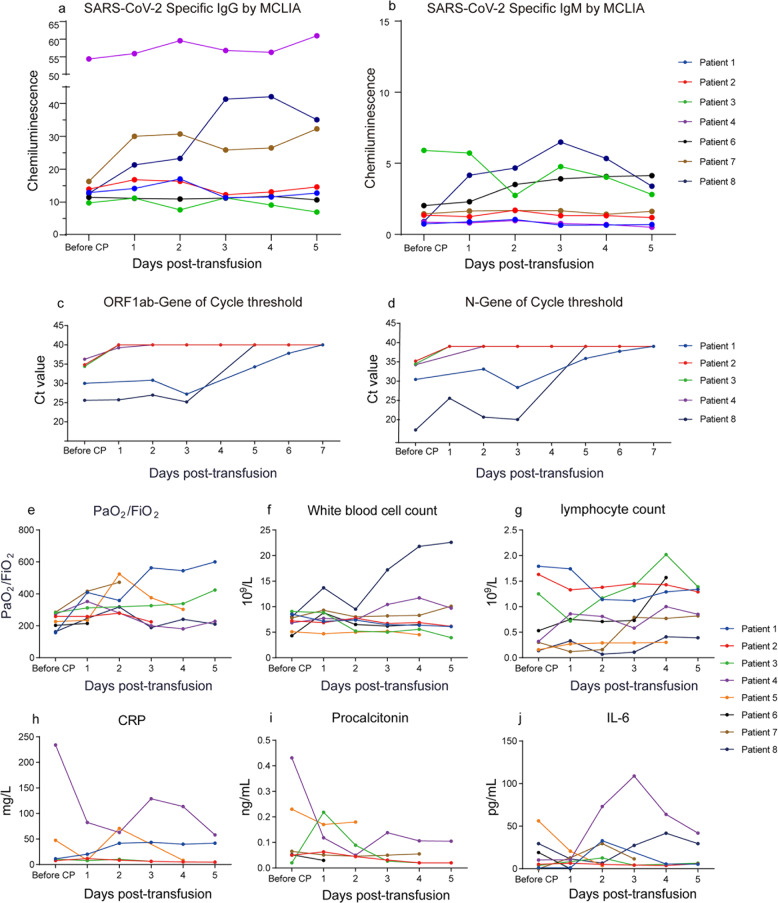
Changes of laboratory results before and at day 1–5 after convalescent plasma transfusion. a, b SARS-CoV-2 specific IgG and IgM levels, respectively, determined by MCLIA. c, d Cycle threshold (Ct) values of ORF1ab-gene and N-gene, respectively. A Ct value of 40 was defined as undetectable. e PaO2/FiO2 (normal range: 400–500 mmHg). f White blood cell count (normal range: 3.5–9.5). g Lymphocyte count (normal range: 1.1–3.2). h C-reactive protein (normal range: <8). i Procalcitonin (normal range: <0.1). j IL-6 (normal range: 0–5.30)

References

    1. Huang C, et al. Clinical features of patients infected with 2019 novel coronavirus in Wuhan, China. Lancet. 2020;395:497–506. doi: 10.1016/S0140-6736(20)30183-5. - DOI - PMC - PubMed
    1. WHO. Novel coronavirus (COVID-19) situation. https://who.sprinklr.com (2020).
    1. Dong L, Hu S, Gao J. Discovering drugs to treat coronavirus disease 2019 (COVID-19) Drug Disco. Ther. 2020;14:58–60. doi: 10.5582/ddt.2020.01012. - DOI - PubMed
    1. Barlow, A. et al. Review of emerging pharmacotherapy for the treatment of coronavirus disease 2019. Pharmacotherapy.10.1002/phar.2398 (2020). - PMC - PubMed
    1. Grein, J. et al. Compassionate use of remdesivir for patients with severe Covid-19. N. Engl. J. Med. 10.1056/NEJMoa2007016 (2020). - PMC - PubMed

Publication types

MeSH terms