


Deep phenotyping of 34,128 adult patients hospitalised with COVID-19 in an international network study
- PMID: 33024121
- PMCID: PMC7538555
- DOI: 10.1038/s41467-020-18849-z
Deep phenotyping of 34,128 adult patients hospitalised with COVID-19 in an international network study
Abstract
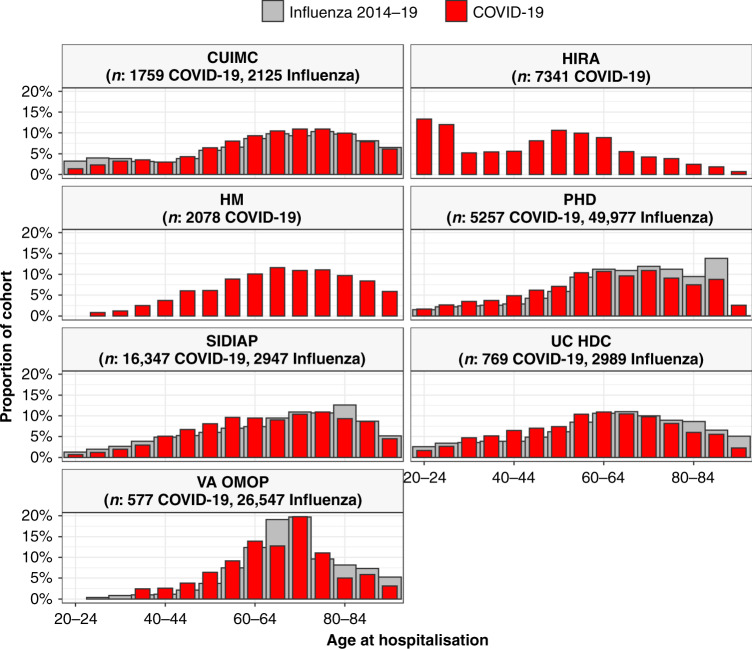
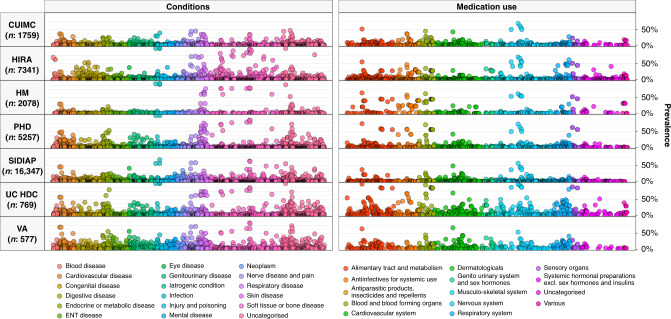
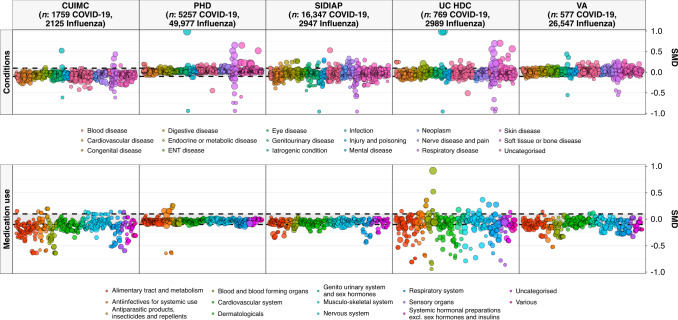
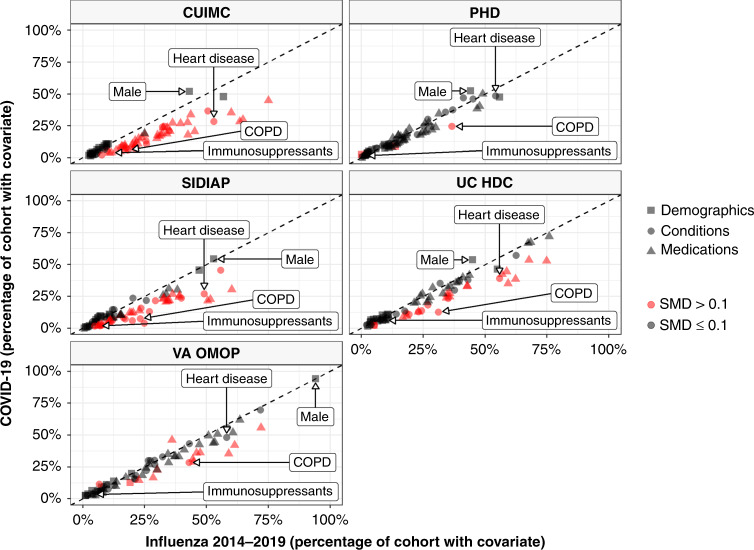
Comorbid conditions appear to be common among individuals hospitalised with coronavirus disease 2019 (COVID-19) but estimates of prevalence vary and little is known about the prior medication use of patients. Here, we describe the characteristics of adults hospitalised with COVID-19 and compare them with influenza patients. We include 34,128 (US: 8362, South Korea: 7341, Spain: 18,425) COVID-19 patients, summarising between 4811 and 11,643 unique aggregate characteristics. COVID-19 patients have been majority male in the US and Spain, but predominantly female in South Korea. Age profiles vary across data sources. Compared to 84,585 individuals hospitalised with influenza in 2014-19, COVID-19 patients have more typically been male, younger, and with fewer comorbidities and lower medication use. While protecting groups vulnerable to influenza is likely a useful starting point in the response to COVID-19, strategies will likely need to be broadened to reflect the particular characteristics of individuals being hospitalised with COVID-19.
Conflict of interest statement
All authors have completed the ICMJE uniform disclosure form, with the following declarations made: D.P.A. reports grants and other from AMGEN, grants, non-financial support and other from UCB Biopharma, grants from Les Laboratoires Servier, outside the submitted work; and Janssen, on behalf of IMI-funded EHDEN and EMIF consortiums, and Synapse Management Partners have supported training programmes organised by DPA’s department and open for external participants. D.V. reports personal fees from Bayer, outside the submitted work, and he is a full-time employee at a pharmaceutical company. DM reports funding support from the Wellcome Trust, NIHR, Scottish CSO and Tenovus Scotland for research unrelated to this work. S.C.Y. reports grants from Korean Ministry of Health & Welfare, grants from Korean Ministry of Trade, Industry & Energy, during the conduct of the study. A.G. reports personal fees from Regeneron Pharmaceuticals, outside the submitted work, and she a full-time employee at Regeneron Pharmaceuticals. This work was not conducted at Regeneron Pharmaceuticals. Y.J. reports employee of AbbVie and owns company stock. A.A. reports that he is currently employed at Alberta Health Services (AHS) as a Data Science Lead redeployed as an epidemiologist to aid in the COVID-19 response. This work was not conducted at AHS, within AHS working hours, or with AHS staff. He contributed and conducted this work as an Independent Epidemiologist, as a member of the Observational Health Data Sciences and Informatics (OHDSI) Network. P.R. reports grants from Innovative Medicines Initiative, grants from Janssen Research and Development, during the conduct of the study. M.S. reports grants from US National Science Foundation, grants from US National Institutes of Health, grants from IQVIA, personal fees from Janssen Research and Development, during the conduct of the study. G.H. reports grants from US NIH National Library of Medicine, during the conduct of the study; grants from Janssen Research, outside the submitted work. A.P.U. reports grants from Fundacion Alfonso Martin Escudero, grants from Medical Research Council, outside the submitted work. H.A. reports personal fees from Eli Lilly and Company, outside the submitted work. A.S. reports personal fees from Janssen Research & Development, during the conduct of the study; personal fees from Janssen Research & Development, outside the submitted work. A.S. is a full-time employee of Janssen and shareholder of Johnson & Johnson. G.R. is a full-time employee of Janssen and shareholder of Johnson & Johnson. F.D. reports personal fees from Janssen Research & Development, during the conduct of the study; personal fees from Janssen Research & Development, outside the submitted work. R.W.P. reports grants from Korean Ministry of Health & Welfare, grants from Korean Ministry of Trade, Industry & Energy, during the conduct of the study. J.P. reports grants from Korean Ministry of Health & Welfare, grants from Korean Ministry of Trade, Industry & Energy, during the conduct of the study. J.C. reports grants from Korean Ministry of Health & Welfare, grants from Korean Ministry of Trade, Industry & Energy, during the conduct of the study. S.D. reports grants from Anolinx, LLC, grants from Astellas Pharma, Inc, grants from AstraZeneca Pharmaceuticals LP, grants from Boehringer Ingelheim International GmbH, grants from Celgene Corporation, grants from Eli Lilly and Company, grants from Genentech Inc., grants from Genomic Health, Inc., grants from Gilead Sciences Inc., grants from GlaxoSmithKline PLC, grants from Innocrin Pharmaceuticals Inc., grants from Janssen Pharmaceuticals, Inc., grants from Kantar Health, grants from Myriad Genetic Laboratories, Inc., grants from Novartis International AG, grants from Parexel International Corporation through the University of Utah or Western Institute for Biomedical Research outside the submitted work. H.J. reports grants from Korean Ministry of Health & Welfare, grants from Korean Ministry of Trade, Industry & Energy, during the conduct of the study. B.S.K.H. reports grants from Innovation Fund Denmark (5153-00002B) and the Novo Nordisk Foundation (NNF14CC0001), outside the submitted work. K.K. reports she is an employee of IQVIA. CR reports he is an employee of IQVIA. J.S. reports other from Janssen R&D, during the conduct of the study; other from Janssen R&D, outside the submitted work; and J.S. was a full-time employee of Johnson & Johnson, or a subsidiary, at the time the study was conducted. J.S. owns stock, stock options, and pension rights from the company. R.M. reports and is an employee of Janssen Research and Development. W.G. is an AbbVie employee. P.R. reports and is an employee of Janssen Research and Development and shareholder of Johnson & Johnson. M.S. is a full-time employee of Janssen R&D, and a shareholder of Johnson & Johnson. J.H. reports other from Janssen Research & Development, during the conduct of the study; other from Janssen Research & Development, outside the submitted work; and full-time employee of Janssen and shareholder of Johnson & Johnson. All other authors declare no competing interests.
Figures
Update of
-
Deep phenotyping of 34,128 patients hospitalised with COVID-19 and a comparison with 81,596 influenza patients in America, Europe and Asia: an international network study.medRxiv [Preprint]. 2020 Jun 28:2020.04.22.20074336. doi: 10.1101/2020.04.22.20074336. medRxiv. 2020. Update in: Nat Commun. 2020 Oct 6;11(1):5009. doi: 10.1038/s41467-020-18849-z. PMID: 32511443 Free PMC article. Updated. Preprint.
